




Bills Bottom Line
A court judgment doesn't mean you've lost all your options. Creditors often prefer a negotiated settlement over the time and expense of wage garnishment or bank levies—which means settlement is still possible, sometimes for significantly less than the full balance. The key is knowing how to approach the creditor's attorney, what to include in your offer, and how to protect yourself with a written agreement before you pay anything.
Table of Contents
- What is a judgment settlement?
- Can you still settle a judgment?
- How to negotiate a judgment settlement
- What kind of discount can you expect?
- Marcus' story: catching a math error
- Can a debt settlement company help with a judgment?
- Can bankruptcy eliminate a judgment?
- What if the creditor won't negotiate?
- What happens after you settle
- Bills Action Plan
Disclaimer: The information in this article is provided for general educational purposes only and does not constitute legal or financial advice. Every situation is different, and laws vary by state. If you're dealing with a judgment, garnishment, or considering bankruptcy, consult with a qualified attorney or financial professional before taking action.
You open your mail and find a letter from a law firm: a creditor has won a judgment against you. Your stomach drops. Maybe you're picturing drained bank accounts or garnished paychecks. But here's something that surprises most people in your situation—even after a judgment, the door to settlement is often still open.
In fact, some creditors become more willing to negotiate your debt once they realize that collecting the full amount could take years and cost them money they'd rather not spend.
So where do you start? Let's break it down.
What is a judgment settlement?
A judgment settlement is an agreement between you and a creditor (or their attorney) to resolve a court judgment for a specific amount—often less than the full balance. When a creditor sues and wins, the court issues a judgment that legally obligates you to pay. But here's the thing: the judgment itself doesn't automatically put money in the creditor's pocket. They still have to collect, which can mean garnishing wages, levying bank accounts, or placing liens on property—all of which take time, paperwork, and legal fees.
Settling a judgment means negotiating a payoff amount the creditor will accept to consider the debt resolved. Once you pay what you've agreed to, the creditor files a Satisfaction of Judgment with the court, which updates the public record to show the debt has been settled. If you're new to debt settlement, this process follows similar principles—but with added legal steps because a court is now involved.
Can you still settle a judgment?
Yes—and here's why creditors often say yes.
Collecting on a judgment isn't automatic. It takes time, effort, and legal fees. Garnishing wages means ongoing court filings. Bank levies can come up empty if your accounts are low. Liens don't produce cash until you sell or refinance—which could be years away (or never). For many creditors, especially debt buyers who purchased your account for a fraction of the original balance, a guaranteed payment today beats uncertain payments stretched over years.
You're in a stronger position to settle when:
- You can offer a lump sum (even a partial one)
- You have documented financial hardship
- Your income is mostly exempt from garnishment (Social Security, disability, etc.)
- The judgment is getting older and collection efforts have stalled
- The creditor is a debt buyer rather than the original lender
Before you negotiate: What to gather
- Court records showing the original judgment amount
- Your state's statutory interest rate for judgments (check annually—rates change)
- Documentation of your current financial hardship
- The maximum lump sum you can offer
- Contact information for the creditor's attorney
How to negotiate a judgment settlement
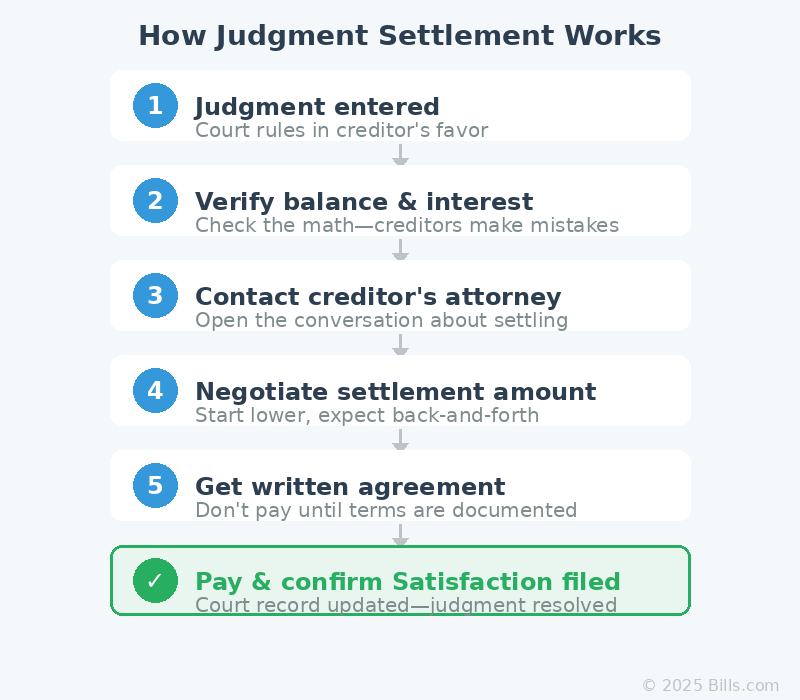
The basics of how to negotiate debt apply here, but judgments add some extra steps. Here's the process.
Step 1: Confirm the judgment amount
Before you pick up the phone, know exactly what you're dealing with. Contact the court clerk's office or check online court records to verify the original judgment amount, any interest that has accrued, and additional fees or costs. Some creditors tack on charges that weren't part of the original judgment—you'll want to catch discrepancies before you start negotiating.
Step 2: Verify the interest calculation
Judgment interest rates vary by state and can change from year to year. In Ohio, for example, the statutory rate for 2025 is 8%—but it was only 3% in 2022 and 5% in 2023. Your state's rate may be higher or lower, and some creditors calculate interest incorrectly (sometimes in their favor). If a creditor claims you owe thousands in interest, ask them to show their math and verify it against your state's official rate. You might find the real balance is lower than what they're asking for.
Where to find your state's rate: Search for "[your state] judgment interest rate" or check your state court's website. Some states publish rates through the tax commissioner or state treasurer's office. Rates often reset annually, so make sure you're looking at the correct year.
Step 3: Figure out what you can realistically offer
Lump sums tend to get the best results. If you can pull together cash from savings, help from family, or an upcoming tax refund, you'll have more negotiating power. That said, some creditors will accept payment plans—though they'll usually want a larger total amount in exchange for the flexibility.
Be honest with yourself about what you can actually afford. Overcommitting leads to default, and a broken settlement agreement puts you right back where you started.
Step 4: Contact the creditor's attorney
Once a judgment exists, you'll typically deal with the creditor's attorney rather than the creditor directly. Find their contact information on the court documents. Call or send a letter explaining that you'd like to discuss settlement options. Keep the initial conversation simple: confirm they represent the creditor, verify the balance, and ask if they're authorized to negotiate.
Sample Opening Script
"Hi, I'm calling about a judgment on my account. I'd like to discuss settling this debt. Can you confirm you're the attorney handling collections, and can you tell me the current balance including any interest? I'm hoping we can work something out."
Keep it simple. You're just opening the door to a conversation.
Step 5: Explain your situation (briefly)
You don't need to write your life story, but a short explanation helps. Mention unemployment, medical issues, reduced income, or other circumstances that make paying the full amount unrealistic. The goal isn't to get sympathy—it's to show that accepting a settlement is the creditor's best option for recovering anything meaningful.
Step 6: Make your offer
Start lower than what you're actually willing to pay, but stay in the realm of reasonable. An opening offer that's too low loses credibility; an offer that's too high leaves money on the table. Expect some back-and-forth. Where you land depends on your circumstances, the creditor's flexibility, and how motivated both sides are to close the deal.
Step 7: Get everything in writing
This is non-negotiable. Before you send a single dollar, get a written debt settlement agreement that spells out:
- The exact settlement amount
- The payment deadline
- Confirmation that the creditor will file a Satisfaction of Judgment
- Agreement to release any liens on your property
- A statement that the debt is resolved in full
You can also prepare a debt settlement letter to formalize your offer in writing. Keep copies of everything. After you pay, follow up to confirm the Satisfaction of Judgment was actually filed with the court.
How judgment settlement works
What kind of discount can you expect?
There's no universal formula—settlement amounts vary widely based on the creditor, your situation, and how the negotiation goes. That said, here's a general sense of how different approaches tend to play out:
| Approach | What You Might Pay | Trade-Off |
|---|---|---|
| Lump-sum offer | Often the lowest amount | Requires cash upfront |
| Payment plan | Usually a higher total | More manageable payments |
| Interest reduction only | Full principal + less interest | Common fallback position |
These aren't guarantees. Some creditors have strict policies; others are more flexible. Your results depend on the specifics of your case and how well you negotiate.
Marcus' story: catching a math error
A few years ago, Marcus had been avoiding a $12,000 credit card judgment for about 18 months when his wages finally got garnished. The creditor's attorney sent a letter claiming he now owed over $16,500—$12,000 in principal plus $4,500 in interest.
That number felt off to Marcus, so he did some digging. He looked up Ohio's statutory judgment interest rate for that year, which was 5%. Running the math himself, 18 months of interest at 5% should have added roughly $900 to his balance—not $4,500. The creditor had apparently been using a rate closer to 25%.
Armed with that information, Marcus called the attorney's office. He explained that he'd been laid off six months earlier and was now on disability—income that's largely protected from garnishment. He pointed out the interest discrepancy and offered $7,000 as a lump sum, which he'd scraped together from family.
The attorney pushed back initially but couldn't justify the inflated interest. After a few rounds of negotiation, they agreed on $8,500—roughly 66% of the corrected balance ($12,900), but far less than the $16,500 the creditor had originally demanded. Marcus got the settlement in writing, paid with a cashier's check, and confirmed two weeks later that the Satisfaction of Judgment had been filed.
The lesson: checking the numbers and negotiating saved Marcus $8,000. Don't assume the creditor's math is right—look up your state's judgment interest rate and verify the calculation yourself.
Can a debt settlement company help with a judgment?
It depends. Most debt settlement companies work with unsecured debts before they go to court. Once a judgment exists, the dynamics shift—now you're dealing with attorneys and court filings, not just collection calls.
Some settlement companies will still negotiate judgments, but others won't touch them. If there's an active garnishment or lien in place, you may need an attorney rather than a debt settlement company. An attorney can file motions, challenge improper collection actions, and make sure the legal paperwork is handled correctly.
If you're considering professional help, ask specifically: Do you handle judgment negotiations? What's your track record with cases like mine?
Can bankruptcy eliminate a judgment?
Yes—for most types of debt, bankruptcy can wipe out the underlying obligation, even after a judgment has been entered. If settlement negotiations stall and you're exploring bankruptcy alternatives, here's what you should know:
- Chapter 7 bankruptcy can discharge (cancel) most unsecured debts, including credit card judgments, medical debt judgments, and personal loan judgments. Once the debt is discharged, the creditor can no longer collect—the judgment becomes unenforceable.
- Chapter 13 bankruptcy puts you on a 3–5 year repayment plan. Unsecured judgment debts are often paid at a fraction of the balance, and whatever remains at the end gets discharged (cancelled).
- Wage garnishment stops when you file. The automatic stay kicks in immediately, halting most collection actions—including garnishment—while your case is pending.
There are limits. Bankruptcy doesn't eliminate every type of judgment. Child support, alimony, most tax debts, and student loans (in most cases) survive bankruptcy. And if a creditor placed a lien on your property before you filed, that lien may remain even after the debt is discharged—though there are ways to address that in some situations.
Bankruptcy is a significant decision with long-term credit consequences. But if you're facing a judgment you genuinely can't pay—and settlement negotiations have gone nowhere—it may be worth consulting with a bankruptcy attorney to understand your options.
What if the creditor won't negotiate?
Not every creditor will settle. Some have firm policies against it. If your first attempt doesn't go anywhere:
- Give it time and try again. Creditor policies change, and accounts sometimes get sold to buyers who are more flexible.
- Build your hardship case. If you can show that garnishment will yield very little (exempt income, minimal wages), creditors may reconsider.
- Talk to an attorney. A lawyer can review your situation and identify options you might have missed—including challenging the judgment if there were procedural errors.
- Consider bankruptcy. If you're stuck with a creditor who won't budge and a debt you can't pay, bankruptcy might provide a faster path to relief than years of unsuccessful negotiations.
What happens after you settle
Once you've paid the settlement amount, a few things need to happen:
Satisfaction of judgment
The creditor files this document with the court, officially marking the judgment as resolved. You should receive a copy. If you don't hear anything within a few weeks, follow up with both the attorney and the court clerk.
Lien release
If the creditor placed a lien on your home or other property, they need to file a separate release. Make sure this is spelled out in your settlement agreement before you pay.
Credit report update
The judgment may stay on your credit report, but it should update to show "satisfied" or "paid." That's better than an open judgment, though the negative mark won't disappear right away. Under current credit reporting rules, paid civil judgments typically fall off after seven years from the original filing date.
Bills Action Plan
Ready to move forward? Here's your checklist:
- Get the facts. Pull court records to confirm the judgment amount, interest rate, and any added fees.
- Check the math. Look up your state's statutory judgment interest rate and verify the creditor's calculation is correct.
- Know your number. Figure out the maximum lump sum you can realistically pull together.
- Make the call. Contact the creditor's attorney and ask about settlement options.
- Negotiate. Start with a lower offer and work toward an amount both sides can live with.
- Get it in writing. Don't pay until you have a signed agreement with every term documented.
- Confirm it's done. After payment, verify the Satisfaction of Judgment and any lien releases are filed with the court.
Free up cash each month with Freedom Debt Relief

Ozzy S., Freedom client
“Right away, I had more money each month because of program costs so much less than what I was paying on my minimums.”
Actual client of Freedom Debt Relief. Client’s endorsement is a paid testimonial. Individual results are not typical and will vary.