
Charge-off Settlement: How to Settle a Charged-off Debt




Table of Contents
- Bills Bottom Line
- Can you settle a charged-off debt?
- Why charged-off debts are often negotiable
- How charge off affects your settlement options
- How much can you settle a charged-off debt for?
- How to settle a charged-off debt: step-by-step
- How settlement affects your credit
- Should you settle a charged-off debt?
- Alternatives to settlement
- Bills Action Plan
Bills Bottom Line
A charge-off doesn't wipe out your debt—and it doesn't mean your chance to settle is gone. Most charged-off debts can still be negotiated, but the process changes depending on who owns the account and how long ago it happened. Settlement won't remove the charge-off mark from your credit report, but it can resolve the balance, reduce stress, and help you move forward with a plan that fits your situation.
When Jordan opened his credit report and saw "Charge-Off" next to an old credit card, his stomach dropped. It felt final, like the bank had closed the book and forgotten the debt. But the next week, a company Jordan had never heard of started calling—saying the balance was now higher and due immediately.
That's when the questions hit: Can this be settled? Who am I supposed to talk to? Do I even negotiate with the bank anymore? If you've felt that way, this guide can help. A charge off can look like a dead end, but settlement is often still possible—sometimes even more flexible than before.
Can you settle a charged-off debt?
Yes. A charge-off is an internal accounting step, not debt forgiveness. You still owe the balance, and the creditor or collector can still work with you to settle the account for less than the full amount.
Settlement is often possible whether the debt is owned by the original creditor, handled by a third-party collector, or sold to a debt buyer. The key is knowing who owns the debt now and what they are willing to offer.
Why charged-off debts are often negotiable
Charged-off debts are often negotiable because the creditor wants to get the debt off their books. From an accounting standpoint, they've already taken the hit. Once that happens, recovering anything is better than nothing — which gives you leverage.
Some creditors try to collect themselves, while others hire a collection agency to do it for them. If the creditor sells the debt instead, a debt buyer becomes the new owner. Debt buyers pay pennies on the dollar for charged-off accounts, so even a reduced settlement is profit for them. That's why older debts, especially those sold to buyers, often have the most room for negotiation.
How charge off affects your settlement options
Your settlement path depends on who owns the debt now. Each type of owner—original creditor, third-party collector, or debt buyer—has different incentives and limitations. Understanding who you are dealing with helps you set realistic expectations and decide how to approach negotiation.
If the original creditor still owns the debt
Some creditors continue collecting after charge-off. In that case, settlement may still be available, though they may expect a higher percentage of the balance than a debt buyer would. They might be more interested in payment plans than deep discounts. Regardless, always get a written agreement before sending money.
If a third-party collector is involved
Collectors working on behalf of a creditor don't own the debt. They must follow FDCPA rules and send a validation notice if you request one. They can talk with you about settlement, but the original creditor usually needs to approve what they offer. This can make the process feel slower or less predictable, but settlement is still possible if everyone agrees on terms.
If a debt buyer owns the debt
Debt buyers purchase portfolios of charged-off accounts, often for pennies on the dollar. Because they paid less than the full balance, they usually have the greatest flexibility to accept lower settlement amounts. Older debts, in particular, may settle for less—though there is never a guaranteed percentage. When dealing with a debt buyer, documentation and accuracy become more important so you don't pay a debt twice or on the wrong terms.
How much can you settle a charged-off debt for?
There is no standard number that applies to every situation. Settlement amounts depend on who owns the debt, how old it is, whether you can offer a lump sum, your financial hardship, and the policies of the creditor, collector, or debt buyer. State laws and the type of debt (credit card, personal loan, auto deficiency, and so on) also matter.
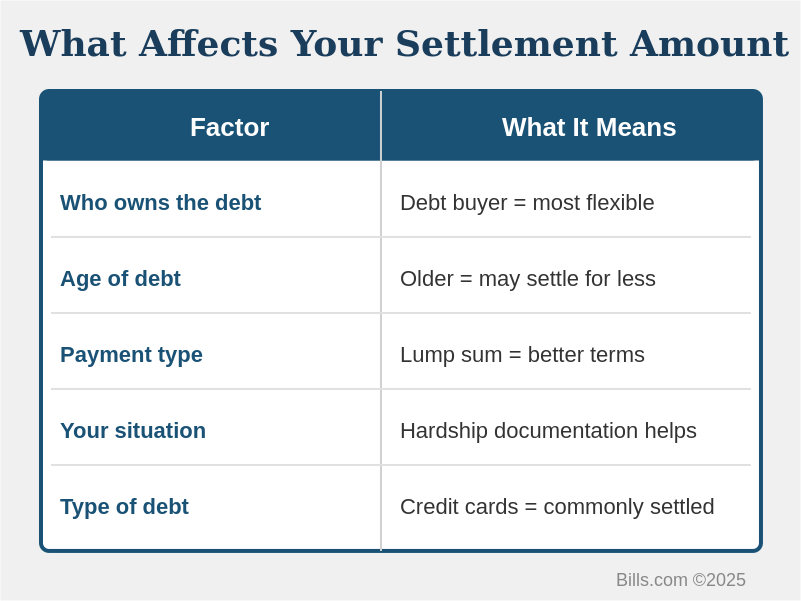
Anyone promising that all charged-off debts settle for a certain percentage is oversimplifying. It's more accurate to think in terms of a range of possibilities rather than a fixed number.
How to settle a charged-off debt: step-by-step
Here is the general process many people follow when settling a charged-off account. Your situation may not match every step exactly, but this can give you a roadmap so you don't feel lost.
Step 1: Confirm who owns the debt
Start by finding out who owns the account today. Ask for the current balance, a breakdown of fees and interest, the date of your last payment, and a validation notice if anything looks unfamiliar. Your strategy depends entirely on who has legal ownership of the debt, so this step is worth taking slowly and carefully.
Step 2: Understand your budget before negotiating
Before you call anyone, look closely at your budget. Decide whether you can realistically afford a lump-sum payment, a short-term settlement plan, or whether settlement is not affordable right now. This is not the moment to overpromise or hope future income will magically appear. A realistic number will help you negotiate with more confidence and less pressure.
Step 3: Start the negotiation
When you contact the creditor, collector, or debt buyer, keep the conversation simple and honest. Explain that you want to resolve the debt and share what you can afford to pay. You don't have to share every detail of your life; focusing on your payment ability is enough. Avoid tying your offer to future money you do not have yet, like possible bonuses or tax refunds.
Step 4: Get every agreement in writing
Before you send any money, ask for a written settlement letter. It should clearly state the agreed settlement amount, the payment schedule or due date, where to send payment, and how the account will be reported after payment (for example, "Settled" or "Paid"). This document is your protection if there is ever a dispute about what was promised or if the debt is resold.
Step 5: Pay exactly as agreed
Once you have the settlement terms in writing, make your payment or payments according to the agreement. Save copies of the settlement letter, payment confirmations, bank records, and any emails or notes from conversations. These records can help if a future collector ever claims you still owe money on the same account.
Step 6: Monitor your credit
It may take 30 to 45 days for your credit report to update after a settlement payment. The charge-off will not disappear, but the balance should show $0 and the status should change to "Settled" or "Paid," depending on the agreement.
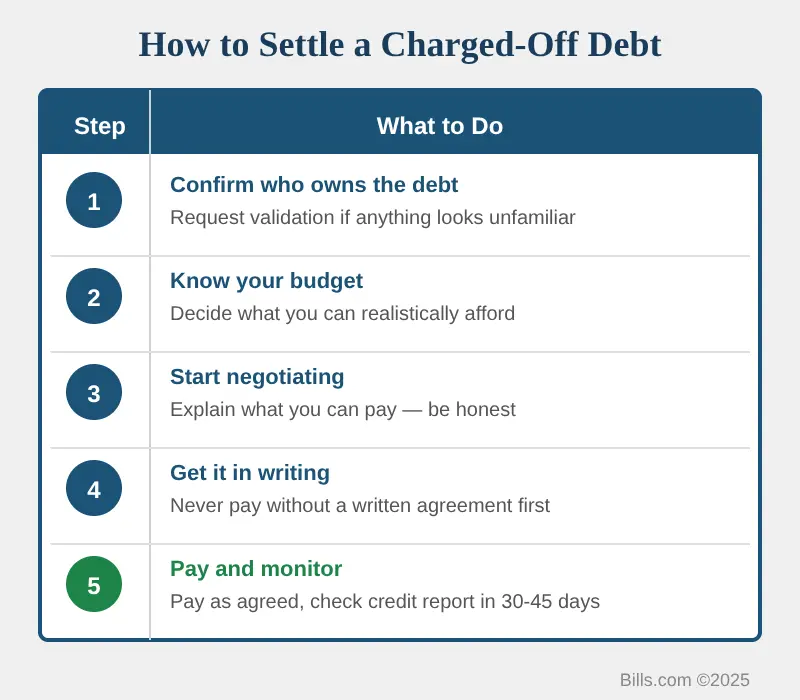
If the update does not appear, you can dispute the information with the credit bureaus and include a copy of your settlement letter and proof of payment.
How settlement affects your credit
A charge off remains on your credit report for up to seven years from the original delinquency date. Settling the account does not remove the charge-off notation, but it does change the status of the balance and shows that the debt has been resolved.
Over time, lenders may view a resolved charge off more favorably than an unpaid one, especially if your recent credit history is positive.
"Paid charge off" vs. "Settled charge off"
On a credit report, a "paid charge-off" generally means you repaid the full outstanding balance after the charge off, while a "settled charge-off" indicates that you paid less than the full amount as part of a negotiated settlement. Both are negative marks, but a resolved account can still be a step forward compared with an open, unpaid charge-off.
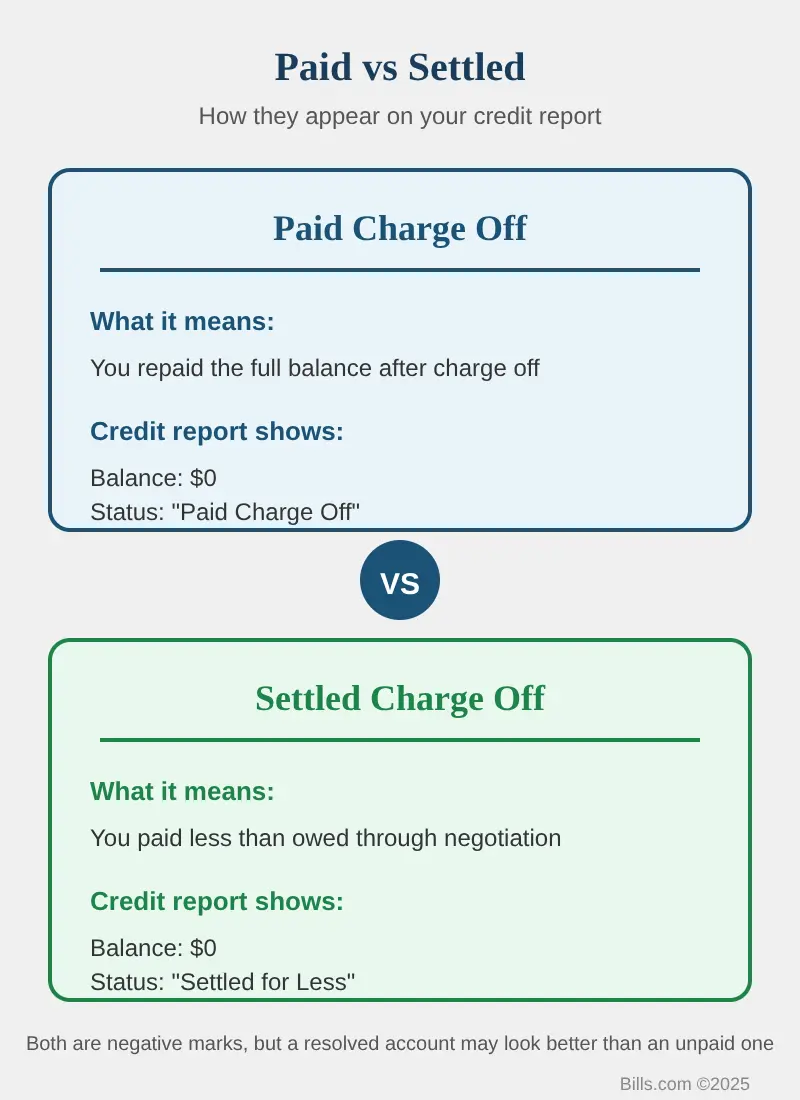
Some lenders, particularly mortgage lenders, may want to see that charged-off accounts are either paid or settled before approving a loan. That is one reason people choose to resolve older accounts even though the mark will not vanish immediately.
Should you settle a charged-off debt?
Settlement is not the right move for everyone, but it can be helpful in many situations. It may make sense if you want to stop collection calls, lower the risk of a lawsuit, or clear the deck before a major credit application. It may not be ideal if settlement would leave you unable to cover essentials or if the debt is close to or past the statute of limitations in your state.
When settlement might make sense
Settlement can be worth considering when you have some funds available, the debt is owned by a creditor or buyer who is open to negotiation, and you are trying to move past old accounts that are still causing stress. Some people also choose settlement when they are preparing for a mortgage or other large loan and want to show that old debts have been addressed.
When settlement might not be the right move
It may not be the right time to settle if you cannot make the settlement payments without skipping rent, utilities, or other critical expenses. It may also be wise to pause if you are disputing the balance or if an attorney has advised you to wait due to statute-of-limitations issues. In those cases, learning your rights and options before you agree to pay can protect you from unintended consequences.
Alternatives to settlement
Settlement is just one way to address a charged-off debt. Depending on your broader situation, you may also consider:
- A payment plan with the creditor or collector.
- Disputing inaccurate information on your credit report.
- Talking with a consumer attorney about lawsuit risk or time-barred debt.
- Reviewing debt relief options if you have several accounts you cannot pay.
Bills Action Plan
Here is a more detailed plan you can follow if you're dealing with a charged-off account and wondering about settlement:
- Pull all three credit reports and review any charge-off listings carefully. Note the creditor name, dates, and whether the account appears to have been sold. Look for inconsistencies that might need to be corrected.
- Confirm who owns the debt today by contacting the creditor listed or the company that recently contacted you. Ask for a validation notice, the current balance, and when your last payment was made. This helps ensure you are negotiating with the right party.
- Review your budget honestly and decide what you can realistically afford to pay, either as a lump sum or over a short period of time. Focus on protecting essentials like housing, food, and utilities first.
- Reach out to the owner of the debt and explain that you want to resolve the account. Share what you can afford without putting your basic needs at risk. Ask if they are willing to accept a lump-sum settlement or a short payment plan.
- Once you reach a tentative agreement, request a written settlement letter that clearly states the amount, due dates, and how the account will be reported. Read it carefully and make sure it matches what was discussed before you send any money.
- Make your payments exactly as agreed, and keep copies of everything—letters, emails, payment confirmations, and bank records. These documents protect you in case the debt is resold or someone later claims you still owe money.
- Check your credit reports again after 30-45 days to confirm the account shows a zero balance and a status of "Settled" or "Paid," per your agreement. If it doesn't, consider disputing the entry and including your documentation.
Free up cash each month with Freedom Debt Relief

Ozzy S., Freedom client
“Right away, I had more money each month because of program costs so much less than what I was paying on my minimums.”
Actual client of Freedom Debt Relief. Client’s endorsement is a paid testimonial. Individual results are not typical and will vary.
Can a charged-off debt be settled for less?

A charged-off debt can often be settled for less than the full balance, but outcomes vary widely. Collection agencies and debt buyers calculate what they are willing to accept based on how much they paid for the debt, how old it is, and your risk of defaulting again. Some are more flexible with lump-sum offers, while others prefer structured plans. Because there are no guarantees, it's helpful to approach settlement as a negotiation rather than expecting a specific percentage. Always get the final agreement in writing before you pay.
Does settling remove the charge-off from my credit report?
No, settling a charged-off account does not remove the charge-off mark itself. That entry can stay on your report for up to seven years from the date of first delinquency, even after you resolve the balance. However, settlement changes the way the account is reported going forward, usually to "Settled" with a zero balance. That may be viewed more positively by lenders than an unpaid charge off, especially when combined with newer, on-time payment history. Over time, the impact of that negative mark generally fades as more positive information is added.
Can a collector sue me after a charge off?
Yes, it is still possible to be sued after a charge off. Charge off is an accounting term, not a legal shield. Creditors or debt buyers may decide to file a lawsuit if they believe it is worth the time and cost, especially for larger balances and within the statute of limitations for your state. Settling a charged-off account can reduce the likelihood of legal action, but it does not guarantee that no lawsuit will be filed. If you receive a summons, it's important to respond by the deadline to avoid a default judgment, and you may want to speak with a consumer law attorney.
Will settling a charged-off debt help my credit over time?
Settling a charged-off debt will not cause the charge-off mark to disappear, but it can still help you over the long term. Lenders reviewing your credit manually may see that you took responsibility for an old account and resolved it, which can be viewed more favorably than leaving it unpaid. Once the account shows a zero balance, your overall debt load is also lower, and new positive accounts can start to carry more weight. While you may not see an immediate score jump, settlement can be part of a broader plan to rebuild your credit history and reduce financial stress
10 Comments
I’m currently negotiating a second mortgage charge off. I made an offer of 5% and the returned at 75% . Is this a good sign that they are willing to negotiate?
Sean, they responded to your offer with a counter offer, so the negoatiations have already begun.
What is the date of the last payment you made on this loan? In what state do you live? I recommend seeing if the statute of limitations on debt in your state is in play. If you have no legal obligation to pay them, until you go to sell the home, refinance the first mortgage, or borrow against equity you may have that would strengthen your negotiating position.