
Four Strategies to Pay Off Expensive Loans
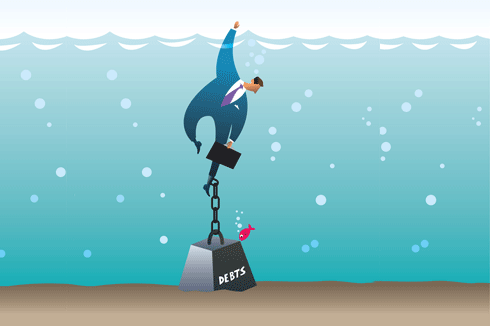



- Pay off payday loans as quickly as possible, since they are expensive debt.
- If you own a home, consider refinancing to pay off high-cost loans.
- Debt resolution or negotiation may be beneficial, if you can't keep up with your payments.
- Start your FREE debt assessment
Help to Pay Off Payday & Credit Card & All Loans.
Too many high-interest loans burn a hole straight through a household's budget. Smart consumers find ways to pay off high-interest loans (such as payday loans) as quickly as possible, and consolidate any remaining loans for convenience, cost savings, and improving their credit profile.
This article explores consolidation options for paying off loans. This article assumes the consumer struggles with one or more payday loans. You may have payday loans or other unsecured debts — the debt resolution techniques described here are the same for almost any unsecured debt. Which option works best for you depends on your situation.
If you struggle with a mortgage, see the Bills.com resource Mortgages in Trouble page. To learn more about student loan consolidation, see How Do I Consolidate My Student Loans?.
If you are struggling with a mixture of loans, use the Bills.com Debt Coach to learn the best tactics for resolving your debts.
Payday Loans
Payday loans, also called "cash advance loans", "check advance loans", or "deferred deposit check loans", are a frequent pitfall for consumers. Payday loans should be an option of last resort, because of their tremendous expense. Fees range from $15 to $30 per $100 borrowed. The average loan totals $300. With rates so high and the term of the loan so short, it's no wonder that a very high percentage of these loans are rolled over by the borrower again and again so that the accumulated fees equal an effective annualized interest rate of 390% to 780% APR.
Quick tip #1:
Get a no-cost, no obligation analysis of your debt options from a pre-screened debt relief provider.
Option 1: Debt Settlement
If you struggle to pay your debts, you may want to consult with a professional debt settlement or consumer credit counseling firm to discuss the options available to you. For a no-cost, no-gimmick debt consultation with one of Bill’s approved debt help partners, visit the Debt Relief Savings Center.
Option 2: Cash-Out Refinance
Another effective method to pay off high-interest loans is to consolidate your loans through a refinance loan, where you pay off all existing loans and roll them into one larger but much cheaper new loan, typically a mortgage. Read about refinance loans as forms of paying off other loans at our refinance center.
Option 3: Payday Payment Plan
You can free yourself from a payday loan trap if you reside in one of the 12 states where payday loans are illegal once the effective rate passes the usury cap in that state. Usury laws dictate the maximum interest that many lenders may legally charge. If the payday lenders follow their normal business model the loan will most assuredly pass the limit very early. New York State even has a criminal statute that sanctions the lender if the rate exceeds 25%. If you are in one of those states, the loan may be void, and you may be only liable for the principal amount borrowed. In addition, there are eight states whose payday loan regulating statutes require lenders to set up an installment repayment plan if an account reaches the maximum number of rollovers allowed by law and the debtor declares that he/she is unable to pay the balance due. Such a repayment plan may help you pay off these loans.
To learn more about debt collection laws in your state, see the Bills.com resource Collection Laws and Exemptions By State.
If you do not live in one of the states whose payday loan regulations favor consumers, the best solution would be for you to borrow the funds needed to repay these loans from a conventional lender or a family member or friend. Converting your payday loans to a conventional loan should allow you to repay the loans within a reasonable time frame and at a reasonable interest rate. If you cannot borrow the funds to repay the payday loans, you may want to make a payment each month to pay down the balances. In some states, the interest on the loans will prevent you from effectively repaying the debts in monthly installments; if you find that to be the case, you should contact the payday lender to try to work out repayment terms that will work with your budget. Hopefully, one of these options will work out for you so these loans do not go into default.
Bills.com also offers more information on the Payday Loan Information page, and has answered reader questions about payday loans in California, Massachusetts, New York, Florida, Texas, Illinois, and Virginia.
If you do not repay a payday loan, the payday loan company has several legal remedies, including wage garnishment, levy, and lien. See the Bills.com resource Collections Advice to learn more about the rights of creditors and debtors.
Option 4: Bankruptcy
Although it is now more difficult to qualify for a Chapter 7 and more people are required to enter into repayment plans, bankruptcy is still available to most people in need of its protection. Several types of bankruptcy are available, depending on your assets, income, and financial situation. Bills.com can help you learn if can avoid bankruptcy, if you qualify for bankruptcy, and what form is best suited for your needs. See the Bills.com bankruptcy page to learn more.
Summary
Read the Bills.com article Debt Negotiation and Settlement Advice to learn more about tactics and strategies for dealing with creditors. See also the free Bills.com Financial Planning and Budget Guide, which can help you manage your finances and you can learn about budgeting and prudent financial management.
Free up cash each month with Freedom Debt Relief

Ozzy S., Freedom client
“Right away, I had more money each month because of program costs so much less than what I was paying on my minimums.”
Actual client of Freedom Debt Relief. Client’s endorsement is a paid testimonial. Individual results are not typical and will vary.
10 Comments
Celina Loan Firm said they could help me get a $100,000 business loan. All I got was ripped off.
Thanks for sharing that information. Amazing how many scam artits are out there with false promises of a forthcoming loan. Good reminder that you should NEVER pay a fee in advance for a loan.
Watch out for Greener Loans Worldwide. They tried to scam me.
See if can help paid off all loan and auto car?
What kind of help are you seeking, exactly, Pamela?