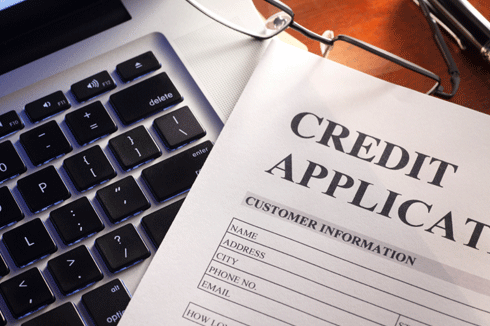

- Consider a consolidation loan to pay-off your debt sooner or to make your monthly payment smaller.
- Review the differences between secured and unsecured loans.
- Avoid running up new debt, after you consolidate your old debt.
Learn your debt relief loan options.
You might be interested in a debt relief loan if payments to many different lenders and high interest rates are straining your finances. Consolidating your debt can reduce your monthly payments by lowering your interest rates and/or extending your term. Usually, in order to do so you must take out a loan. By allowing you to pay off your original debt, this loan will consolidate all your separate payments into one monthly payment. Note that you are not actually eliminating your debt, but instead giving yourself relief from the pressure associated with the debt you have.
You have a few different debt relief loans to choose from when you consolidate your debt. All loans break down into two types: secured and unsecured.
Secured Debt Relief Loans
An asset or collateral of some sort protects the lender when you obtain a "secured loan." You must own items, such as property or a car, which the loan can be secured against, even if they are not fully paid off, to obtain a secured loan. The lender can place a lien against these items. A lien will keep you from selling the property or will allow the lender to force your property into sale in order to collect on the loan if you fail to make payments according to the agreed upon terms. When you take out a secured loan, the lending company holds your title to your property until you settle your debt in full, including all interest and applicable fees. Because your debt is secured against actual assets, lenders are more likely to grant you larger amounts of money than an unsecured loan.
Types of secured loans include home equity loans, home equity lines of credit, mortgage refinance loans and second mortgages. These loans are based on the total value of your home minus the amount you still owe. You can use these loans to consolidate your debt and pay your original debt off. Once you pay the original debt off, you will have a more convenient single monthly payment and hopefully a lower interest rate, as secured loans typically have lower interest rates than unsecured loans. The downside to this sort of loan is that if you have budgeted incorrectly and are unable to make payments for your consolidated loan, you may lose the property against which the loan is secured.
Unsecured Debt Relief Loan
An unsecured debt relief loan is harder to obtain because the lender has nothing to collect if you are unable to pay them back. Lenders will look at your credit and employment history in order to determine your risk level: or what is the statistical likelihood that you will repay the loan. Regular payments on your current debt and a stable employment history show that you are not a high risk. There are lenders who will give unsecured loans to you if you have bad credit or unstable employment history, but their interest rates are usually very high. Any unsecured loan will have a higher interest rate than a secured loan and usually will be for a limited amount.
It is easier to obtain unsecured personal loans through consolidation companies if your debt is good debt as opposed to bad debt. Good debt is incurred from an investment (mortgage) or improving yourself (student loan). Bad debt is incurred from credit cards, retail charge cards, and financing luxury items like electronics or boats.
If you believe you will be able to make one larger payment on time and in full, then consolidation may be an easier option for you. However, remember that even at a lower interest rate, which may be difficult to get if your loan is unsecured, paying your debt off over a longer term will result in a higher grand total on your loan just by virtue of the increased amount of time over which your loan will have interest applied to it.
Staten Island, NY | November 18, 2012
November 19, 2012
July 09, 2012
July 10, 2012
Is your goal to simply have one payment? Are you struggling with high interest rates on your debts? Are you having trouble making your payments? Your answers to these questions will dictate what your best solution will be.
I suggest that you use the Bills.com Debt Coach, to find the best debt solution for your individual situation.
Redding, CA | June 18, 2012
June 19, 2012
- A credit counseling program could help you lower your interest rates from the penalty rates you've been saddled with. It is possible that some of your late fees could be reduced, too.
- Continue negotiating settlements on your accounts. You could speak with a professional debt settlement firm, too.
It is smart to work to build up a rainy-day fund, but doing so may be less of a priority than paying off high-interest debt.
El Cajon, CA | April 28, 2012
April 30, 2012
If you can't get a loan that helps you, look into a credit counseling program, if your interest rates are a main problem.
Wilmington, NC | April 05, 2012
- Can the credit card company take my husband's house from him?
- Do credit card companies play nice when you are in debt relief and are trying to pay them off?
April 06, 2012
- It is highly unlikely a credit card issuer or its collection agent would attempt to take a delinquent debtor's house to satisfy an unpaid credit card bill.
- Creditors must follow the rules found in the Fair Debt Collection Practices Act (FDCPA), or risk fines levied by the FTC and civil judgments from consumers they harm.
- Let us say Person X lends money to Person Y. Both sign a loan contract. Let us say Y does not repay the loan as agreed. X tries calling Y, sends Y letters, and Y still does not repay the loan. X sues Y in their state court for breach of contract, there is a trial, and X wins. The state court awards X a judgment, which X can use to do three things:
- Get a wage garnishment order that forces Y's employer to pay X a portion of Y's wages. This is common.
- X can track down Y's bank or credit union and use the judgment to force Y's bank to give X some or all of the money in Y's accounts.
- X can track down Y's real estate and place a lien on Y's property. The lien is a claim on the property. If and when Y tries to sell the property the lien would be an encumbrance on on the property that a buyer would probably Y to pay off before touching the property.
- You asked if credit card companies play nice with people enrolled in debt settlement plans. Expect to receive phone calls from the three credit card issuers. Initial calls will be friendly, and expect some of the issuers to follow a very chummy script when they learn you enrolled their account in a debt settlement program. They will, in a friendly manner, attempt to convince you debt settlement is not a wise choice, and you should cancel your contract with the debt settlement company. They will explain the horrible damage to your credit score, and the possibility of a lawsuit, and losing everything if you do not reverse course. Their friendly sounding script will exaggerate the possibility of a lawsuit. Remember, the person reading the script is paid to bring you back into the fold away from debt settlement, and back into paying your monthly minimums and exorbitant late fees. The person reading the script is not trying to help you fix your finances and get ahead.
Wilmington, NC | April 06, 2012
Coolville, OH | October 13, 2011
October 16, 2011
When a tax relief firm tells a prospective client that an Offer in Compromise (OIC) will not succeed, it is to the tax relief firm's credit. It is much better that you hear that your assets prevent a successful OIC than for you to scrape together the money to hire someone who assures you that you can reduce your IRS taxes only to find out after you pay the fee that no OIC is forthcoming.
I think that you should consult with a bankruptcy attorney. Payroll tax debt can't be wiped out, even in a Chapter 7 bankruptcy, but you don't have to make payments while in a bankruptcy. If you qualify for a Chapter 7, you may be able to clear out other debts and be able to afford paying the IRS once the BK is over. Your home equity may be a barrier to a Chapter 7, depending on the state in which you reside. If a Chapter 7 is off the table, then speak with the attorney about the kind of payment you could set up in Chapter 13. A Chapter 13 payment will factor in your income and necessary expenses, when working out a payment plan with your creditors.
St Louis, MO | September 22, 2011
September 22, 2011
El Paso, TX | September 20, 2011
September 20, 2011
Chicago Ridge, IL | July 11, 2011
July 12, 2011
I applaud your goal to be debt-free in two years. Maybe you need to work on your non-student loan debt separately? I suggest that you look at the Debt Coach tool, to figure out the best way to work on your consumer debt.
Smyrna, GA | February 22, 2011
February 22, 2011
Loading more commentsSince you don't have facebook, please provide us with your location and a valid email address so we can answer it. Without a valid email address,we can't reply. (Go back to login with Facebook)
Due to the high volume of comments received, we cannot publish and/or respond to every comment received. If you have a specific question, we recommend you search our site for an answer before commenting.
* Bills.com will not share, sell, lend, or make public your e-mail address. We reserve the right to delete any questions or comments that violate the Bills.com terms of service.
We get a lot of comments! Before commenting, we ask you to do 2 things:
Log in
Like us
Submit your comment!
Due to the high volume of comments received, we cannot publish and/or respond to every comment received. If you have a specific question, we recommend you search our site for an answer before commenting.
* Bills.com will not share, sell, lend, or make public your e-mail address. We reserve the right to delete any questions or comments that violate the Bills.com terms of service.
Thank you for your comment. Your comment will be posted shortly.
Comments (27)