

How to Handle Collection Calls From Midland Credit Management




Bills Bottom Line
Midland Credit Management is a legitimate debt collector, not a scam. It buys charged-off debts and collects them for profit. Before paying, request written debt validation to confirm the debt is really yours. If you're sued, respond before your court's deadline.
Table of Contents
- Who is Midland Credit Management, and are they legit?
- Why Midland is contacting you and who they collect for
- What to do when Midland Credit Management calls
- How to make Midland validate the debt and use your FDCPA rights
- Your options: set up a payment plan, settle debt, or respond to a lawsuit
- Bills Action Plan
- Key Terms
An unknown number keeps calling. Or, a letter arrives from Midland Credit Management about a debt you half-remember. You can't tell if it's real, and you're not sure you even owe it.
Paying it right away or ignoring it could cost you. Tempting as it may be to get rid of the problem now or pretend it doesn’t exist (and hope it goes away), there’s a third option, and it could save you money.
Communication with a debt settlement company doesn’t have to be difficult. Here’s how to exercise your rights in response to Midland Credit Management, and what roads you could take moving forward.
Who is Midland Credit Management, and are they legit?
Midland Credit Management is a real, established debt collector, not a scam. It's a debt buyer that purchases old unpaid accounts, like unpaid credit card debts, and collects on them. Midland is owned by Encore Capital Group. Encore and its companies are the largest debt buyer and collector in the United States.
Legitimate doesn't mean you have to pay on the spot. Sometimes, legitimate debt collectors make mistakes. A collector may ask you to pay a debt that isn’t yours, or threaten to sue you over debt too old to sue over. You can dispute debts you don’t recognize, including those floated by Midland.
For the wider picture on how to handle collection calls, start with our guide to collection agencies.
Though Midland Credit Management is legitimate, its history is not spotless. In 2020, Midland and Encore resolved a CFPB action for violating a 2015 consent order. They paid a $15 million penalty plus money back to consumers, and were ordered to stop collecting time-barred debt (too old to sue over) without proper disclosures.
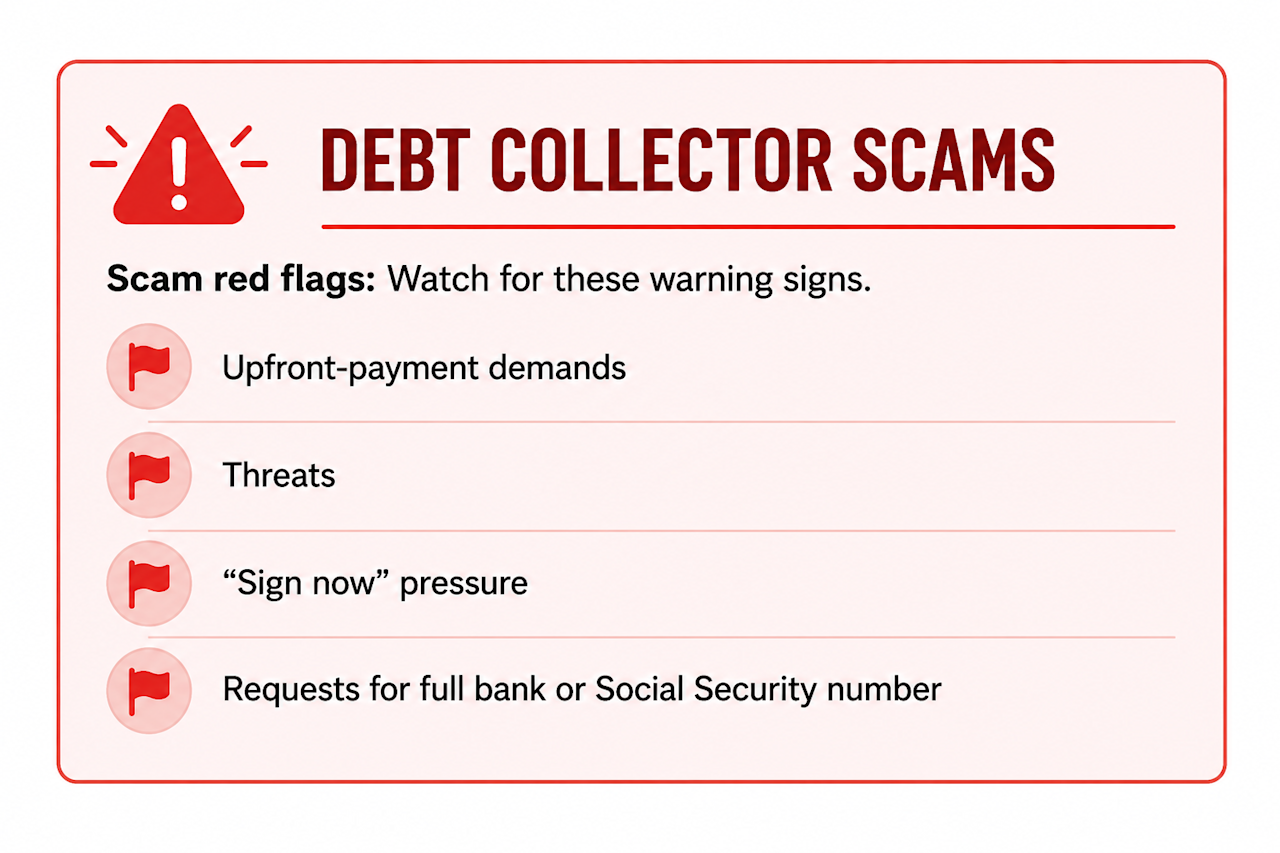
Debt collector scams
Scammers sometimes pose as collectors. Typical red flags are demands for upfront payment, threats, pressure to sign or pay now, and requests for your full bank or Social Security number. You can check any collector through the CFPB complaint database or your state attorney general.
Why Midland is contacting you and who they collect for
You made payments on an unsecured account—possibly, a credit card or personal loan. When you fell behind, your original bank or credit card company likely charged it off, writing the balance off as a loss. A charge-off doesn't erase what you owe, it simply reclassifies debt. The company then sold the account to Midland Credit Management, which now owns it and collects for profit.
Midland buys from major credit card issuers, retailers, and other lenders. Most are credit-card debts.
The Midland name may be unfamiliar because the company calling you, Midland, isn't the one you first borrowed from. It’s possible that Midland has purchased your debt from another company. That said, you want to confirm this is true before agreeing to pay anything. A debt buyer has to prove it owns your account and that the details are right.
What to do when Midland Credit Management calls
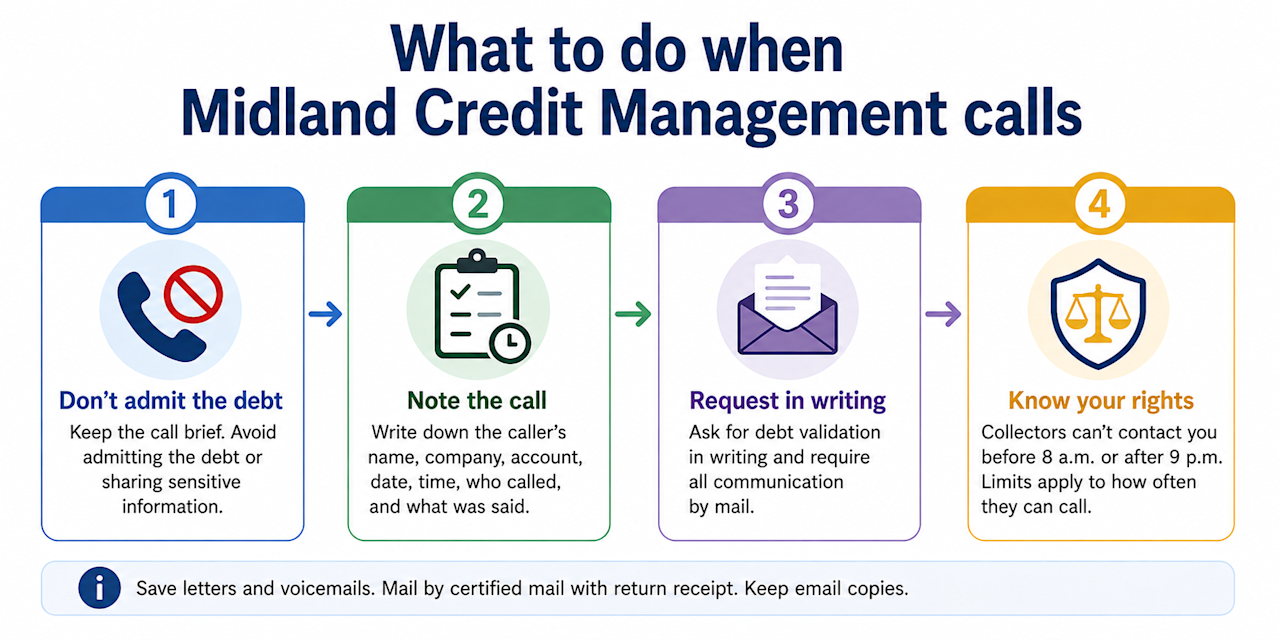
Keep the first call short. Don't admit the debt is yours, don't promise a payment, and don't hand over your bank account or credit card numbers. The CFPB warns that anything you say, including apologizing or admitting the debt, can be used against you later.
Get details instead. Ask for the caller's name, the company, and the account. Then note the date, the time, what was said, and who called. Keep every letter and voicemail, and mail anything by certified mail with a return receipt for proof. If you submit a communication via email, keep a copy.
Federal law limits when they can reach you. A collector can't contact you before 8 a.m. or after 9 p.m. your local time, or during times you say you don’t want to be contacted, such as during work hours. The CFPB's Regulation F caps how often a collector can call. More than seven calls in seven days about one debt is presumed illegal, and so is any call within seven days of speaking with you.
You don't have to settle anything on the phone, and you can require it all in writing. For more on limiting contact, read how to get debt collectors to stop calling.
How to make Midland validate the debt and use your FDCPA rights
The Fair Debt Collection Practices Act (FDCPA) is the federal law that limits how third-party collectors can contact and treat you. Its most useful tool is debt validation.
In its first message, or within five days of first contact, a collector must send you a validation notice. Among other things, this notice lists the original creditor's name, the amount owed, an itemized balance, and the date your 30-day dispute period ends. You then have 30 days to dispute the debt in writing.
Also demand the original account number and proof that Midland owns the debt. Debt buyers don't always get full records, and thin records can weaken a collector's position. If Midland cannot provide the original account number and proof it owns the debt, it cannot collect on it.
Tip: See the CFPB’s article on what information a debt collector must give you for the full checklist.
What happens when you dispute the debt
If you request verification in writing within that 30-day window, the collector must pause collecting the disputed amount until it responds. Send the verification request by certified mail and keep copies.
The FDCPA sometimes lets you recover money for violations that cost you, and you have one year to sue. Whether a court awards damages depends on your case.
How to stop Midland Credit Management collection calls
You can tell Midland in writing to stop contacting you, and it must stop. After that, it can only confirm it won't contact you again or tell you about a specific action, such as a lawsuit. A cease-contact letter doesn't erase the debt, and Midland can still sue you or report the account. To report a violation, file with the CFPB, your state attorney general, or the Better Business Bureau.
Your options: set up a payment plan, settle debt, or respond to a lawsuit
Once you've confirmed the debt is valid and yours, you have choices.
One is to negotiate a payment plan with Midland Credit Management. Midland may ask you to pay off the entire balance owed, plus accumulated interest and fees. Be clear on what’s owed so you don’t pay more than you should.
You can attempt to negotiate a settlement with Midland. Because debt buyers like Midland pay far less than the full balance, often pennies on the dollar, they sometimes accept less than what's owed. You can negotiate this yourself and avoid a debt settlement company's fee, which typically runs 15% to 25% of your enrolled debt. Or, you could hire a debt settlement company to negotiate for you.
What to do if Midland Credit Management sues during debt settlement negotiations
Beginning the process of debt settlement doesn't automatically stop a lawsuit, so Midland can still sue. The CFPB warns that ignoring a properly served lawsuit can let the court enter a judgment against you and limit your ability to dispute the debt. A judgment could also lead to wage garnishment or a bank levy, taking money from your paycheck or bank account. If you're served, respond before your court's deadline, set by your state and court. If you fear the papers are fake, confirm them with the court rather than ignore them, then read what to do if you're served a summons.
Very old debt may be time-barred: the CFPB says a collector can't win a lawsuit once the statute of limitations has passed. The limit depends on your state and the debt type, so read the statute of limitations on debt to learn where you stand. Don't confirm an old debt is yours or make a partial payment, because either can restart the clock in some states.
Bills Action Plan
- Don't confirm or pay anything on the first call. Write down who called, when, and what they said.
- Send a written debt-validation request by certified mail within 30 days. Ask Midland to prove the debt is yours and that it owns it.
- Once the debt is validated, choose your path: dispute an inaccurate debt, set up a payment plan, negotiate a settlement, or talk with a consumer-rights attorney. If you've been served, respond before your court's deadline.
Key Terms
Debt buyer: A company that buys old, unpaid debts for a fraction of the balance and then collects for itself.
Charge-off: When your original creditor writes the account off as a loss, usually after about 180 days late. You still owe the debt.
Debt validation: Written proof, which you can demand, that the debt is yours and the amount is right.
FDCPA: The federal law that limits how third-party collectors can contact and treat you.
Default judgment: A court ruling you lose automatically because you didn't respond to a lawsuit in time.
This information is for general education, not legal or financial advice. For guidance about your specific situation, talk to a licensed attorney.
Free up cash each month with Freedom Debt Relief

Ozzy S., Freedom client
“Right away, I had more money each month because of program costs so much less than what I was paying on my minimums.”
Actual client of Freedom Debt Relief. Client’s endorsement is a paid testimonial. Individual results are not typical and will vary.
Is Midland Credit Management a scam?

Midland Credit Management is a legitimate debt collector, not a scam. It buys and collects charged-off debts as a subsidiary of Encore Capital Group. A real collector must prove the debt, so verify the account before you pay.
Should I pay Midland Credit Management?
Confirm the debt is valid and yours before you pay. Request written validation, then decide based on the proof it sends back. If it checks out, you can pay in full or attempt to negotiate a settlement.
Can Midland Credit Management sue me or garnish my wages?
Midland can sue you if the debt is still within your state's statute of limitations, and a lawsuit it wins can lead to wage garnishment. Respond to any summons before the deadline. A debt too old to sue over is time-barred, and a collector can't win that case in court.
What happens if I ignore Midland Credit Management?
If you ignore Midland, the calls usually keep coming and it can still sue you over the debt. The costly mistake is ignoring a court summons, which can lead to you losing by default and having your wages garnished, among other things. If papers arrive, respond before the deadline, even if you plan to dispute.
Is Midland Credit Management the only debt buyer?
No, Midland is one of several large buyers, along with Portfolio Recovery Associates and Resurgent Capital Services.