

Banks That Offer Personal Loans




Bills Bottom Line
Many national and regional banks offer personal loans, including Citi, Wells Fargo, U.S. Bank, Discover, Huntington, and TD Bank. Loan terms typically run two to seven years. Comparing at least three lenders on rates, fees, and terms could help you find the better fit.
Table of Contents
You've decided you want a personal loan, and the first place you think to check is your own bank. It makes sense. You already have a relationship there, and you're hoping that counts for something.
Banks that offer personal loans are easy to find. Several of the biggest names in the country compete for your business: Citi, Wells Fargo, U.S. Bank, Discover, Huntington, and TD Bank. What each one offers on rates, loan amounts, and who qualifies varies enough to matter.
You don't have to guess which bank fits your situation. The comparison in the next section lays out what each one actually requires, so you can see where you stand before you apply anywhere.
How a bank personal loan works
Personal loans generally work the same way. Most personal loans are unsecured. Most personal loans have fixed rates.
A personal loan gives you the full amount upfront, and you repay it on a fixed schedule. A personal line of credit (or PLOC) lets you borrow as needed up to a limit, repay, and borrow again. Loans suit one-time expenses, and lines of credit suit ongoing needs.
If you're weighing a big one-time cost like debt consolidation or a major purchase, that structure points you toward a loan. If you want ongoing access to funds instead, a line of credit fits better.
Bank vs. credit union vs. online lender
Not every bank treats new customers the same way. Wells Fargo only lends to customers who've held an account for 12 months or more. Citi and U.S. Bank lend to new customers too. Both raise your borrowing limit if you already have an account with them.
Beyond your own bank, you have two other paths. A credit union is member-based and often competitive on rate, especially for borrowers with fair or better credit. Some online lenders accept a wider credit range than a traditional bank.
A bank makes the most sense if you already have a relationship there or want branch access. Compare rates from all three types of lenders before you commit to one.
Banks that offer personal loans, compared
Here's how six major banks compare on personal loans.
Citi lends up to $30,000 to new customers. If you already hold an eligible Citi checking or savings account, or a Citi credit card, that limit rises to $50,000. The loan comes with $0 fees: no origination fee, no prepayment penalty, and no late fee.
Wells Fargo only lends to customers who've held an account for 12 months or more, so this option is available to current account holders.
U.S. Bank lends $1,000 to $50,000 to existing clients over 12 to 84 months. Non-clients can borrow up to $25,000 over up to 60 months, at an APR of 9.24% to 24.99%, with no origination fee or prepayment penalty.
Discover lends $2,500 to $40,000 over terms up to 7 years, at 6.99% to 24.99% APR, with no origination fee, late fee, or prepayment penalty.
Huntington's unsecured personal loan runs 8.72% to 25.00% APR, up to $50,000, with no stated existing-customer requirement. A deposit-secured version is also available, backed by a CD, savings, or money market account, at 7.01% to 25.00% APR and up to $500,000. Huntington doesn't publish a term length or say whether it charges an origination fee for the unsecured loan. Confirm both directly with a lending specialist.
TD Bank's Fit Loan covers $2,000 to $50,000 over 3 to 5 years, at 7.99% to 23.99% APR, with no origination fee. It's available in 15 states and Washington, D.C.
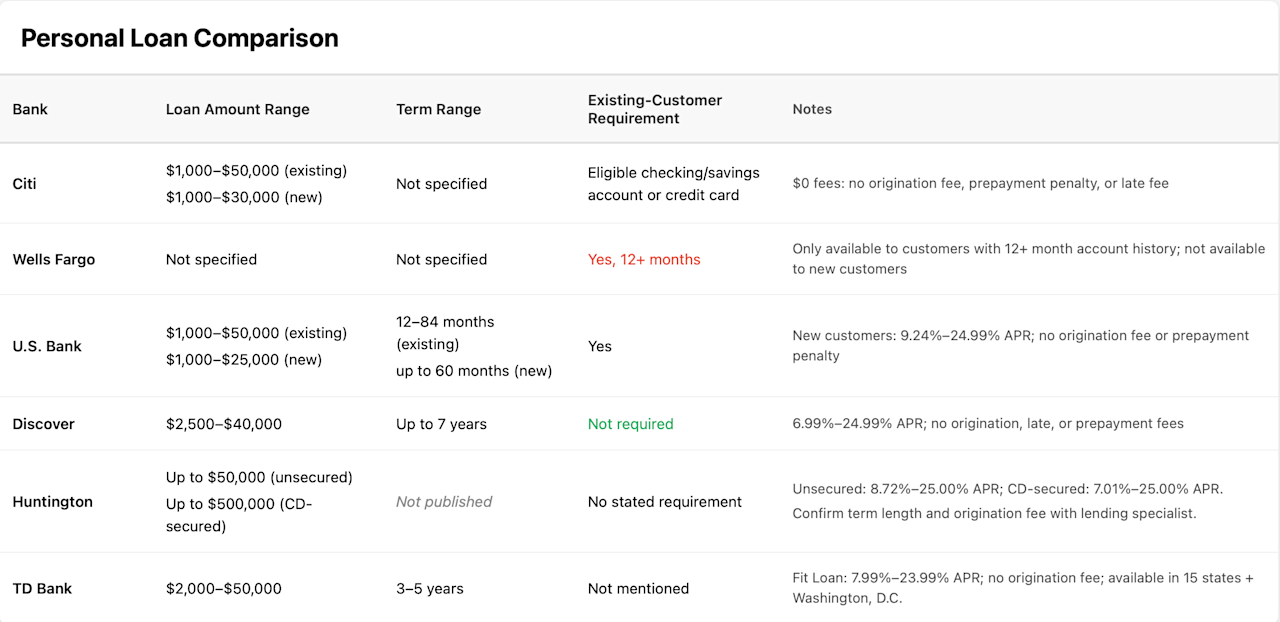
Rates, terms, and fees shown are subject to credit approval and can change without notice. Confirm current figures with each lender before applying.
What you'll need to qualify for a personal loan
Lenders evaluate your ability to repay using your credit score, credit history, income, employment status, and debt-to-income ratio.
Your credit score matters most for the rate you're offered. FICO's tiers run Poor (below 580), Fair (580 to 669), Good (670 to 739), Very Good (740 to 799), and Exceptional (800 and above). Lenders generally treat sub-620 scores as higher risk, per the CFPB's classification. That's not a FICO label itself. FICO's own tiers stop at Poor and Fair.
A missed payment can affect your credit score if the lender reports it to the bureaus and it's late enough to be reported. Check the specific timeline with your lender.
Pre-qualification is usually a soft credit pull (ask to be sure). It isn't a guarantee of final approval.
What people use bank personal loans for
Common uses of personal loans, per CFPB, include making a large purchase, covering unexpected expenses, and consolidating existing debt.
Compare more personal loan options to see choices beyond the banks compared here. That list includes credit unions and online lenders, which may fit your credit profile differently.
Whatever the use, matching the loan term to how quickly you can realistically repay it matters more than chasing the lowest advertised rate alone.
If a bank turns you down for a personal loan
If a bank turns you down, you still have options. Cosigner and joint-applicant rules vary by lender. Some banks allow joint applications, and others don't. Check the lender's eligibility page before you assume either way.
A credit union is often more flexible on credit score than a bank, and it's worth checking next. A secured personal loan can also open up approval and a lower rate, since the lender has less risk to price in. It's backed by savings, a CD, or another asset you own.
One denial from one bank doesn't rule out a personal loan altogether. It just means a different lender or a different loan structure fits better.
Bills Action Plan
- Check whether your own bank offers personal loans, and find out if it requires an existing account relationship before you apply anywhere else.
- Prequalify with at least three lenders, including one bank and one credit union or online lender, using each one's soft-pull rate check.
- Compare the loan amount, term, and total fees across your options, not just the headline rate, before choosing where to apply.
Key Terms
APR: The full yearly cost of your loan, including the interest rate and fees. It's the number to compare across banks, not just the interest rate.
Origination fee: A fee some lenders take out of your loan before you get the money. Bank personal loans range widely here. Some banks, like Citi and U.S. Bank, charge none.
Unsecured loan: A loan that doesn't require collateral like your house or car. Most bank personal loans work this way.
Soft credit pull: A check lenders use to show you likely rates before you apply. It doesn't affect your credit score. A hard pull, which happens when you formally apply, can.
Personal loan terms, rates, and fees vary by lender and are subject to credit approval. Consult a financial professional for guidance specific to your situation. Nothing here is financial or legal advice.
Can I get a personal loan from my own bank?

Many banks offer personal loans to both new and existing customers. Some, like Wells Fargo, only lend to customers who've held an account for a year or more. Check your bank's personal loan page or ask a banker directly.
Is it harder to get a personal loan from a bank than from a credit union or online lender?
Banks may require a stronger credit profile for their best rates. Credit unions and online lenders are often more flexible on credit score. Comparing prequalified rates from a few different lender types is the more reliable way to find where you stand.