

How to Get a HELOC in 6 Steps




Bills Bottom Line
Getting a HELOC starts with knowing your numbers—your equity, your credit score, and your debt-to-income ratio. From there, it's a matter of comparing lenders, pulling together documents, and moving through underwriting. Most applications could close in 2–6 weeks, subject to credit approval and your lender's process.
Table of Contents
You've built equity in your home. Now you want to use it. Once you learn how to get a HELOC, you can tap into home equity and use it to help reach your financial goals.
A HELOC application moves through several stages—qualification, lender selection, documentation, underwriting, and closing—and how smoothly it goes depends largely on how prepared you are going in.
Here's what to expect at each step.
What you need to qualify for a HELOC
Before the process starts, it helps to know where you stand. Lenders usually focus on three things: how much equity you have, how strong your credit is, and how much of your income is already committed to debt.
Equity. Most lenders require you to keep at least 15–20% equity in your home after the HELOC is opened. That means your combined loan-to-value (CLTV) ratio—all loans on the property divided by the home's appraised value—typically can't exceed 80–85%. If your home is worth $400,000 and you owe $280,000 on your mortgage, your current CLTV is 70%, which leaves room to borrow.
Credit score. The industry floor is generally 620, although requirements vary from lender to lender. In practice, most mainstream lenders prefer 680 or higher. A lower score doesn't automatically disqualify you — but it narrows your lender options and typically raises the rate you'll be offered.
DTI ratio. Many lenders require debt-to-income (DTI) no higher than 43%, though some will go to 50% depending on other factors.
One thing worth knowing upfront: because your home is collateral for a HELOC, failure to repay could result in foreclosure.
For a deeper look at each requirement, see our full guide to home equity loan requirements.
How to get a HELOC, step by step
The process is straightforward once you know the sequence. Here's how it typically works.
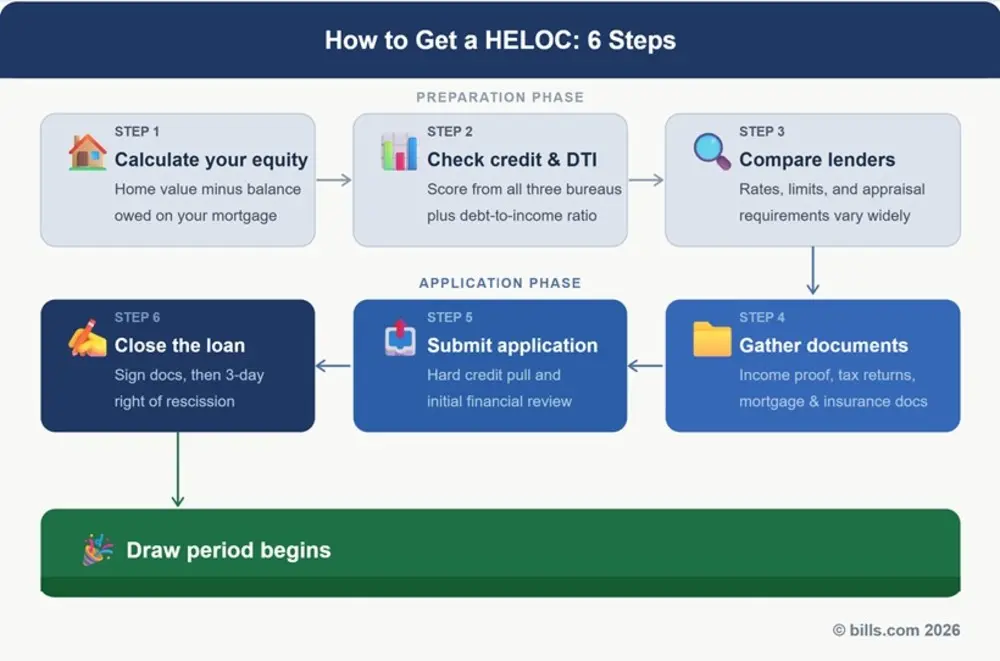
Step 1: Calculate your equity. Find your home's current market value — a recent appraisal, a tax assessment, or an online estimate can give you a starting point. Subtract your outstanding mortgage balance. Divide the result by the home's value to get your equity percentage. Most lenders will allow you to borrow up to 80% to 85% of your home's value minus what you already owe.
Step 2: Check your credit and DTI. The consumer credit reporting agencies (Equifax, Experian, and TransUnion) all have free credit score tools online. To calculate your DTI ratio, add up your monthly debt payments and divide by your gross income. Both numbers can affect your HELOC options and the rates you’re offered.
Step 3: Compare lenders. Rates, borrowing limits, and appraisal requirements vary, and those differences affect both what you can borrow and how long the process takes.
Step 4: Gather your documents. Lenders usually want to see proof of income, tax returns, your mortgage statement, and homeowners insurance. Having these ready before you apply could shorten your application timeline.
Step 5: Submit your application. The lender will likely run a hard credit pull and begin an initial review of your financials. This is when you may be asked for additional documentation. Respond quickly to avoid delays.
Step 6: Close the loan. After underwriting is complete, you'll receive a closing disclosure and sign your documents. Federal law then requires a three-business-day right of rescission—a window during which you could cancel the loan without penalty. Your draw period begins once that window closes.
VISUAL PLACEHOLDER
How to compare HELOC lenders
Most articles tell you to "shop around." That's a good starting point, but you also need to know what to compare to find the right lender.
Interest rate margin. A HELOC rate is typically set as an index interest rate (usually the prime rate) plus a margin the lender sets. Two lenders with the same starting rate could have very different long-term costs if their margins differ. Ask specifically: "What is your margin over prime?"
Maximum CLTV. Some lenders cap at 80%, others go to 90%. That difference could mean tens of thousands of dollars in available credit, depending on your home's value.
Appraisal type. Some lenders use automated valuation models (AVMs) for appraisals—faster, but they rely on what the software can see. Interior renovations often don't register. Others require a full in-person appraisal, which takes longer but could result in a different appraised value. Ask upfront which method the lender uses.
Fees. Look for origination fees, annual fees, and early closure or inactivity fees. Some lenders waive closing costs; others don't. Factor these in before comparing rates.
Lender type. Local credit unions often have more flexibility on CLTV limits than national banks—and if you already have an account there, that relationship might help. Online lenders tend to move faster but may have less flexibility on edge cases.
Documents you'll need
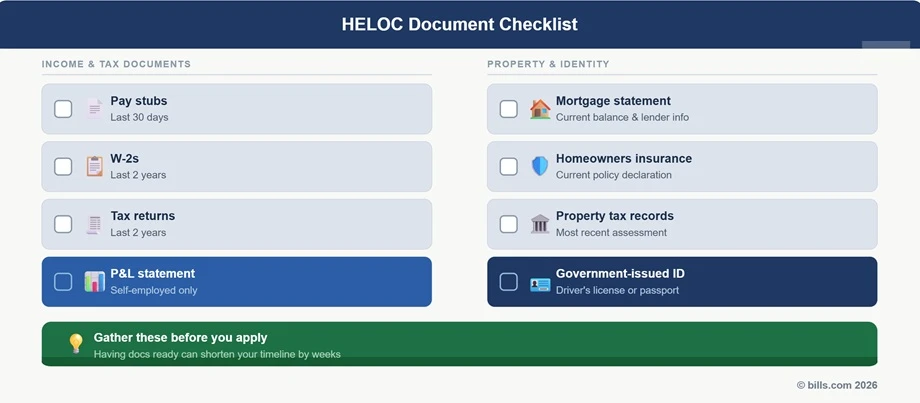
Lenders normally won't move until they have your documents. Get them together before you apply to get through the process as quickly as possible. Required documents can vary a bit by lender, but they often include:
- Proof of income: Pay stubs from the last 30 days, W-2s from the past two years
- Tax returns: Two years, personal (and business returns if self-employed)
- Mortgage statement: Current balance and lender
- Homeowners insurance: Proof of active coverage
- Property tax records: Recent bill or assessment
- Government-issued ID: Driver's license or passport
Self-employed borrowers typically also need a profit-and-loss statement for the current year. Some lenders may ask for bank statements as well.
Having these ready before you start the application could shorten your timeline significantly.
How to get a HELOC with bad credit
If your credit score is below 680, your options narrow, but they don't disappear.
Most lenders set 620 as a hard floor. Below that, very few will approve a HELOC application, and those that do typically charge significantly higher rates.
Above 620, a few things can work in your favor. First, equity is a compensating factor. A borrower with a 650 score and 40% equity is a fundamentally different applicant than one with 650 and 16% equity. Some lenders will recognize that. Second, credit unions and community banks tend to have more flexibility than national lenders when a profile is borderline. Third, if your timeline allows, taking a few months to improve your score before applying could meaningfully change the rate you're offered.
Steps worth taking: dispute any errors on your credit report with the credit bureau that issued the report, pay down revolving balances to reduce credit utilization, and avoid opening new credit accounts in the months before you apply.
A 'no' from one lender isn't a final answer with every lender. Different lenders draw the line in different places.
What happens after you apply
Here's what happens next after you submit your HELOC application.
Underwriting. The lender verifies your income, employment, and existing debts. This is typically the longest part of the process — how quickly it moves depends on how complete your documentation is and how busy the lender is.
Appraisal. The lender orders a home appraisal to confirm your property's value. Depending on the method used (AVM or full in-person), this could take less than a day or a couple of weeks
Conditional approval. The underwriter may come back with requests for additional documents — a letter of explanation, more recent pay stubs, clarification on a deposit. Respond quickly. Every day of delay extends your close date.
Closing. Once underwriting is complete, you'll receive a closing disclosure and sign your final documents.
Right of rescission. Federal law (Regulation Z) gives you three business days after closing to cancel the loan without penalty. You can't access your funds until that window closes. This applies even if you're certain you want to proceed.
Draw period begins. Once rescission passes, your line of credit is open. You can begin drawing funds as needed, up to your credit limit.
Bills Action Plan
Step 1. Run your numbers before you apply — calculate your current CLTV and pull your credit report at annualcreditreport.com to check for errors.
Step 2. Compare at least three lenders — include a local credit union alongside any national bank or online lender. Ask specifically about their maximum CLTV and appraisal process.
Step 3. Gather your documents before you start the application — two years of tax returns, recent pay stubs, your current mortgage statement, and proof of homeowners insurance.
Key Term - How to Get a HELOC
| Term | Definition |
|---|---|
| Equity | The difference between your home's current value and what you owe on your mortgage |
| CLTV | Combined loan-to-value ratio — all loans on the property divided by the home's appraised value |
| Draw period | The phase (typically 5–10 years) when you can borrow from your HELOC |
| Repayment period | The phase (typically 10–20 years) when you repay what you borrowed from your HELOC |
| AVM | Automated valuation model — a software-based appraisal that skips the in-person visit |
| Right of rescission | A federal 3-day window after closing during which you could cancel the loan |
How hard is it to get a HELOC?

Getting a HELOC is manageable if your numbers are in good shape. Lenders are typically evaluating the following: your equity, your credit, and your income stability. The most common reasons applications run into trouble are a CLTV that's too high, a credit score below 680, or a DTI ratio that's close to the lender's limit. If one of those is borderline, more strength in another area could help. For example, significantly more equity may offset a lower credit score with some lenders.
How long does it take to get a HELOC?
Most HELOC applications take 2–6 weeks from submission to funding, though some lenders can move faster. The biggest variables are the appraisal method your lender uses and how quickly you provide documents. Federal law also requires a three-business-day right of rescission after closing before funds are released.
What's the difference between a HELOC and a home equity loan?
A HELOC is a revolving line of credit — you draw what you need, when you need it, typically at a variable interest rate. Some HELOC lenders allow interest-only payments for the first few years. A home equity loan gives you a one-time loan, usually at a fixed rate, with repayment starting immediately. If you know exactly how much you need and want a predictable payment, a home equity loan may be worth checking out. If you want flexibility to draw over time, a HELOC is generally the better fit.
Can I get a HELOC on a rental or investment property?
Some lenders offer HELOCs on non-primary residences, but the requirements are typically stricter — higher equity, better credit, and fewer lenders willing to do it. Expect a lower maximum CLTV (often 70–75% rather than 85%) and a higher rate. It's worth calling lenders directly rather than applying online, since not all advertise this option prominently.