

How to Compare Personal Loan Rates Before You Borrow




Bills Bottom Line
To accurately compare personal loan rates, evaluate the APR rather than the interest rate alone. The APR accounts for the origination fee, which typically ranges from 0% to 12% of your borrowed total. Prequalifying generates a soft credit inquiry, so this rate-checking process doesn’t impact your credit score.
Table of Contents
- Why APR is the number to compare on personal loan rates
- What an origination fee truly costs you
- How your credit tier shapes the rate you're offered
- How loan term length changes what you pay
- What a prequalified rate does and doesn't guarantee
- How to tell whether a rate is truly good
- Bills Action Plan
- Key Terms
You have two loan offers open side by side. One quotes a lower rate but charges a setup fee. The other charges nothing and quotes a higher rate. Both call themselves the better deal. Offers usually differ in more than one way, so examining interest rates side-by-side won't settle it.
One figure on every offer already accounts for several of those differences at the same time. When you compare personal loan rates, compare the APR, not the interest rate. APR includes the origination fee, which runs 0% to 12% of the loan amount. When you prequalify with lenders, it's usually a soft credit inquiry, so checking rates shouldn’t affect your credit score (formally applying does). To protect your credit score, confirm with each lender.
Here's how to quickly and effectively compare personal loan rates, one factor at a time.
Why APR is the number to compare on personal loan rates
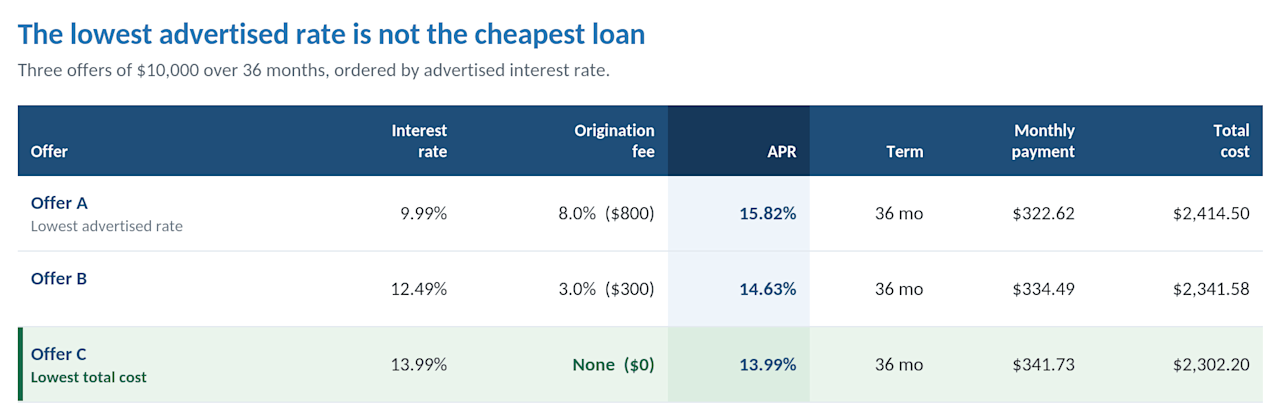
Compare offers on the annual percentage rate, or APR. The personal loan APR is the total yearly cost of borrowing, including the interest rate plus most lender fees, so it's generally the most accurate standard for comparing personal loans.
Your interest rate covers one thing: what the lender charges you for the money. The APR adds the lender's fees on top. Two offers can carry the same interest rate and still cost you different amounts.
The federal Truth in Lending Act requires lenders to state credit costs as an APR. The APR settles the fee-versus-rate question. A no-fee loan at a higher rate and a fee-charging loan at a lower rate compare directly on APR, because the origination fee already sits inside the number.
When the APR and the interest rate match, it means the lender charges no upfront fee.
One warning about advertised rates. Advertised floor rates go to the strongest applicants, and they tell you nothing about fees. Current personal loan rates give you context for what a competitive offer looks like.
What an origination fee truly costs you
Some lenders charge an origination fee to set up your loan. Personal loan origination fees range from 0% to 12% of the loan amount. Some lenders charge none; some charge up to 12%. When it's charged, the fee is deducted from your loan disbursement.
Start with the loans that don't charge this fee, because it changes your shortlist fast. Several major lenders charge no origination fee at all. If two offers land close on APR, the no-fee option often gives you more room.
Here's an example of what the deduction means in dollars. You borrow $5,000 with a 5% origination fee ($250). The lender sends you $4,750. You repay the full $5,000, plus interest.
That gap is why the fee belongs inside your comparison.
Two other charges sit outside the APR: late fees and returned-payment fees. Both depend on what happens after you sign, so neither shows up in the APR. So factor them in separately.
Most personal loan lenders don't charge a prepayment penalty, but it's worth confirming that before you sign.
How your credit tier shapes the rate you're offered
Most personal loans are unsecured, which means no collateral backs them. As a result, your credit score does more to shape your personal loan rate than any other factor you control.
FICO sorts scores into five bands: Poor (under 580), Fair (580 to 669), Good (670 to 739), Very Good (740 to 799), and Exceptional (800 and above). Lenders create their own credit tiers, and they often treat scores below 620 as higher risk.
Rates vary with your credit profile. Where you land sets the range you're likely to find. Credit scores also explain why one lender quotes two people different numbers for the same loan.
Pull your score before you start collecting offers. When you know where you stand, you can more accurately tell a competitive offer from a weak one.
Your score isn't the only input. Lenders also weigh your credit history, annual income, employment status, and debt-to-income ratio, which is the share of your monthly income that goes to debt payments. Some lenders also factor in education and employment data.
How loan term length changes what you pay
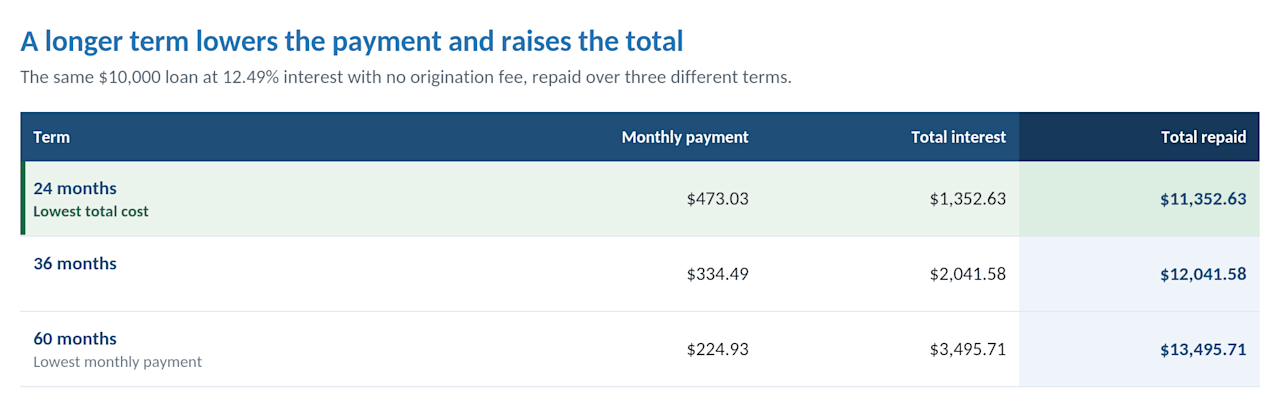
The term is how long you have to pay the loan back. Personal loan terms typically run two to seven years, though some lenders offer shorter or longer.
Term length pulls your costs in two directions at once. A longer term lowers your monthly payment. Your total interest goes up, because you're paying it for more months. A shorter term does the reverse, giving you a higher payment, but less interest overall.
Two offers with different terms can't be judged on payment size, because those payments cover different stretches of time. Compare the total cost across the full term instead. If you're taking out a debt consolidation loan, measure that total against what you're paying now.
Pick the shortest term whose monthly payment fits your budget comfortably. That gives you the lowest total cost that fits your budget.
What a prequalified rate does and doesn't guarantee
Prequalification, sometimes called prescreening, is usually a soft credit inquiry. Soft inquiries don’t affect your credit score. Prequalification isn’t a guarantee of final approval. The numbers are estimates.
Collecting several prequalified rates costs you nothing. Just make sure each lender is doing a soft credit pull. At this stage you're prequalified, not approved. Any offer is subject to credit approval. Final terms depend on more factors, and might differ from the estimate.
A formal application works differently. Applying creates a hard inquiry, and the two main credit scoring systems, FICO and VantageScore, handle those inquiries differently.
FICO gives special rate-shopping treatment to three application types: mortgage, auto, and student loans. Multiple inquiries of the same type inside a short window count as one. Personal loans do not have a rate-shopping window.
VantageScore groups multiple hard inquiries made within a 14-day window. Several personal loan applications in that period would generally count as one.
You can't control which system a given lender uses. FICO is more widely used, and does not give any grace for rate-shopping a personal loan. Try to select a lender and feel good about your chances of approval before you apply, so that hopefully you only need to apply once.
How to tell whether a rate is truly good
Personal loan rates vary widely based on credit, income, lender, and current market conditions. Though the key consideration is your personal budget and what you can comfortably pay back, note that the National Consumer Law Center recommends a 36% APR limit that includes all fees. The Military Lending Act caps APR at 36% for active-duty servicemembers and their families. If a loan is more expensive than that, it’s generally considered predatory (bad for the borrower).
How lender type affects the rate you're quoted
Banks, credit unions, and online lenders price loans differently and set different eligibility bars. Federal credit unions operate under a federal interest rate ceiling. That cap is part of why credit union pricing often undercuts other lenders. Membership requirements vary by institution, and many are easier to meet than you may expect.
Bills Action Plan
1. Prequalify with at least three lenders. A soft credit check doesn't affect your score, and you get real numbers instead of advertised ones.
2. Line the offers up on APR and total cost across the full term, in addition to the monthly payment.
3. Set your limits before you look, and hold to it. If nothing comes in under it, waiting and rebuilding your credit could put you in a stronger position next time.
Key Terms
APR: What the loan costs you in a year, including the interest plus most of the lender's fees. The number to compare.
Origination fee: What the lender charges to set up the loan. It usually comes out of the loan before it reaches you.
Prequalification: A preview of the rate you might get. It usually uses a soft credit check, so it shouldn’t affect your score. It isn't a commitment from either side.
Soft inquiry: A credit check that doesn't affect your score.
Hard inquiry: The credit check a lender runs when you formally apply. It can take a few points off your score.
Loan term: How long you have to pay the loan back.
Unsecured loan: A loan with no collateral behind it. Nothing you own is pledged against it.
This article is for general education. Bills.com can't advise you on which loan or lender is right for your situation. Consult a qualified financial professional for advice specific to your circumstances.
What is a good interest rate on a personal loan?

A good rate beats the market average for your credit profile and stays under 36% APR. The National Consumer Law Center treats 36% as the line past which a loan turns predatory.
Will checking your rate affect your credit score?
Checking your rate doesn't affect your credit score if the lenders use a soft credit inquiry for prequalification. A soft inquiry leaves your score untouched.
Can you negotiate personal loan fees?
You can often negotiate an origination fee down or get it waived, particularly when you have a competing offer in hand. Ask directly and name the competing terms.