

What Is an ACH Payment? How It Works and How to Stop One


Bills Bottom Line
An ACH payment is an electronic transfer between bank and credit union accounts over the Automated Clearing House network, which moves paychecks in and bill payments out. A standard transfer is scheduled for either the next business day or the one after. You can stop an automatic debit through your bank, and dispute one you never allowed if you tell your bank in time.
Table of Contents
Imagine your gym, landlord, or lender asks for your account details so you can pay your bill automatically, or maybe you spot an unfamiliar charge on your bank statement. There's no need to panic. Whether the money is coming into your bank account or going out, it may just be an ACH payment.
Here's what you need to know about how ACH payments work.
What is an ACH payment?
An ACH payment is money sent electronically between bank and credit union accounts via the Automated Clearing House (ACH) network. ACH payments also go by other names: direct debit, electronic funds transfer (EFT), electronic bank transfer, or eCheck.
ACH payments move in batches. In a direct deposit, your employer's bank sends your pay, with many other payments, to an ACH operator such as the Federal Reserve. The operator sorts them and sends a file to your bank, which deposits the funds into your account on payday.
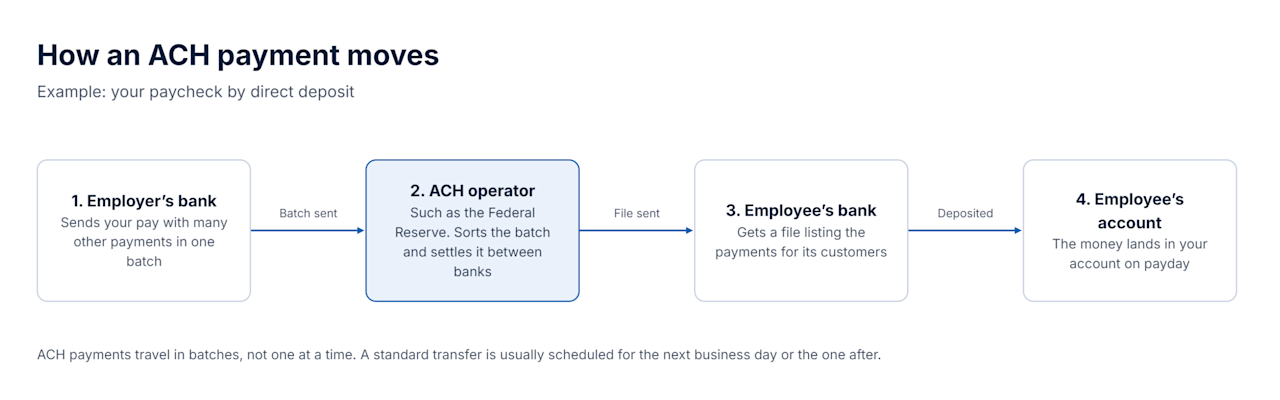
ACH is used for all kinds of banking transfers. ACH commonly carries paychecks, Social Security benefits, and tax refunds into accounts, and mortgage and utility payments out. The network also handles one-time payments you make by phone or online. Some banks' and credit unions' online bill pay services run on it, too.
What is an ACH credit and an ACH debit?
An ACH credit pushes money into your account, and an ACH debit pulls money out of it. The table shows the other difference: who starts the payment.
| Payment | Money moves | Who starts it | Everyday example |
|---|---|---|---|
| ACH credit | Into your account | The payer, such as your employer | Paycheck by direct deposit |
| ACH debit | Out of your account | The company you're paying, on your instructions | Automatic bill pay you set up when you log in to your account on that company’s site |
A company may withdraw money from your account only with your permission. You can authorize a one-time payment online or by phone. Recurring payments require written authorization, which may be provided electronically, and the company must give you a copy. If you authorize a payment by phone, the company must record your approval or confirm it in writing before the payment is processed.
How long does an ACH transfer take?
Settlement is when the money moves between banks. Scheduling a payment doesn’t move money right away. Money moves when the payment settles.
While many ACH transfers settle the next business day or the day after, a Same Day ACH can settle within hours on the same business day. As of October 2026, Same Day ACH supports payments up to $1 million, but not international payments.
ACH payments settle at certain times on business days at set times, depending on the type of ACH payment and what time it was sent. The Federal Reserve does not settle ACH payments on weekends or federal holidays. Banks also set daily cutoff times for sending transfers, so check the cutoff time before paying a bill through your financial institution.
Most ACH deposits must be scheduled to settle within two business days of being sent. ACH withdrawals must be scheduled within one business day. These limits don’t apply to deposits from the U.S. Treasury. If a deposit is late, ask the sender when it was sent, then contact your bank.
Since September 2019, here's when a deposit settles and when your bank must make the money available.
| Type | Settles | You can use a deposit by |
|---|---|---|
| Standard ACH | Next business day or the one after | 9 a.m. local time or end of settlement day, by arrival |
| Same Day ACH | Same business day | 1:30 p.m., 5 p.m., or end of the bank's day, by window |
The 9 a.m. time applies when your bank had the payment by 5 p.m. the day before. If it didn't, the end of settlement day applies. Same Day ACH runs in three windows a day, and the three times follow them in order. Federal law also requires your bank to allow you to use an ACH deposit no later than the business day after it receives the funds.
ACH vs wire transfer
A wire settles faster than ACH and is generally final once processed. With ACH, you can dispute an unauthorized debit if you notify your bank in time.
Fees vary. Some banks charge $25 to send a domestic wire online or $35 with a banker’s help, while ACH transfers may be free. Check your bank’s fees for both.
To try to recover a wire, you would need to ask your bank to request a recall; it isn’t guaranteed. Use ACH for routine payments and wires for large, urgent payments to people you trust.
Is there a downside to ACH payments?
Yes, three, and you can guard against each: a debit on a low balance, a change in a recurring amount, and stolen account numbers.
If your balance can't cover an automatic ACH debit, your bank decides whether to pay it, and either choice can cost you.
When an automatic ACH debit hits a short balance
- Your bank can pay it, overdraw your account, and charge an overdraft fee.
- Your bank can decline it and charge a non-sufficient funds (NSF) fee, often the same amount.
- The company you were paying can add its own returned-item fee, or a late fee on a loan.
On a recurring ACH debit, your bank can charge an overdraft fee or an NSF fee even if you never signed up for overdraft coverage. Some banks let you opt out of overdrafts on recurring payments. If you opt out, your bank declines a debit your balance can't cover. It can then charge an NSF fee in place of the overdraft fee.
If a recurring debit differs from the last one or from the amount you approved, the company or your bank must send you a written notice. The notice must give the amount and date at least 10 days before the debit.
You're entitled to a notice of every change. The company or bank may let you choose to receive a notice only when the amount falls outside a set range. Read those notices when they arrive, since they give you time to move money or stop the payment.
Businesses often accept ACH bill payments using your account number and routing number. Someone who obtains those numbers through a phishing scam or a data breach could use them to make unauthorized withdrawals. Give them only to companies you've chosen to pay.
How do I stop or dispute an ACH payment?
You have two ways to stop an automatic payment, and you can use both: withdraw your permission, or give your bank a stop payment order. To get money back from a debit you never authorized, report it to your bank.
To withdraw your permission, call the company and say you're withdrawing it, then call your bank and say the same. Follow up each call in writing. Your bank must then block future debits under the permission you withdrew, without waiting for the company to stop them. Any debit the company takes once both know is an error your bank can refund.
Your bank may ask for a copy of your notice to the company within 14 days of your call to the bank. If it doesn't get one, it may allow later debits to go through.
A stop payment order tells your bank not to pay that company, and it works even if you haven't told the company. Give it to your bank by phone or in writing at least three business days before the scheduled debit. If you call, your bank may require written confirmation within 14 days of that call. Your bank must keep honoring the stop if the company tries the debit again.
Banks generally charge for a stop payment order. Our guide on how to cancel automatic ACH payments covers each step in detail.
To dispute a debit you never authorized, make sure to understand the deadlines.
Your window to report an unauthorized ACH debit
Your bank must get your report within 60 days after sending the statement that first shows the debit.
Miss the 60 days, and you could have to cover unauthorized debits taken after day 60 and before you report them, if your bank shows an on-time report would have stopped them.
Your bank must investigate and, except in some cases federal rules set out, decide within 10 business days, or within 45 days of your report if it needs longer. To take longer, it must do certain things, including temporarily crediting your account for the disputed amount within those 10 business days. A bank that finds an error must correct it within one business day.
If your bank or the company doesn't act, file a complaint with the Consumer Financial Protection Bureau (CFPB) online or at (855) 411-2372. Most companies respond within 15 days. If a lender won't stop taking money, also contact your state regulator or state attorney general. The CFPB's website lists each state's banking regulator, and the National Association of Attorneys General's website helps you find your attorney general.
Bills Action Plan
Three habits keep ACH debits under your control.
- Check each statement for ACH debits. Your statement lists each electronic transfer with its amount, date, and the name of the company on the other end. If no one on your account approved a debit, report it to your bank right away, within the 60-day window.
- Keep a list of who can debit your account. File the copy of your written permission each company gives you, and note how to withdraw it with each. When you stop a payment, record each request and its date.
- Set low-balance alerts and choose your overdraft setting. Sign up for low-balance alerts if your bank offers them. Then ask whether you can opt out of overdraft protection for recurring payments, and compare your bank's overdraft and NSF fees before you choose.
With these habits, you can catch a problem early.
Key Terms
ACH (Automated Clearing House): The network banks and credit unions use to move money electronically between accounts.
ACH credit: A payment sent into your account by the payer, such as your pay arriving by direct deposit.
ACH debit: A payment a company collects from your account under your permission, such as a monthly mortgage or utility bill.
Same Day ACH: An ACH option that settles a payment the same business day, for payments up to $1 million as of October 2026.
Non-sufficient funds (NSF) fee: A fee your bank charges when it rejects a payment because your account doesn't hold enough to cover it.
Stop payment order: An instruction telling your bank not to pay a specific company from your account. Banks generally charge a fee for one.
Free up cash each month with Freedom Debt Relief

Ozzy S., Freedom client
“Right away, I had more money each month because of program costs so much less than what I was paying on my minimums.”
Actual client of Freedom Debt Relief. Client’s endorsement is a paid testimonial. Individual results are not typical and will vary.
Is Zelle an ACH transfer?

After you send a Zelle payment, your bank and the recipient's bank settle the funds between themselves via ACH or another payment network. You send a Zelle payment with only the recipient's email address or U.S. mobile number. Zelle payments to enrolled users typically arrive within minutes, faster than a standard ACH transfer.
How do I pay someone via ACH?
To pay someone via ACH, start with your bank's online bill pay, which some banks and credit unions run over ACH. Some banks that pay a person by direct deposit ask for the person's routing number and account number, plus other details that vary by bank. To pay a company, give it your own account number and routing number so it can collect the payment from your account.
Is an ACH number the same as a routing number?
The number a company asks for to set up an ACH payment is your bank's routing number, along with your account number. A routing number identifies your bank for checks and electronic payments, including ACH and wires. Check your bank's site or app for the right number before you set up a payment.