

Chapter 7 Bankruptcy Discharge: What It Means and What Happens Next




Table of Contents
Bills Bottom Line
If you've been waiting and wondering—here's the short version. A Chapter 7 discharge is the court's way of saying: you don't owe these debts anymore. It usually arrives 3 to 4 months after you file. Credit cards, medical bills, and personal loans could be wiped out. Child support, alimony, and most student loans stick around.
If you're reading this, you're probably somewhere in the middle of the Chapter 7 bankruptcy process—or thinking about starting it—and you keep hearing the word "discharge
But what does that actually mean?
Does it mean your debts disappear? Your assets? Your case? Is it the same as your case being closed? And when does it happen—are we talking weeks or months?
These are the questions nobody seems to answer in plain English. So let's fix that.
So what is a discharge, exactly?
A bankruptcy discharge is a court order. It says: "You are no longer legally responsible for paying these debts."
That's it. It's not about your assets. It's not about your credit score (directly). It's about your debts—specifically, the ones you listed in your bankruptcy filing.
Once you get a discharge, creditors can't call you. They can't sue you. They can't garnish your wages. They can't send you to collections. Legally, it's over. You walk away from those debts.
The law that makes this possible is called the discharge injunction (11 U.S.C. § 524). It sounds technical, but all it means is that the court has put a permanent stop to collection efforts on discharged debts.
One thing that trips people up: a discharge isn't the same as your case closing. You'll get your discharge first—that's when your debts are eliminated. The case closes a little later, after the trustee wraps up the paperwork.
A discharge is also not the same thing as a dismissal. When your case is dismissed, that means you aren’t getting any relief from your debts. Your case is being thrown out. That could happen if the court decides you’re not eligible for the kind of bankruptcy relief you’re asking for, or if you miss a deadline or complete a form incorrectly, or if you fail to do something else that’s required of you.
When will I get my discharge?
Most people receive their Chapter 7 discharge about 3 to 4 months after filing, according to the U.S. Courts. Here's roughly how it breaks down:
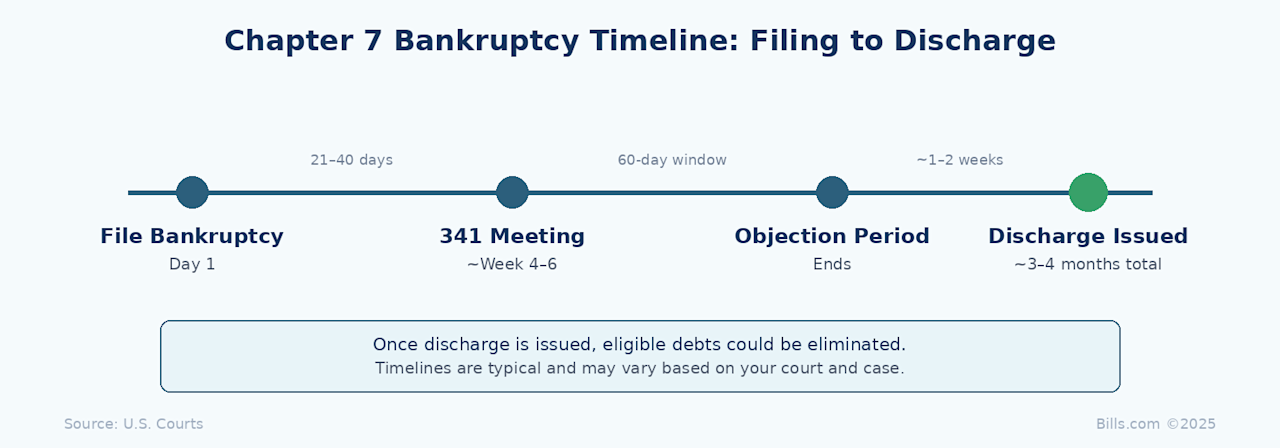
If you've already had your 341 meeting (a brief hearing where a trustee asks questions about your finances) and you're just... waiting? That's normal. The 60-day window has to pass before the court can issue your discharge. It feels slow, but it's moving.
Which debts go away in Chapter 7?
The short answer: most unsecured debts are eligible to be discharged in a Chapter 7 bankruptcy. If you're buried under bills you can't pay, this is where real relief could come from:
- Credit card balances
- Medical bills
- Personal loans
- Payday loans
- Old utility bills
- Collection accounts
But some debts don't go away—no matter what. Under federal law, these typically survive personal bankruptcy:
- Child support and alimony
- Most student loans (unless you prove "undue hardship" in a separate case)
- Recent tax debts
- Criminal fines and restitution
- Debts from fraud or intentional harm
If you're not sure where a specific debt falls, ask your attorney. The rules can get nuanced.
What happens after you get a Chapter 7 Discharge?
After you receive your discharge, those debts are gone. You'll get a piece of paper in the mail. It doesn't look like much—just a court order with your name and case number. But that document is your proof that you're legally free from those debts.
Here's what to expect:
Creditors have to stop contacting you. If they don't, they're breaking the law.
Your credit report will update. Discharged debts should show a zero balance. The bankruptcy itself stays on your report for 10 years from your filing date.
You could start rebuilding. Credit scores could improve over time with responsible financial habits. If you have some cash for a deposit, you could apply for a secured credit card soon after discharge. For mortgages, FHA loans could be possible as early as 2 years after discharge; conventional loans typically require a 4-year wait.
The discharge doesn't erase what happened—but it does give you a real chance to move forward.
What if a creditor keeps calling about a discharged debt?
Tell them it was discharged — clearly and calmly. Sometimes a debt gets sold to a new collector who doesn't know about your bankruptcy. Sometimes a creditor just ignores the rules.
| 📞 What to Say If a Creditor Calls About a Discharged Debt |
|---|
| "This debt was discharged in my Chapter 7 bankruptcy, case number [YOUR CASE NUMBER], filed in [COURT NAME].My discharge was issued on [DATE]. Please update your records and stop contacting me about this debt." |
| 💡 Tip: Keep it calm and factual. If they continue calling, that's a violation you can report. |
| Bills.com ©2026 |
Bills.com ©2026
If they keep calling, that's a violation. The CFPB says creditors who ignore a discharge could face contempt of court. You could file a complaint with the CFPB, report them to your bankruptcy court, or talk to an attorney.
This is why you want to keep your discharge paperwork somewhere safe. It's your proof.
Can the discharge be taken away?
It’s very rare for a discharge to be reversed.
This is a fear a lot of people have—especially if they're not 100% sure they did everything right.
The honest answer: most people get their discharge and keep it.
A discharge could be denied if you:
- Hid assets or lied on your paperwork
- Destroyed financial records
- Didn't complete the required debtor education course
- Already got a Chapter 7 discharge in the last 8 years
And technically, under 11 U.S.C. § 727(d), a discharge could be revoked within one year if fraud is discovered after the fact. But we're talking about intentional, serious fraud—not honest mistakes.
If you forgot to list a creditor? In most cases, the debt is still discharged. If you made a typo? That's fixable. Courts understand that people aren't perfect.
The key is whether you acted in good faith. If you did, you're probably fine.
Bills Action Plan
Step 1: Keep your discharge order somewhere safe. If a creditor ever questions you, this is your proof.
Step 2: Check your credit reports about a month after discharge. Make sure discharged debts show zero balances. If something's wrong, dispute it.
Step 3: Make a simple budget. You've got a chance to build new habits—start with knowing where your money goes.
Step 4: If a creditor calls about a discharged debt, tell them it was discharged. If they keep calling, report them.
Step 5: Questions about a specific debt? Talk to your bankruptcy attorney. Many will answer quick questions even after your case closes.
Free up cash each month with Freedom Debt Relief

Ozzy S., Freedom client
“Right away, I had more money each month because of program costs so much less than what I was paying on my minimums.”
Actual client of Freedom Debt Relief. Client’s endorsement is a paid testimonial. Individual results are not typical and will vary.
How long does bankruptcy stay on my credit report?

A Chapter 7 bankruptcy stays on your credit reports for ten years from your filing date. But the impact on your score usually fades well before that. It’s easier to rebuild good credit if you avoid credit card debt and consistently pay your bills on time.
Could I file bankruptcy again after this?
You may file for bankruptcy again after mandatory waiting periods pass. Under federal law, you'd need to wait 8 years from your first filing date for another Chapter 7. For Chapter 13, it's 4 years. Hopefully you won't need to—but the option exists.
Will I owe taxes on discharged debt?
No, debts discharged in a Chapter 7 bankruptcy aren't taxed. If you get a 1099-C from a creditor, you'll need to file IRS Form 982 with your tax return to exclude the forgiven amount from your income. The form tells the IRS the debt was discharged in bankruptcy. Check with a tax professional if you're unsure.
I forgot to list a creditor. Is that a problem?
If you remember a creditor that should have been included, let your attorney or the bankruptcy trustee know right away. Honest mistakes are usually not a problem, especially if you don’t have assets. If there's nothing to distribute to creditors, the debt is typically discharged anyway. But it's worth telling your attorney so they can advise you—and in some cases, you could amend your paperwork to add the missing creditor.