

Debt Settlement Pros and Cons: Is It Worth It?




Bills Bottom Line
Debt settlement could lower what you repay on unsecured debts like credit cards. If you work with a professional debt settlement company, the costs are steep. Debt settlement usually hurts your credit, adds fees of 20% to 25% of your enrolled debt, and could raise your tax bill. It fits best when your accounts are already behind and paying in full isn't realistic.
Table of Contents
You're staring at credit card balances you can't realistically pay off, and the ads promising to cut what you owe look tempting. Before you call anyone, you want to know whether debt settlement is worth it, or a trap.
Debt settlement means negotiating with your creditors to accept less than your full balance, usually on unsecured debt like credit cards. You typically begin the settlement process after your accounts fall behind. Depending on the agreement negotiated, you pay the settlement in multiple payments or as a single lump sum.
Weigh pros and cons to decide whether debt settlement is a good idea for your situation.
What are the pros of debt settlement?
Debt settlement's biggest draw is simple: you could repay less than the full balance you owe. Here's what pulls people toward it:
- You could repay less than 100% of your balance on unsecured debts like credit cards.
- You could avoid bankruptcy and the public court record it creates.
- You could resolve enrolled debt in 2–4 years instead of making minimum payments indefinitely.
- You might not have to pay federal income taxes on the forgiven debt if you were insolvent (your debts exceeded your assets) when you settled.
Every one of these is a "could," not a "will." The details depend on your settlement program.
What are the cons of debt settlement?
The costs are where settlement gets expensive. Here's what to weigh:
- Fees usually run 20% to 25% of your enrolled debt when you hire a debt settlement company.
- Forgiven debt is generally taxable as income, no matter the amount, unless you can show that you were insolvent when you settled the debt.
- Nothing is guaranteed. According to a 2021 CFPB report, some credit card issuers keep a policy of not working directly with debt settlement companies. Debt collectors may not agree to settlement, either.
- Settlement gives you no automatic stay. Working with a debt-settlement company could lead to a creditor filing a debt collection lawsuit, and collection calls can continue the whole time.
- Your balances could keep growing with late fees and interest while you save toward a settlement.
DIY settlement is an excellent alternative to debt settlement programs. You can avoid paying fees by negotiating with creditors yourself, coming to a settlement agreement. Other cons listed remain true.
Will debt settlement ruin your credit?
Debt settlement does serious damage to your credit. The CFPB warns that using these services can hurt your credit scores and your ability to get credit in the future.
It hits so hard because payment history is about 35% of a FICO Score, and settlement generally works only after you've stopped paying, and most creditors won’t negotiate until your account is seriously delinquent. According to a 2020 CFPB report, more than 70% of accounts that reach settlement were charged off first. A charge-off means the lender had already written the account off as a loss, usually after about 180 days of missed payments.
The mark also lingers. Settled accounts remain on your credit report for seven years, counted from your first missed payment, not the settlement date.
Is debt settlement a good idea for you?
Debt settlement is sometimes worth it when you have more debt than you can afford to repay. Start with the honest odds. Programs typically take two to four years to complete. Settlement is appropriate for unsecured debt only, and it isn't guaranteed.
Settlement tends to be worth considering when:
- Your accounts are already delinquent or charged off.
- Paying the full balance isn't realistic.
- Bankruptcy is off the table for you.
It's usually the wrong fit when your accounts are still current, when the debt is secured like a car loan or mortgage, or when protecting your credit score matters most.
Alternatives to debt settlement
You have a few paths besides settlement, and one of them costs nothing extra.
- Negotiate it yourself. The CFPB notes that issuers who work with settlement companies generally offer consumers the same settlement rates directly, without the 20% to 25% provider fee.
- Try a debt management plan. Set up through a nonprofit credit counseling agency, a debt management plan (DMP) repays 100% of your principal at a lower interest rate, typically 7% to 10%. The credit hit is typically much less severe than settlement. It's a different tool, not automatically better than settlement.
- Consider bankruptcy. Chapter 7 can discharge most unsecured debt in about three to four months and stays on a credit report around 10 years. It triggers an automatic stay, meaning creditors can’t come after you for the debts. You also avoid being taxed on forgiven debt.
Our guide on how debt relief programs compare lays them out side by side.
| Method | How it works | Credit impact | Typical cost/fees | Timeline | Taxable forgiven debt? |
|---|---|---|---|---|---|
| Debt Settlement | Negotiate with creditors for less than balance | Severe | 20% to 25% of enrolled debt | At least 2 to 4 years | Yes |
| DIY negotiation | Negotiate directly with creditors | Severe | No provider fee | Varies | Yes |
| Debt management plan | Repay 100% of principal through nonprofit credit counseling | Less severe | $30–$70/mo plus the balances | Within 5 years | No |
| Chapter 7 bankruptcy | Legal discharge of unsecured debt | Severe | Court/attorney fees | 4-6 months | No |
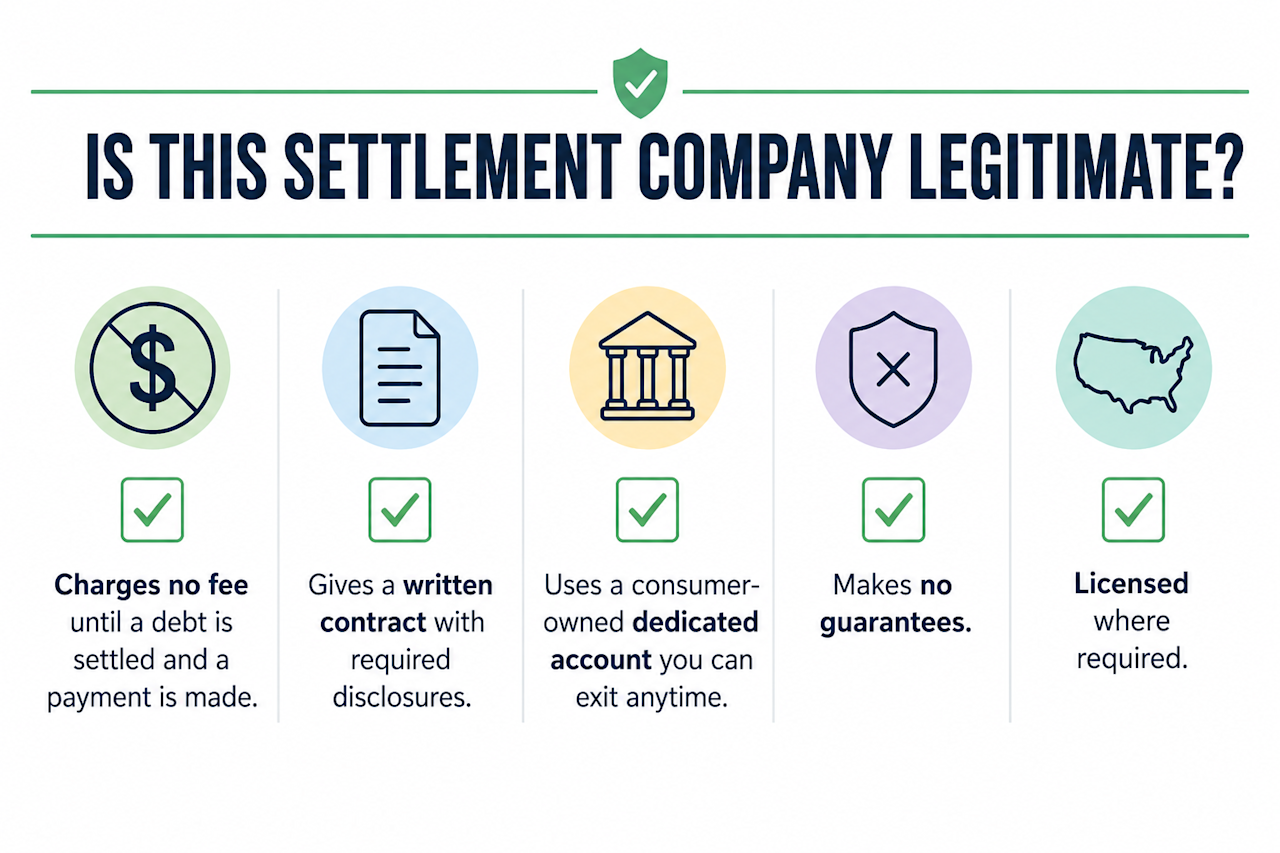
Before you hand any company your money or your information, make sure it's legitimate.
Bills Action Plan
Step 1: List your unsecured debts and mark which are current, behind, or already charged off.
Step 2: Before you enroll anywhere, call a nonprofit credit counselor and ask whether a debt management plan fits your budget. It repays 100% of what you owe at a lower interest rate, with a smaller credit hit.
Step 3: If debt settlement still makes sense, verify any provider through the CFPB complaint database, and get the fee schedule in writing.
Key Terms
Charge-off: After about 180 days of missed payments, your lender writes the account off as a loss. You still owe the money, and it still shows on your credit report.
Debt management plan (DMP): A repayment plan set up through a nonprofit credit counselor. You repay 100% of what you owe, usually at a lower interest rate. Credit score recovery is possible on a shorter timeline compared to debt settlement.
Disclaimer
This article is for general education and isn't financial, legal, or tax advice. Debt settlement results vary by your situation and aren't guaranteed. Consider speaking with a nonprofit credit counselor or a tax professional before you decide.
Free up cash each month with Freedom Debt Relief

Ozzy S., Freedom client
“Right away, I had more money each month because of program costs so much less than what I was paying on my minimums.”
Actual client of Freedom Debt Relief. Client’s endorsement is a paid testimonial. Individual results are not typical and will vary.
Is settling a debt better than paying it in full?

A paid-in-full account protects your credit and reports more favorably to the bureaus. Settling could cost you less cash than paying a debt in full, ideally. If your accounts are current and you can afford them, paying in full is the stronger move. If you're already behind, settling may be the more realistic trade-off.
Do you have to pay taxes on forgiven debt?
Forgiven debt is generally taxable as income, no matter the amount, unless you can show the IRS that you were insolvent when you settled the debt. Insolvent means the value of what you owe is greater than the value of what you own. Insolvency is a sliding scale, so some of your forgiven debt might still be taxable.
How long does debt settlement take?
At least two to four years is typical for debts enrolled in a settlement program. Often, debts are settled one at a time. You might settle your first debt in a few months, and another a year later. It depends on how quickly you’re able to set aside money to offer creditors, and the sizes of your original balances. . Results aren’t guaranteed, though. A company that owns your debt might decide not to settle, at any point during negotiations.