

How to Negotiate Debt




Bills Bottom Line
Negotiating credit card debt with creditors or debt collectors could reduce what you owe, but it requires preparation and realistic expectations. Most creditors might accept 40-60% of the balance if you can pay a lump sum or agree to a payment plan. Before you call, confirm what you owe, assess what you can afford, and understand the risks: your credit will take a hit, and forgiven debt might be taxable. Get any agreement in writing before paying.
Table of Contents
You've been behind on credit card payments for months. Creditors keep calling, other bills are stacking up, and you're wondering whether they'll negotiate at all—or whether calling might somehow make things worse
Negotiation is worth a try. Creditors might accept less than the full balance if you can demonstrate financial hardship and make a realistic offer. The key is knowing what to offer, how to prepare, and what to expect.
Here's how debt negotiation works.
Prepare before you negotiate with creditors
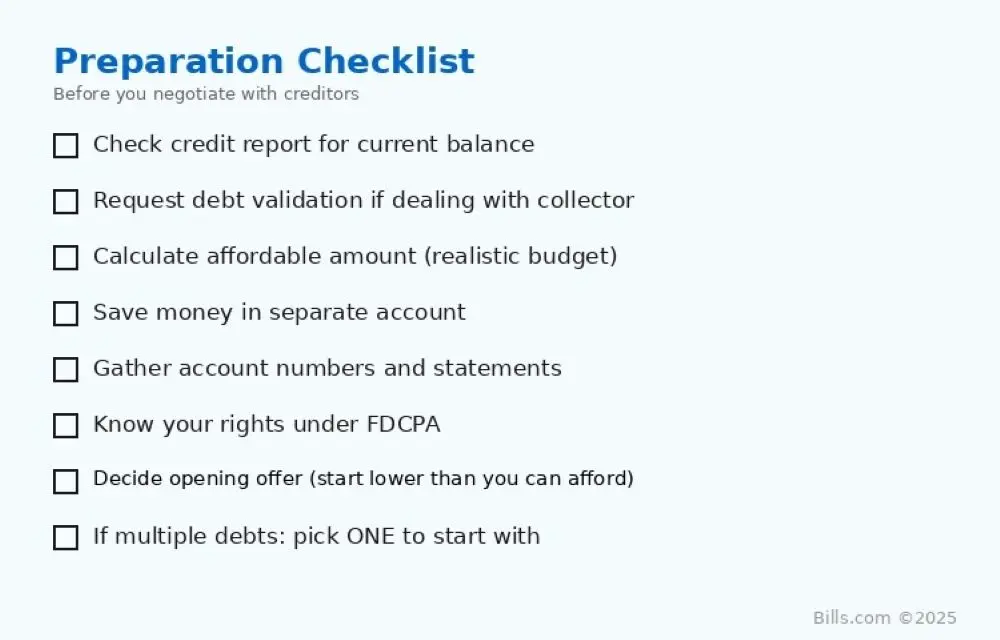
Before you call, get your information and strategy together. Here's what you need.
Confirm what you owe. Check your credit report to verify the balance and who currently holds the debt. If you're dealing with a debt collector, request debt validation—ask them to prove you owe the debt and that they have the legal right to collect it. They're required to provide this information under the Fair Debt Collection Practices Act (FDCPA).
Calculate what you can afford. Add up your monthly income, subtract essential expenses like rent and utilities, and determine what's realistically available. If you can scrape together $2,000 for a lump sum, that's your ceiling—don't offer $3,000 hoping you'll find it later.
Save money in a separate account. If you're planning a lump-sum offer, start setting money aside now. Having even $500-$1,000 ready shows creditors you're serious.
Gather your documentation. Have your account number, recent statements, and any previous correspondence ready before you call.
If you have multiple debts: Start with one. Pick either the oldest (closest to falling off your report) or the one where you have the most leverage (like a debt that's already been sold to a collector). Negotiating everything at once is overwhelming and reduces your success rate.
Who you're negotiating with matters
Original creditor: The company you originally owed (your credit card issuer or lender). They want something rather than nothing, but they're less desperate since they haven't written off the full loss yet.
Debt buyer: Companies that purchase debts from creditors, typically for 10-30% of face value. If they paid $2,000 for your $10,000 debt, any settlement over $2,000 is profit. That means they often accept lower settlement amounts.
Ask directly: "Did you purchase this debt, or are you collecting on behalf of [original creditor]?" The answer affects your negotiation strategy.
Know your rights. If you're dealing with debt collectors, the FDCPA prohibits harassment, false statements, and unfair practices. They can't call you at work if you tell them not to, can't threaten actions they won't take, and can't discuss your debt with third parties.
How much should you offer to settle credit card debt?
Great, now that you're prepared, you need to figure out how much to offer.
If you look around, it’s easy to find real stories of creditors who have settled for anywhere from 10% to 90% of the balance owed. Somewhere in the middle is more common
If you're paying in a lump sum, plan to offer 30-40% of what you owe. Creditors will likely counter at 50-60%. These ranges are based on typical debt settlement negotiations and industry practice—your actual results will vary depending on your creditor, how far behind you are, and your specific circumstances.
Debt buyers often accept less. Since they purchased your debt at a steep discount (typically 10-30% of face value), they have more room to negotiate. You might settle for 25-40% with a debt buyer versus 40-60% with the original creditor.
If you owe $10,000 in credit card debt, start at $3,000-$4,000 and be prepared to negotiate up to $5,000-$6,000. If you're dealing with a debt buyer who paid $2,000 for your debt, they might accept $3,500 since anything above their purchase price is profit.
For payment plans, creditors might accept the full balance but waive interest and fees. This reduces your monthly payment without showing a settlement on your credit report.
Your leverage depends on how far behind you are (creditors typically become more willing to negotiate at 90-180 days past due), whether you have cash now versus promises of future payments, and who's collecting the debt.
If you agree to a payment plan, stick to it. Missing payments typically voids the agreement and collection efforts start over.
How to negotiate with creditors: Step by step
Once you're prepared, it's time to make the call. Here's the process.
Step 1: Call and ask for the right department
Don't talk to the first person who answers. Ask for the loss mitigation department, settlement department, or hardship department. These representatives have authority to negotiate.
What to say: "I'd like to speak with someone about settling my account."
Step 2: Explain your hardship briefly
Give a factual, brief explanation. Keep it to one or two sentences.
Examples:
- "I lost my job three months ago and can't pay the full balance."
- "I had unexpected medical bills and fell behind."
- "My income was reduced and I can't maintain the current payment."
Step 3: Make your opening offer clearly
State your offer with confidence and specifics.
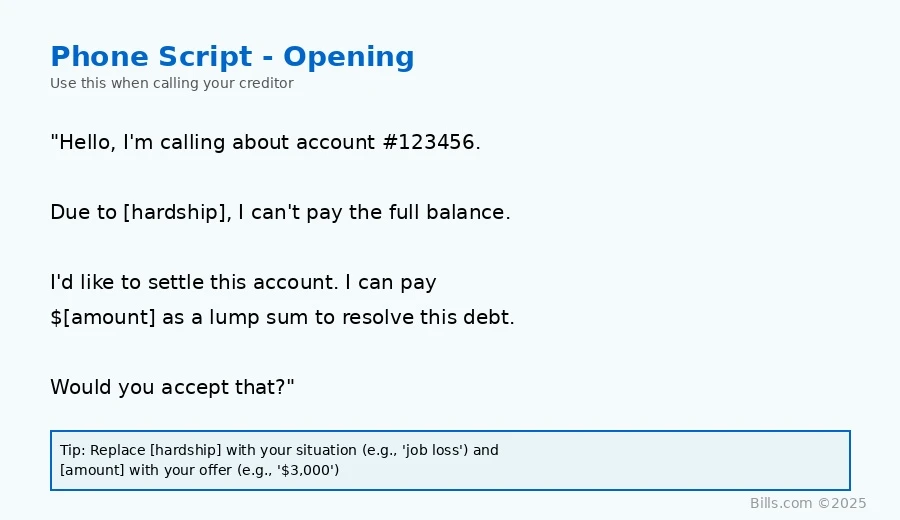
Script: "I'm calling about account #123456. Due to financial hardship, I can't pay the full balance. I'd like to settle this account. I can pay $3,000 as a lump sum to resolve this debt. Would you accept that?"
Step 4: Listen to their counter-offer
The representative might accept, reject, or counter with a higher amount. Don't commit immediately if it's more than you can afford.
What to say: "Let me review my finances and call you back tomorrow."
Step 5: Negotiate if needed
If they counter at $6,000 and you offered $3,000, you might meet at $4,500. This is normal negotiation.
What to say: "I can stretch to $4,000. Would that work?"
Step 6: Confirm terms before hanging up
Once you reach agreement, repeat the terms clearly.
What to say: "Just to confirm—if I pay $4,000 by [date], this account will be settled in full, and no further collection activity will occur. Is that correct?"
Step 7: Request written confirmation
Don't let them talk you into paying first.
What to say: "I need this agreement in writing before I make the payment. Can you email that to me today?"
Step 8: Wait for written agreement before paying
Don't pay anything until you receive written confirmation. If they refuse to provide it, that's a red flag.
Step 9: Honor the agreement
Your creditor is doing you a favor. Hold up your end of the bargain and make the promised payment by the promised date. If you fail to follow through, they might cancel the agreement.
Protect yourself: Document everything
You might be tempted to trust the person on the phone, especially if they're being nice or if you're just relieved they agreed to settle. Don't.
Write down everything during the call: the date, time, representative's name and ID number, what was discussed, what was offered, and what you agreed to. If they say "We'll accept $4,000 paid within 30 days," write that exact phrase and who said it.
Some people record their calls. If you're in California, Connecticut, Florida, Illinois, Maryland, Massachusetts, Michigan, Montana, Nevada, New Hampshire, Pennsylvania, or Washington, you need permission from both parties to record.
In other states, only you need to consent.
Get it in writing before you pay
This is where people get burned. The representative says yes, you're relieved, and you want to pay immediately and move on. Stop. Get the agreement in writing first—email is fine—before you send any money.
Make sure the written agreement includes how much you're paying, confirmation that this payment settles the debt, your account number, and their promise to stop collection. If they won't send it, or if they say "just pay now and we'll send it after," walk away. Legitimate creditors understand this protects both of you.
Keep copies of everything: the written agreement, your payment proof, and any later correspondence. If collection activity continues after you've paid what was agreed, you'll need this documentation.
What if you need help?
Not everyone wants to handle this themselves. If you'd rather have someone negotiate for you, debt settlement companies will do it—but they typically charge 15-25% of your enrolled debt as fees. Source: Federal Trade Commission
The FTC regulates these companies and prohibits them from charging upfront debt settlement fees before they settle a debt. Some people find the fees worth it to avoid the stress.
>>Learn more about debt settlement companies and how they work.
Bills Action Plan
Step 1: Pull your credit report right now at AnnualCreditReport.com. Don't wait—do this today.
Step 2: Pick ONE debt to tackle first. Choose either the oldest (closest to falling off your report) or the one where you have the most leverage (already with a debt buyer).
Step 3: Write down your hardship in one sentence. Practice saying it out loud until it sounds natural.
Step 4: Do the math. If you owe $5,000 and can scrape together $2,000, that's your starting offer. Write it down.
Step 5: Put the creditor's phone number in your phone. Schedule the call for tomorrow morning between 9-11am when you're fresh.
Step 6: Set up your workspace: quiet room, notepad, account number, your offer amount, water.
Step 7: Make the call. Ask for the settlement department. Don't agree to anything—just listen, take notes, and say you'll call back tomorrow.
Step 8: Get it in writing before you pay a single dollar.
Free up cash each month with Freedom Debt Relief

Ozzy S., Freedom client
“Right away, I had more money each month because of program costs so much less than what I was paying on my minimums.”
Actual client of Freedom Debt Relief. Client’s endorsement is a paid testimonial. Individual results are not typical and will vary.
Do I have to pay taxes on forgiven debt?

Yes, you need to report that forgiven amount as taxable income to the IRS.
However, you may qualify for exceptions if you were insolvent (total debts exceeded total assets) when the debt was forgiven. Review IRS Publication 4681. There’s a link to an insolvency worksheet on page 6. It’s a good idea to talk to a qualified tax professional before you make the decision to pursue debt settlement.
What if the creditor rejects my settlement offer?
Creditors aren't required to accept settlement offers. If they reject your initial offer, they might counter with a higher amount—you can continue negotiating. If they refuse to negotiate at all, try calling back in a few weeks when you might speak to a different representative. You could also consider other debt relief options or consult a bankruptcy attorney. Rejection isn't the end—it means you need to explore other approaches.
Can I negotiate debt if I'm still making payments?
Creditors are unlikely to negotiate if your account is current because they have no incentive to accept less. They typically consider settlements when accounts are 90-180 days past due—three to six months of missed payments. However, if you're struggling, ask about hardship programs. These programs might lower your interest rate or reduce your minimum payment without settling for less than the full balance.