

HELOCs in California: Rates, Requirements, and What Makes Them Different



Bills Bottom Line
A HELOC could let you borrow against the equity you've built, but eligibility, rates, and rules vary. Many lenders use 680 as a rough credit score starting point and look for at least 20% equity. Check out California state-specific protections before you apply.
Table of Contents
California homeowners sit in one of the most varied real estate markets in the country. You might own a modest, 15-year-old home in Fresno or a decade-old property along the beach. The equity picture looks different for everyone, but there’s one thing many California homeowners share: home value. A HELOC could let you make the most of it.
California makes HELOCs safer for residents. State law adds requirements and protections beyond what the federal government requires, and a strong credit union presence means more lender options than most other states offer.
Californians would probably benefit from knowing HELOC eligibility, rates, and what's genuinely different about borrowing against your home in California.
What do you need to get a HELOC in California?
Lenders look at your credit, your equity, your debt load, and your income.
Credit score
Many lenders use 680 as a rough starting point. Some lenders set the bar higher or lower, depending on how much equity you have and how much you’re looking to borrow. Some lenders consider credit scores in the 620 range.
Equity
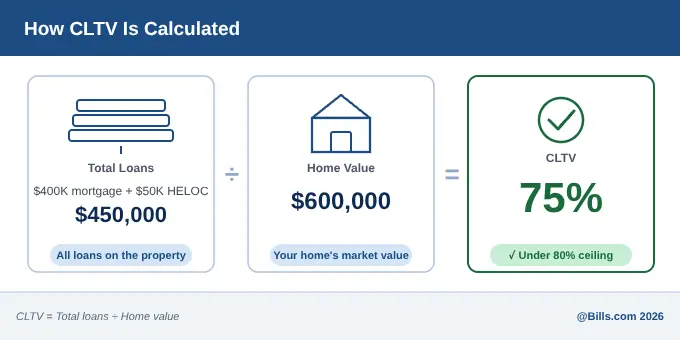
As a rough guide, most lenders want you to maintain at least 20% equity, how much of your home you own outright. Lenders might say they want to see a combined loan-to-value ratio (CLTV) of 80% or less. CLTV is the total of all loans on your home divided by its value.
Say your home is worth $600,000. You owe $400,000 on your mortgage, and you want a $50,000 HELOC. Your CLTV would be 75%.
400,000 + 50,000 = 450,000
450,000 / 600,000 = 0.75 (or 75%)
Many lenders would green flag that.
Some California lenders go to 85% or even 90% CLTV, letting you take out HELOCs with less equity. The catch: The lender will probably charge you a higher interest rate.
Debt-to-income ratio (DTI)
A debt-to-income ratio of 43% or lower is a common benchmark. If you earn $8,000 a month and carry $3,000 in monthly debt payments, your DTI is 37.5%, comfortable for most lenders.
Income documentation
Most lenders require standard income docs: tax returns, W-2s/1099s, pay stubs.
Appraisal
Lenders often ask for a formal appraisal to confirm your home's value. Some use automated valuation models (AVMs) that require no work on your part and take minutes to complete. Lenders are more likely to offer AVMs when you have lots of equity in your home.
One California-specific requirement: community property
California is a community property state. Under California law, both spouses must join in executing any instrument that encumbers community real property. What exactly does that mean? That if you're married, your spouse will typically need to sign certain documents, even if they're not a co-borrower. This is a California legal requirement, not just a lender preference.
What are current HELOC rates in California?
Most HELOCs use the Prime Rate as their index. In the spring of 2026, the Bank Prime Loan Rate was 6.75%. Your lender adds a fixed margin on top of that. Your rate will be the prime rate plus the lender’s margin. The margin varies by lender, how good your credit is, and how much home equity you have. For example, your lender might approve you for 9.75%, which in this example would be prime plus 3%.
HELOCs usually have a variable interest rate, so payments may change from month to month. Exceptions are rare fixed-rate HELOCs, which offer predictable monthly payments.
Two HELOC phases, the draw and repayment periods, impact your monthly payments:
The draw period
Typically lasts 10 years. During this phase, you can borrow from your line as needed. You typically pay for interest only. Your balance and your payment can shift each month as rates change.
The repayment period
Often runs 10 to 20 years. Once the draw period ends, you can no longer borrow. Payments increase significantly because you're now paying both principal and interest.
Fixed-rate options
Some lenders let you convert part of your variable balance to a fixed rate, or offer a fixed-rate HELOC from the start. The fixed rate is typically higher, but it gives you predictable payments.
Rates change frequently. For the best deal, get quotes from three to five lenders. The gap between the highest and lowest HELOC rate could be 7% or more.
What makes California HELOCs unique?
Borrowing power, legal protections, and tax rules all look a little different in California.
Bigger line sizes
California residents averaged HELOC lines of about $200,000 in 2024, well above what's typical in most other states. Why: lots of home equity and higher-than-average home prices. Your particular credit limit depends on your home's value, your mortgage balance, and your lender's CLTV limits.
The Home Equity Loan Disclosure Act (HELDA)
California requires lenders to give you a specific written warning at application: that the loan is secured by your home. Failure to repay, for any reason, could cause you to lose your home. This is a state requirement on top of federal disclosures. Before you sign anything, California law requires your lender to put the stakes in writing. Might be worth a read.
Proposition 13 and your property taxes
Taking out a HELOC does not trigger a property tax reassessment under Proposition 13. Borrowing against your equity is neither a change of ownership nor new construction. Your existing assessed value stays intact, therefore, your property taxes don’t change.
One nuance: if you use HELOC funds for new construction, that addition may be assessed separately at current market value. This includes adding a room, building a pool, or constructing an ADU. The HELOC doesn't trigger reassessment. What you build with the money might.
California's homestead exemption
California law protects a portion of your home equity from certain creditors, up to:
- The countywide median home sale price, capped at $722,151, or
- A minimum of $361,113, whichever is greater.
This amount adjusts annually for inflation. The numbers above are accurate as of January 2025.
The homestead exemption matters because it could protect you from needing to sell your home during bankruptcy proceedings or when a creditor sues you in court and wins.
This protection does not apply to your HELOC lender. If you stop making payments, your lender can foreclose. The homestead exemption shields you from some creditors, but not from the lender who holds a lien on your home.
How do you find a HELOC lender in California?
Banks, credit unions, and online lenders offer HELOCs in California.
Credit unions
Credit unions are highly active in California and often offer competitive rates, lower fees, and more flexible underwriting than banks. Some California credit unions offer HELOCs with no annual fee.
Banks
Banks may offer relationship discounts if you already hold accounts there. Larger banks tend to have established HELOC programs with clear processes.
Online lenders
Online lenders may offer faster processing and a streamlined application. Compare APR carefully. Headline rates don’t always include fees. Interest rates change, but fees remain.
What to compare when shopping HELOC lenders in California
- APR: Not just the introductory rate. Ask what the rate becomes after any promotional period.
- Draw period length: Typically 10 years.
- Repayment term: Often 10-20 years. Longer terms mean lower monthly payments but more interest paid.
- Upfront fees: Ask about application fees, appraisal costs, and closing costs. Some lenders advertise no-closing-cost HELOCs, but costs may be rolled into the rate.
- Annual fees: Some lenders charge $50 to $100 per year. Some lenders waive this.
- Early-termination fees: Some lenders charge a fee if you close the line within two to three years.
- Minimum draw requirements: Some lenders require you to draw a minimum amount at closing or keep a minimum balance.
- Fixed-rate option: Some lenders offer a fixed-rate HELOC from the start. Others let you convert part of your variable balance to a fixed rate later. The fixed rate is typically higher, but payments become predictable. Ask which option the lender offers.
The best choice depends on your goals, your credit profile, and your situation.
Bills Action Plan
- Estimate your equity. Subtract your current mortgage balance from your home's estimated market value. If you'd maintain at least 20% equity after the HELOC, you may meet the basic threshold many lenders use.
- Pull your credit report. Review it at AnnualCreditReport.com before applying. Errors happen. Incorrect information can affect your rate or eligibility. Dispute anything that looks wrong.
- Get quotes from at least three lenders, including at least one California credit union. Compare APR, draw period, repayment term, and fees. If you're married, ask each lender about their community property signature requirements upfront. No surprises at closing.
Key terms
CLTV: Combined loan-to-value. All loans on your property divided by its value. Most lenders use a rough cap of 80–85% CLTV.
DTI: Debt-to-income ratio. Your total monthly debt payments divided by your gross monthly income. A ratio of 43% is a common HELOC benchmark.
Draw period: The phase (typically 10 years) when you can borrow from the line. Payments are often interest-only.
HELDA: California's Home Equity Loan Disclosure Act. Requires lenders to warn you that your loan is secured by your home, and if you fail to pay, you could lose your home.
HELOC: Home equity line of credit. A revolving credit line secured by your home's equity.
Homestead exemption: California protection that shields a portion of home equity from certain creditors. Does not protect from your HELOC lender.
Index: The benchmark rate a variable HELOC tracks. Most use the Prime Rate.
Margin: The lender's fixed markup added to the index. Your rate = index + margin.
Repayment period: The phase (often 10-20 years) when draws stop and you repay principal and interest. Monthly payments increase significantly.
How much would a $50,000 HELOC cost per month in California?

Your monthly payment depends on the current interest rate and whether you're in the draw period or repayment period. During the draw period (typically 10 years), many HELOCs require interest-only payments. At 7.5%, a $50,000 balance could cost roughly $313 per month in interest only. Once the repayment period begins, payments increase substantially, as you're now paying both principal and interest on whatever remains.
Is HELOC interest tax deductible in California?
HELOC interest may be tax deductible if the funds were used to buy, build, or substantially improve the home that secures the loan. Interest on funds used for other purposes, like debt consolidation or a car purchase, is generally not deductible. Talk to a tax advisor for guidance specific to your situation.
Does a HELOC affect property taxes in California?
Taking out a HELOC does not trigger a property tax reassessment under Proposition 13. Borrowing against your equity is not a change of ownership or new construction. Your assessed value stays the same. However, if you use HELOC funds to build something new like a pool, that improvement may be assessed separately at current market value, affecting property taxes. For guidance on a specific project, consult a tax advisor.