

What Is a HELOC? Home Equity Line of Credit Explained




Bills Bottom Line
A HELOC lets you tap your home’s equity as a flexible line of credit. You borrow what you need, when you need it, and only pay interest on what you use. Check out how the draw and repayment periods work, and what’s at stake: your home is the collateral.
Table of Contents
Your neighbors are talking about a “HELOC,” but no explanation is forthcoming. What is a HELOC? Why is it such a big deal? It sounds technical, and possibly expensive.
At its core, a HELOC, a home equity line of credit, is a way to borrow against your home. That’s it.
Here’s what this article covers: what a HELOC actually is, how the two borrowing phases work, what people typically use it for, and the one risk worth knowing before you go any further.
HELOC: a simple explanation
A HELOC, or home equity line of credit, is a reusable line of credit secured by your home. Lenders cap your borrowing limit based on your home’s equity, and you only borrow what you need. During the draw period, you can borrow, repay, and borrow again, up to your limit.
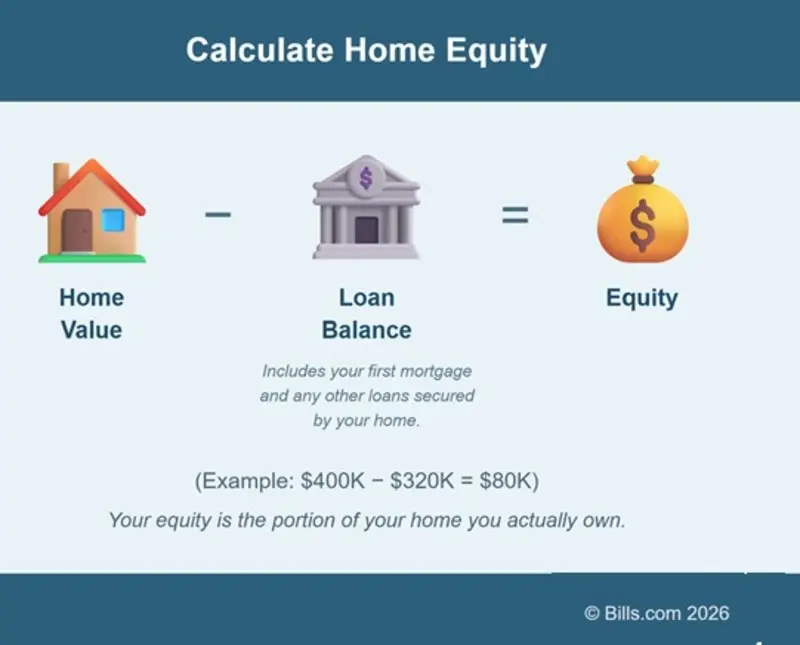
What equity means: Your home equity is the difference between what your home is worth and what you still owe on your mortgage. If your home is worth $400,000 and your mortgage balance is $320,000, you have $80,000 in equity. A HELOC lets you access part of that value as a line of credit.
Think of it like a credit card. You’re approved for a limit, you use what you need, you pay it back, and that credit becomes available again. How a HELOC works is similar. But there's one key difference. A credit card is unsecured debt. A HELOC uses your home as collateral. If you default, your lender could foreclose.
FYI, some lenders also call it a HELOC loan or home equity line. Same product, different names.
How a HELOC works: draw period and repayment period
A HELOC has two distinct phases. Most people only think about the first one.
The draw period is when you can actually borrow. It typically lasts 5–10 years. During this time, you can pull funds as needed, up to your approved limit. Payments during the draw period are often interest-only. You’re paying only on what you’ve borrowed, not the full credit line.
The repayment period starts when the draw period ends. You can no longer borrow. Now you’re paying back both the principal—the amount you originally borrowed—and interest, typically over 10–20 years.
| Draw Period | Repayment Period | |
|---|---|---|
| Duration | Typically 5–10 years | Typically 10–20 years |
| What you can do | Borrow, repay, and borrow again up to your limit | No new borrowing—repay only |
| Payment type | Interest-only payments typical | Principal + interest, or a single large payment |
Say you’re approved for a $60,000 HELOC and you draw $20,000 for a kitchen remodel. During the draw period, you’re only paying interest on that $20,000. As you pay down the $20,000, that credit becomes available again. When the draw period ends, you repay whatever balance remains, plus interest, over the repayment period.
One more thing to know: HELOC rates are typically variable, meaning they’re tied to a benchmark rate (like the prime rate) and can rise or fall over time. That affects your payments. For more on how HELOC rates change, see How Do HELOC Interest Rates Change?.
What is a HELOC used for?
A HELOC tends to work well for expenses that unfold over time because it’s flexible. Home improvements are the most common use, and often the most financially sound, since you’re reinvesting in the asset securing the loan.
Beyond renovations, people use HELOCs for debt consolidation (paying off higher-interest balances with a lower-rate credit line) and large ongoing expenses like education, medical bills, or major repairs. The flexibility to draw only what you need, when you need it, is the key advantage over a lump-sum loan. Also, rates tend to be better than what you'd see on a personal loan. Your commitment is secured by your house, so lenders might give better rates.
One note on taxes: HELOC interest may be tax deductible in some cases. For example, if the funds are used to buy, build, or substantially improve the home you borrowed against Other uses, like debt consolidation, usually don’t qualify. What counts as tax deductible can be a little blurry. You may want to talk to a tax advisor for your specific situation.
The risk you need to know
Your home is the collateral on a HELOC. If you can’t repay, the lender could foreclose.
That’s not a reason to avoid HELOCs entirely—it’s a reason to use one carefully. A HELOC is a secured debt, which means it’s much riskier than a credit card or personal loan. Missing payments on a credit card hurts your credit. Missing payments on a HELOC could cost you your home.
HELOC vs. home equity loan: the short version
A HELOC is a revolving credit line. You borrow what you need, when you need it, and only pay interest on what you use. A home equity loan is installment credit. It gives you a lump sum upfront, with fixed monthly payments from day one.
For most people, the right choice comes down to whether your need for cash is ongoing (HELOC) or one-time (home equity loan). For a full side-by-side breakdown, see HELOC vs. home equity loan.
Bills Action Plan
Step 1: Check how much you owe on your home. Find your current mortgage balance on your monthly statement. Use the HELOC calculator to get a rough sense of how much you may be able to borrow. Keep in mind that lenders set their own requirements, and borrowing limits vary.
Step 2: See if you may be eligible. Beyond equity, lenders typically evaluate your credit score, debt-to-income ratio, and income stability. Different lenders, different requirements—you won’t know your eligibility until you apply.
Step 3: Compare lenders before applying. Rates, draw periods, fees, and repayment terms change meaningfully from lender to lender. Compare three to five lenders to get the best deal. Prequalification doesn’t impact your credit score at all.