

How to Get a Small Personal Loan




Bills Bottom Line
If you need a few hundred dollars rather than a few thousand, your options narrow. Many national lenders set minimums in the low thousands. You still have options. Banks, credit unions, and online lenders may offer loans as small as $100. Prequalify before you apply, since doing so usually doesn't affect your credit score.
Table of Contents
You needed $700 for a car repair. The first lender's page said its minimum started well above that, so you closed the tab and assumed the answer was no.
Lender minimums vary more than most people expect. Small personal loans less than $500 exist, though not all lenders will offer them. The problem isn’t your credit score, necessarily. Oftentimes, lenders are simply unwilling to lend below a specific dollar amount. Others require an existing relationship.
We’ll outline how to get a personal loan in five steps. Different lenders serve different ends of the personal loan market. Some are more than happy to offer short-term loans.
What counts as a small personal loan
There's no official cutoff for what qualifies as a small personal loan. It usually means a few hundred to a couple of thousand dollars, below where many national lenders start. In general, personal loan amounts range from several hundred to tens of thousands of dollars. Some lenders may offer more.
Small personal loans can be unsecured or secured. Most personal loans are unsecured, meaning you don’t have to put anything up as collateral. Secured loans are different. You must put up collateral, like a car. Lenders offer secured loans to borrowers who want better rates and easier approvals, and are willing to offer collateral that the lender can take if the borrower defaults.
Small personal loan vs payday loan
A small personal loan is a different product from a payday loan. The difference is cost. A payday loan is short-term, high-interest, and due on your next payday. When you borrow $100 with a $15 fee due in two weeks, that works out to a 391% APR. To put that in context, most credit cards max out at 36%, which is considered high. A small personal loan has a longer payoff: You typically repay it over months or years. Your APR is also likely to be much lower than a payday loan.
What credit score you need for a small personal loan
Lenders check your credit; they may set a minimum credit score. FICO Scores run from 300 to 850 and fall into five ranges: Poor is 579 or lower, Fair is 580 to 669, Good is 670 to 739, Very Good is 740 to 799, and Exceptional is 800 or higher. Lenders generally treat scores of 619 or lower as higher risk.
Unfortunately, many lenders do not tell you whether they have a minimum credit score. This means prequalification is the best way to understand whether you’re likely to qualify for a loan. Unlike a full loan application, prequalification usually doesn’t damage your credit. However, there are exceptions. Some lenders won’t give you a personalized rate without a full application, and that could ding your score. It’s a good idea to check your lender’s website or call a representative to confirm.
Your credit score isn't the whole picture. Lenders also weigh your credit history, annual income, and employment status. Your debt-to-income (DTI) ratio counts, too. DTI is the share of your monthly income that already goes to debt payments. The smaller portion of your income you put toward debt payments, the better your DTI ratio, and the more likely you are to qualify for a small personal loan.
A smaller loan doesn't mean looser standards. Rates depend heavily on your credit profile. If you would like to be approved for more loans and better rates than you’re getting now, it may be prudent to improve your credit score first. You might do so by making timely payments, among other things.
How to get a small personal loan in five steps
Start with your credit report and end with the documents you need to fill out the application.
- Check your credit reports for errors you can correct. AnnualCreditReport.com is the only federally authorized source for free credit reports; you can request one from each bureau every week. You can check your own report without any damage to your credit scores. Check for accounts you don't recognize and balances that look wrong. You can send requests for corrections online. Doing so may improve your credit score, making it easier to qualify for good loans.
- Decide on your loan size before you shop. Write down the exact figure you need. Be conservative. Since bigger loans cost you more interest, it’s best to apply for the smallest loan possible that meets your needs. You don’t want a $700 problem to turn into a $2,000 loan.
- Prequalify with lenders. When you prequalify for a personal loan, the lender usually does a soft credit inquiry. A soft inquiry doesn't affect your credit score. Before you enter your details, ask each lender whether its prequalification affects your credit score. Note: prequalification isn't a guarantee of final approval. It’s just an estimate.
- Compare loan APRs, not the monthly payment. Cheaper monthly payments could cost you more over the long term. A longer term lowers the monthly payment and increases what you pay in interest overall. APR is useful because it includes interest rate and fees, such as origination fees.
- Apply with your documents ready. Lenders might ask for a government ID, proof of address, and proof of income, such as recent pay stubs. A full application is the last step because a formal application triggers a hard credit inquiry, which could knock a few points off your credit score.
Once you accept an offer, the lender disburses money into your designated account. Funding times vary by lender. Money often arrives within a week of approval. Some online lenders get you the money within 24 hours of approval. If you need the money right away, it’s best to check with a lender before applying.
Where to get a small personal loan
Banks, credit unions, and online lenders sometimes offer small personal loans.
| Lender Type | Rate Ceiling | Typical Term | What it asks of you |
|---|---|---|---|
| Banks and national online lenders | None set by law | Two to seven years | Application and credit check |
| Credit unions and community banks | 18% | Two to seven years | Credit union membership, application, and credit check |
| Payday alternative loans | 28% | One to six months for the smaller PAL, up to 12 months for the larger | Credit union membership of at least one month, application, and credit check |
Credit unions have a rate ceiling that banks don't. Federal credit unions can't charge more than 18% on most personal loans. This 18% cap is scheduled through at least September 10, 2027 and could change after that
Federal credit unions can also offer payday alternative loans (PALs). These are designed to be cheaper than typical payday loans. The smaller version runs from $200 to $1,000 over one to six months and requires that you’ve been a member for at least one month. A larger version of the loan goes up to $2,000 over one to 12 months, available as soon as you join. Both cap the application fee at $20 and the rate at 28%.
A payday alternative loan costs more than an ordinary credit union loan, 28% vs 18%, and asks less of you to get one. It’s probably cheaper than a payday loan if you qualify.
What a small personal loan actually costs
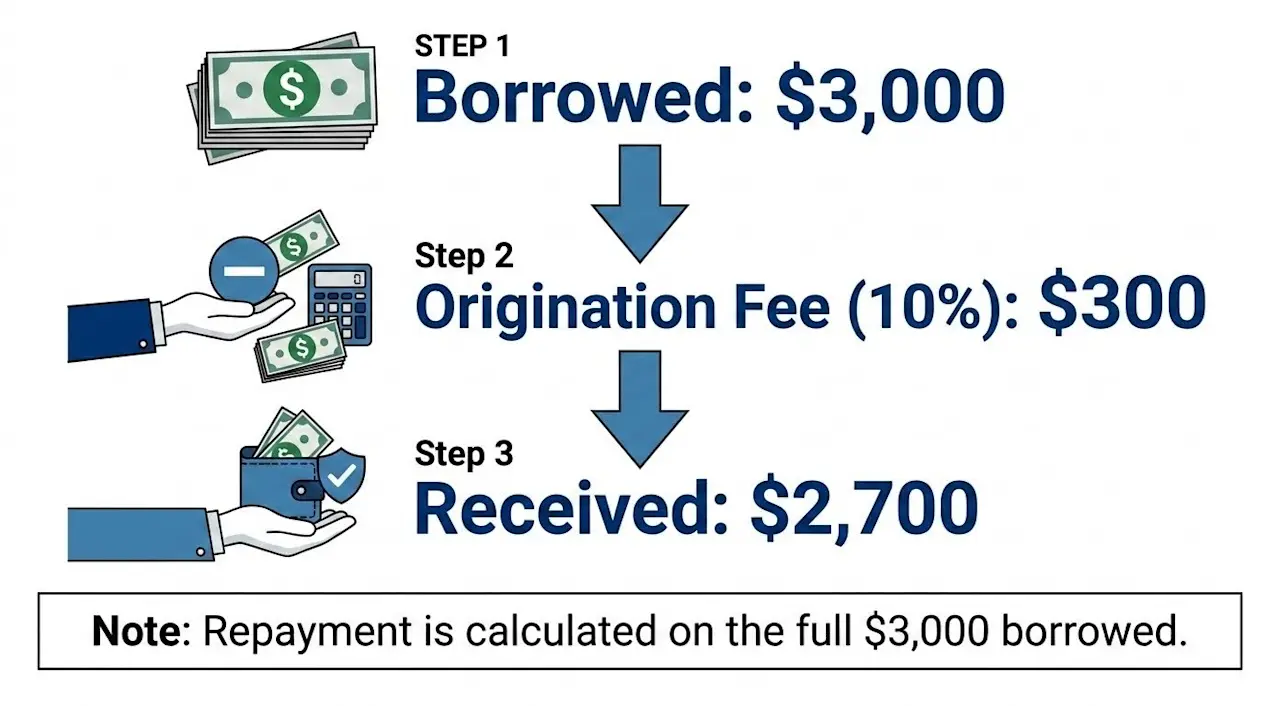
Personal loan origination fees range from 0% to 12% of the loan amount. When charged, the fee is deducted from disbursement, the money sent to your account.
For example, on a $3,000 loan with a 10% origination fee, $300 comes off the top. You receive $2,700. You repay the full $3,000 with interest. It’s worth knowing about an origination fee because it eats into what money lands in your account. If you need $3,000 but your lender charges an origination fee, you may need to borrow more than $3,000 to cover your bills.
Personal loan terms typically run two to seven years, though some lenders offer shorter or longer. Relative to a shorter loan, a longer loan term raises total interest costs.
The National Consumer Law Center (NCLC) recommends a 36% APR ceiling, including all fees, as the benchmark for affordable lending. Federal law sets the same cap for active-duty service members.
Is a small personal loan a good idea?
If you need money for something that can't wait and you can afford the payment, a small personal loan is a reasonable tool.
Before you borrow, work through the options:
- Ask your bank or credit union (even if you’re not a member yet) what it offers
- Ask your current lenders if they offer hardship programs that make payments easier for a bit.
- Ask your employer about an advance on your pay.
- Contact your state or local government about emergency assistance programs.
- Reach out to a service relief society if you're active duty military.
If it’s feasible for you to borrow from a family member, you might save quite a bit on fees.
Bills Action Plan
- Pull your credit reports free at AnnualCreditReport.com, then write down the exact amount you need. Be precise.
- Prequalify with two or three lenders, including at least one credit union. Ask whether each lets you check your options without damaging your credit score.
- Compare offers. Check the offered APRs and origination fees in particular. If nothing comes in at or under 36%, consider alternatives like PALs.
Key Terms
APR (annual percentage rate): The total yearly cost of borrowing, including interest plus most lender fees. Compare offers on this instead of the interest rate alone. APR factors in the cost of fees.
Origination fee: A setup fee some lenders charge. It comes out before the money reaches you, so you receive less than you borrowed. Even though it's taken out of what you receive upfront, the origination fee is included as part of what you borrow.
Prequalification: A quick check showing what a lender might offer. It isn't a guarantee of final approval. Prequalifying usually doesn’t damage your credit score, but it can. Ask your lender first.
Soft credit inquiry: A look at your credit that doesn't affect your score. Checking your own report triggers one. Prequalifying usually triggers one, too.
Hard credit inquiry: A look at your credit that does affect your score. Lenders run one when you apply for a small personal loan.
Unsecured loan: A loan that isn't tied to anything you own. Most personal loans are unsecured. Secured options put something of yours on the line, like a car, furniture, or money in a bank account.
Payday alternative loan (PAL): A small loan from a federal credit union, priced below a payday loan. Amounts start at $200. Federal regulation caps the rate below what payday lenders usually charge.
For general education only. Not financial advice. All loans are subject to credit approval. Rates, terms, and amounts vary by lender and by state.
What's the smallest personal loan you can get?

Federal credit unions lend as little as $200 through payday alternative loans, the practical floor for most borrowers. Banks and online lenders usually start in the low thousands, though exceptions exist. Ask your current banking institutions whether they offer small loans—some offer small personal loans to customers they have relationships with. Learn more about what a personal loan is and how it works.
Does applying for a small personal loan hurt your credit?
A formal application triggers a hard credit inquiry, which does affect your credit score. Prequalifying works differently. Prequalification usually uses a soft inquiry, and a soft inquiry doesn't affect your score, which is helpful if you want to compare offers before you commit. Learn how applying affects your credit score.
Can you get a small personal loan with bad credit?
Some lenders work with borrowers who have lower credit scores, and a credit union is often the best place to start. Rates vary with your credit profile, so compare more than one offer. Learn more about applying for personal loans with bad credit.