
What Is the 50/30/20 Rule and How Does It Work?

Bills Bottom Line
The 50/30/20 rule splits your take-home pay three ways: 50% for needs, 30% for wants, and 20% for savings goals. Required minimum debt payments count as needs. Anything you pay above the minimum comes out of the 20% share.
Table of Contents
- What is the 50/30/20 rule?
- Who came up with the 50/30/20 rule?
- Needs vs. wants in the 50/30/20 rule
- How to manage money with the 50/30/20 rule
- 50/30/20 budget example
- Using the 50/30/20 rule while paying down debt
- When might the 50/30/20 rule not be the best strategy?
- Pros of the 50/30/20 rule
- Bills Action Plan
- Key Terms
You've heard the 50/30/20 rule is a simple way to budget. But can it work for your paycheck once rent, bills, and a credit card payment or two come out?
The 50/30/20 method is easy to learn, and you can adjust it to fit your life. It sorts your spending into needs, wants, and savings, and gives each group a share of your take-home pay.
Paying off debt? There's a simple way to fit those payments in, too.
What is the 50/30/20 rule?
The 50/30/20 rule is a budgeting rule of thumb that puts 50% of your take-home pay toward needs, 30% toward wants, and 20% toward savings goals. Take-home pay is what's left in your paycheck after taxes and other deductions, so taxes don't count toward any of the three shares. However, if you have payroll deductions into savings, like a 401(k), you may be able to direct more money toward wants and needs because you’re already covering some of your savings goals with the deduction.
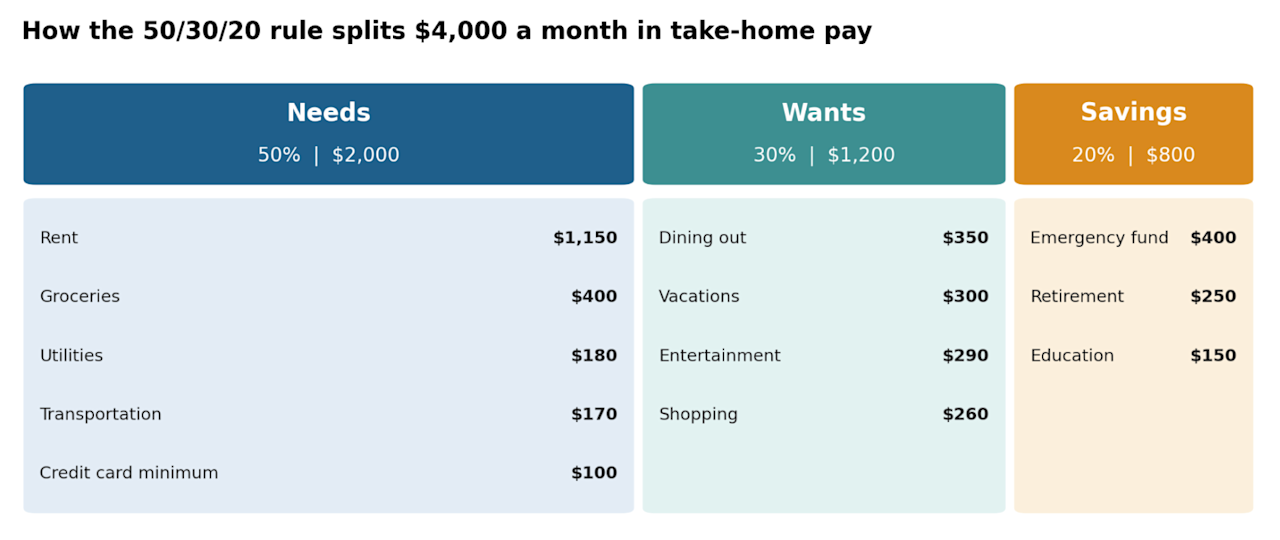
Here’s an example: If you take home $4,000 a month, that's $2,000 for needs, $1,200 for wants, and $800 for savings.
The rule is one approach to budgeting, and you can adjust the three numbers to fit your pay.
The needs share
The needs share covers what you must pay to live, earn an income, and protect what you have. These costs include rent or mortgage, groceries, utilities, basic transportation, medical costs, insurance, necessary clothing, and child care. List these costs first when you sort your spending.
The wants share
The wants share covers spending you'd enjoy but could live without, such as dining out, entertainment, vacations, and specialty coffee. Upgrades to needs, like collector cars, designer duds and fancy food also count as wants.
The savings share
The savings share pays for future goals: an emergency fund, retirement, education, or a large purchase. Debt payments above your required minimums come out of it too. An emergency fund for surprises like car repairs or medical bills, can keep those costs off a credit card or loan.
Who came up with the 50/30/20 rule?
Elizabeth Warren and Amelia Warren Tyagi, a mother-and-daughter team, popularized the 50/30/20 rule in their 2005 book, All Your Worth. It divides money into three parts: Must-Haves, Wants, and Savings. The book's Must-Haves are the bills you have to pay every month, a handy test for spotting a need.
Needs vs. wants in the 50/30/20 rule
Ask what the expense is for. If you need it to live, to earn your income, or to protect your money and property, it's a need. If it's an upgrade, or nice to have without being necessary for any of those, it's a want.
Food can fall on both sides: groceries are a need, while dining out is a want.
Emergency savings passes the need test, since it protects your money. In this rule, it usually goes in savings.
Two people can sort the same expenses differently. Pick a side for each gray-area expense and see how it works. You can always change your mind and demote a need to a want or promote a want to a need..
How to manage money with the 50/30/20 rule
Set up a 50/30/20 budget in five steps:
- Find your monthly take-home pay. Use the amount on your pay stubs after taxes and deductions, not your pay before them. Add other regular money you get, such as child support. If some months bring no paycheck, add up last year's take-home pay and divide by 12.
- Work out the three amounts. Multiply your take-home pay by 0.50 for needs, 0.30 for wants, and 0.20 for savings.
- List what you spend now. Go through the last 30 to 60 days of bank and credit card statements, including housing, food, transportation, subscriptions, and debt payments. A personal budget worksheet can help you keep it all in one place.
- Sort and total each share. Put each expense under needs, wants, or savings, add up each group, and divide each total by your take-home pay. Compare the results with 50%, 30%, and 20%.
- Adjust where you're off. Pick two or three categories to trim, such as unused subscriptions, groceries, or shopping. Check in weekly or monthly, and update the plan when your personal finance picture changes, such as a new job, a move, or a new loan.
A share that comes in over its target shows you where to look first.
50/30/20 budget example
Here's how a household that takes home $4,000 a month might split its spending.
If you have an expense that isn't listed, ask whether you need it to live, earn an income, or protect what you have. If not, it's a want.
| Share | Amount | Sample expenses |
|---|---|---|
| Needs (50%) | $2,000 | Rent $1,150, groceries $400, utilities $180, transportation $170, credit card minimum payment $100 |
| Wants (30%) | $1,200 | Dining out $350, vacations $300, entertainment $290, shopping $260 |
| Savings (20%) | $800 | Emergency fund $400, retirement $250, education $150 |
The $100 credit card minimum is a need because you have to pay it each month. Each share adds up to its target, so the whole $4,000 has a job.
Using the 50/30/20 rule while paying down debt
Fit debt into the 50/30/20 rule by splitting each payment in two. The required minimum is a need, and anything extra comes out of the 20% share. Not sure which debt to pay off first? Compare a few ways to get out of debt.
Where your debt payments go
Required minimum payments: needs (50%)
Payments above the minimum: savings and debt payoff (20%)
Where minimum payments go
Count the required minimum on each debt as a need, like any other bill you have to pay. A minimum payment is the least you must pay each month on a loan, credit line, or other debt. If you miss the due date, your credit card issuer or auto lender will generally charge a late fee.
Where extra debt payments go
Money you pay above the minimum comes out of the 20% share, alongside savings. With the split unchanged, each extra dollar sent to debt is a dollar you don't save that month.
Say the same $4,000 household sends $200 extra toward paying down credit cards each month. Its $800 share becomes $600 for savings and $200 for debt.
To keep saving $800, the household could move $200 from wants into that share, for a 50/25/25 split: $2,000 for needs, $1,000 for wants, and $1,000 for savings and debt.
When might the 50/30/20 rule not be the best strategy?
The 50/30/20 rule doesn't fit every budget. If you live where housing is expensive, you may need to spend more of your pay on housing. In a Consumer Financial Protection Bureau sample budget, a family of four takes home $5,271 a month. The family's housing, food, utilities, transportation, insurance, and child care cost $4,230, about 80% of that pay.
What if your needs take more than half your income?
That's common, especially where housing is expensive, and you have options. You can cut costs, raise income, or change the split.
- Cut costs. Shop around for insurance, replace your car less often, and weigh whether a more modest home would bring needs closer to half. For more ideas, try these money-saving tips.
- Raise income. Options include overtime, a second job, renting out a room, or, if you usually get a large tax refund, using Form W-4 to lower the tax taken out of each paycheck.
- Change the split. Set your own cap on wants, as a dollar amount or a share of take-home pay.
Start with the one you can act on this month.
Alternatives to the 50/30/20 rule
If three fixed shares don't suit you, try one of these:
- Zero-based budget. Give every dollar you earn a job: spending, saving, or paying bills.
- Pay yourself first. If you get a regular paycheck, move part of it to savings automatically at the start of each pay period, for emergency savings, retirement, or other goals.
- Cash budget. If you tend to overspend in a category like groceries, set aside cash for it and stop spending there when the cash runs out.
You can also mix methods.
Pros of the 50/30/20 rule
The 50/30/20 rule's biggest strength is its simplicity. Here's what it gives you:
- Easy recall. Three numbers can be easy to learn and remember when you need them.
- A quick benchmark. Divide each share's total by your take-home pay, and you see right away which share is over or under.
- Room for wants, with a limit. Wants get up to 30%, so the budget leaves space for fun and caps it.
- Savings in the plan. The split sets money aside for future goals while still covering your needs and wants.
Bills Action Plan
- Work out your three amounts. Multiply this month's take-home pay by 0.50, 0.30, and 0.20. Or plug it into a budget calculator.
- Sort last month's spending. Put each expense on last month's bank and credit card statements in needs, wants, or savings, and total each group. Mark the share that runs over its target.
- Place your debt payments and set your shares. Put each required minimum in needs and any extra payment in the 20% share. Then pick your split: 50/30/20 or your own.
Key Terms
Take-home pay: Your pay after taxes and other deductions, also called net income.
Needs: Costs you must pay to live, work, and protect what you have.
Wants: Things you'd enjoy but could live without.
Minimum payment: The least you must pay each month on a loan, credit line, or other debt.
Emergency fund: Cash set aside for surprises like car repairs or medical bills.
Free up cash each month with Freedom Debt Relief

Ozzy S., Freedom client
“Right away, I had more money each month because of program costs so much less than what I was paying on my minimums.”

Actual client of Freedom Debt Relief. Client’s endorsement is a paid testimonial. Individual results are not typical and will vary.
What is the 50/30/20 rule for savings?

The 50/30/20 rule sets aside 20% of your take-home pay for savings goals, such as an emergency fund, retirement, and education. Payments above your debt minimums also come out of that 20%. On $4,000 a month, the savings share is $800.
What are the best savings strategies?
Automatic saving is an easy way to save consistently, particularly if your paycheck is steady. Set up a recurring transfer from checking to savings, or, if your employer allows it, split your direct deposit between the two accounts. Keep an eye on your checking balance so a transfer doesn't trigger an overdraft fee. If your income is irregular, save all or part of one-time money, such as a tax refund, to build an emergency fund quickly.