

Borrow for the Dental Quote or for What She Can’t See Yet


Bills Bottom Line
When a cost arrives in stages and the final total stays hidden until you’re partway in, what’s the safer way to borrow? A fixed loan locks one amount at one rate, with a payment that never moves, though it makes you name the number before you know it. A line of credit charges interest only on what you draw, as you draw it, but the rate could climb while you’re still spending. Is it riskier to commit too early, or to leave it open?
The treatment plan runs two pages, and Nadia has read the second one until she could recite it. Extractions, two implants, crowns: $9,200, spread across eight months of appointments she’s spent two years not making. That number she’d finally made peace with.
It was the surgeon’s other sentence that took the peace back. Until he’s in there, after the extractions, he can’t tell whether the bone will hold the implants. If it won’t, she needs grafts. Another $7,500. He said it kindly, the way you mention the sky might open up later.
She’s 38 and careful with money, the kind of careful that reconciles a bank app on Sunday nights. She rents, so there’s no house to borrow against, no quiet equity to lean on. She has about $6,000 saved, but that money is the only thing standing between her and a bad month, and she doesn’t want to spend her cushion.
The dental office had pushed its own financing: a medical credit card, zero percent if she cleared the balance within 18 months. She’d read the back of the brochure twice. Miss that window, even by a day, and the interest gets added, all the way back to day one, the whole deferred amount at once.
She wasn’t going to bet her teeth on finishing a year of uncertain treatment exactly on schedule. So it comes down to borrowing, and to a question she didn’t expect to find hard: not whether she can, but how.
Her credit union sent back two offers, and they don’t resemble each other.
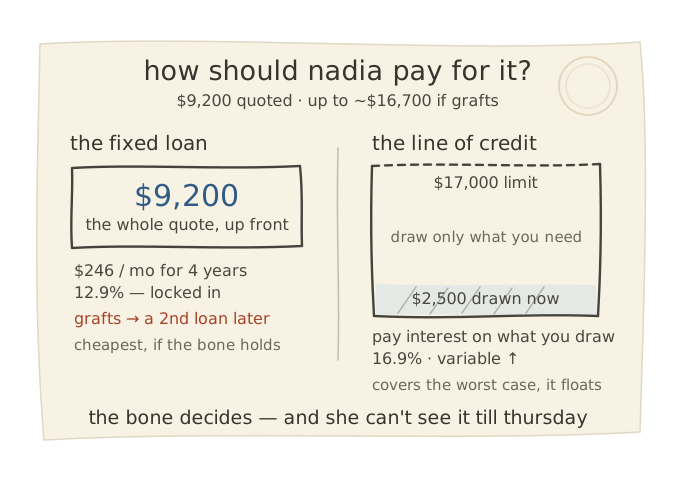
The first is a one-time, fixed-rate personal loan: $9,200 at 12.9%, four years, $246 a month. It covers the plan to the dollar.
Nadia likes the way it sits still. She can see every one of the 48 payments from here, identical, marching toward a last payment she could circle on a calendar. It’s the kind of borrowing that feels like her: bounded, named, finished.
The loan stops at $9,200.
If the bone is bad, the grafts start at another $7,500, and a loan doesn’t stretch to meet a number it was never told.
That’s the catch. The loan is $9,200 because the plan says $9,200. But the plan is a guess.
If the bone won’t hold, she’ll be calling the credit union for a second loan in about the worst week to make such a call: jaw packed with gauze, healing, asking for money she hadn’t known she’d need, at whatever rate the market hands her that morning. Not impossible. Just potentially expensive, and badly timed, and out of her hands.
The second offer is a line of credit: $17,000, draw what she needs, pay interest only on what she’s drawn.
It’s shaped for the exact thing she’s afraid of. If the grafts come, the money is already sitting there: no second call, no fresh application, no waiting on a yes while her face is numb.
Draw $2,500, owe interest on $2,500.
The line bills her for the chair she’s sitting in, not the ones she may never sit in.
But the rate on the line won’t hold still: 16.9%, variable, a full four points over the loan, riding a benchmark that has climbed before.
And grafts don’t only add money, they add time. Bone has to knit before an implant can anchor, which stretches the whole job toward a year. A year is a long while to carry a rate that can rise while she isn’t watching.
So here’s what she keeps circling. If the bone is fine, the loan was right and the line was an expensive worry she paid for and never used. If the bone is bad, the line was quietly brilliant and the cheap loan becomes a scramble at the worst possible moment.
The choice depends on a fact still hidden under a tooth that hasn’t come out, and won’t, until Thursday.
The first extraction is Thursday. The credit union won’t release a cent until she names which offer she wants, and the surgeon won’t lift an instrument without a deposit.
It’s Sunday night. Both offers are open on the laptop, the steady $246 on one side, the $17,000 ceiling on the other. Beside them, a legal pad where she’s built the same two columns four times and scratched them out four times.
Everything turns on one fact she can’t have until she’s already in the chair, already cut, the money already moving. She uncaps the pen and starts the columns a fifth time.
Bills Takeaways
Nadia isn’t choosing between a good option and a bad one. She’s choosing which uncertainty she can stand to carry, and the gap between a fixed loan and a line of credit is really the gap between two kinds of not-knowing.
A one-time loan turns a known cost into a known payment, but it has to be told the cost first. When the price is settled, the locked rate and the steady payment are the whole appeal. When the price might still grow, naming a figure means either borrowing high for room you may never use, or borrowing right and having no plan if the number climbs.
A line of credit is built for the cost that hasn’t arrived. Paying interest only on what’s drawn is its real strength when spending comes in stages, because nothing is owed on money still sitting untouched. The price of that flexibility is often a variable rate that can rise over a long stretch, turning an open balance into a moving target.
Which one fits comes down to how settled the number really is. A firm, one-time price rarely needs an open line; a staged or uncertain one is where a line earns its premium. The same question, how knowable the cost is, sorts most of the other personal loan types too.
Key Terms
Personal line of credit: Revolving credit you can draw from up to a set limit, paying interest only on the amount you’ve actually used.
Variable rate: An interest rate that can rise or fall over time with a benchmark, so the cost of what you’ve borrowed isn’t locked.
Real Talk Disclaimer
The rates, terms, and financial details in this story are illustrative examples. Actual rates and qualification requirements vary by lender, market conditions, and individual circumstances.