

Best Online Lenders for Personal Loans October 2026: Compare Rates and Fees




Bills Bottom Line
The best online lenders for personal loans differ most on APR, fees, and loan size. Rates run roughly 6% to 36%, amounts range from $1,500 to $100,000, and some lenders charge no origination fee. If possible, prequalify before applying for a loan. Prequalifying usually runs a soft credit check, so you can compare real offers without affecting your score.
Table of Contents
- Best online lenders for personal loans at a glance
- What APR will you actually be offered
- How origination fees work on a personal loan
- Banks, credit unions, and online lenders compared
- How to compare personal loan offers
- When not to take out a personal loan
- How we chose these lenders
- Bills Action Plan
- Key Terms
You know roughly what you need to borrow. Maybe it's the four card balances you want rolled into one payment. What you don't know is which of the dozen lenders you’re viewing is the right one.
The best personal loan is the one that fits your goals, your budget, and what you're eligible for. A lender built for large loans and strong credit profiles might not be the one for you, if you need $3,000 by Friday and your credit is thin.
Compare a few of them side by side to find out which lenders will offer you loans that meet your needs.
Best online lenders for personal loans at a glance
Eight lenders made this list, each for a different reason. Compare them on APR first, then on fees.
| Lender | Best for | APR range* | Loan amount | Term | Origination fee | Can you prequalify w/o credit damage |
|---|---|---|---|---|---|---|
| SoFi | Large loan amounts | 6.99% to 35.49* | $5,000 to $100,000 | 24 to 72 months | 0% to 7% if a direct loan | Yes |
| Discover | No-fee option | 6.99% to 24.99%* | $2,500 to $40,000 | 36 to 84 months | 0% | Yes |
| LightStream | Low rates with good credit | 7.24% to 24.89%* | $5,000 to $100,000 | 24 to 240 months | 0% | No |
| Upstart | Limited credit history | 6.3% to 35.99%* | $1,000 to $75,000 | 36 or 60 months only | Undisclosed | Yes |
| Avant | Fair credit | 9.95% to 35.99%* | $2,000 to $35,000 | 24 to 60 months | Up to 9.99% | Yes |
| OneMain | Bad credit | 11.99% to 35.99%* | $1,500 to $30,000 | 24 to 60 months | Flat fee of $25 to $500, or a percentage fee of 1% to 10% | Yes |
| Happy Money | Credit card consolidation | 8.95% to 35.99%* | $5,000 to $50,000 | 24 to 60 months | Yes, varies | Yes |
| Prosper | Joint applications | 8.99% to 35.99%* | $2,000 to $50,000 | 24 to 72 months | 1% to 9.99% | Yes |
*Rates shown include the autopay discount where a lender offers one.
SoFi: best for large loan amounts
SoFi lends up to $100,000, more than most online lenders offer. The advertised floor of 6.99% APR needs autopay plus a relationship discount you re-qualify for every 31 days. Watch which bank funds your loan. SoFi Bank loans carry an optional origination fee of 0% to 7%. Loans routed to its partner Cross River Bank may carry higher origination fees.
Discover: best no-fee option
Discover charges no origination fee, no late fee, and no prepayment penalty. APRs run 6.99% to 24.99% on loans of $2,500 to $40,000, with terms of 36 to 84 months. The 24.99% ceiling is lower than most online lenders reach, so a fair-credit borrower could land better here than at a lender advertising a lower floor.
LightStream: best for low rates with good credit
LightStream charges no fees and no prepayment penalty, and terms stretch from 24 to 240 months depending on what you borrow for. According to Lightstream 2026 data, at least 33.00% of approved applicants applying for the lowest rate qualified for the lowest rate available. Rates are quoted with autopay. Choosing paper invoicing adds 0.50 points. It lends only to borrowers with strong credit profiles, and it says so plainly.
Read our full LightStream review
Upstart: best for a limited credit history
Upstart weighs education and employment history alongside your credit file, which opens the door if your score is thin rather than damaged. The trade-off may show up in the fee. Origination fees vary by lender and can be high. Upstart doesn’t lend directly; it partners with lenders who compete for your business on Upstart’s online personal loan marketplace.
Avant: best for fair credit
Avant works with fair-credit borrowers and funds fast, often the next business day. APRs run 9.95% to 35.99%. The administration fee reaches 9.99% and is deducted from what you receive. Avant doesn't accept co-signers or joint applicants.
OneMain Financial: best for bad credit
OneMain lends $1,500 to $30,000 at 11.99% to 35.99% APR over 24 to 60 months, and it has 1,300 branches if you want to sit across from a person. You can secure the loan with a vehicle to lower the rate. That also means you could lose the vehicle if you stop paying.
Read our full OneMain Financial review
Happy Money: best for credit card consolidation
Happy Money pays your card issuers directly, so the balances close instead of sitting there tempting you. The product exists for one job, credit consolidation. Happy Money doesn’t offer loans directly, working with lenders to originate loans.
Read our full Happy Money review
Prosper: best for joint applications
Prosper accepts a joint applicant, which can open better terms than applying alone. It runs as a peer-to-peer marketplace, so funding takes a little longer than a direct lender.
What APR will you actually be offered
Your rate depends on your credit profile, how much you borrow, and your repayment term. The advertised floor is the best case, and lenders publish how rare it is.
LightStream discloses that at least 29.46% of approved applicants who applied for its lowest rate qualified for it, based on its own data from January through March 2026. The real share could be higher.
U.S. Bank spells out some conditions. Its lowest APR requires a loan of $10,000 or more, a term of 12 to 36 months, a credit score of 800 or higher, a home improvement purpose, and autopay from a U.S. Bank account. All five at once. Achieve's 6.25% floor requires top-tier credit, a loan under $12,000, and a 24-month term.
Where you land depends partly on your FICO Score. Lenders generally treat sub-620 as higher risk. Each lender weighs credit history, income, and existing debt differently, so the same application can draw different offers.
| Credit Tier | FICO Score Range |
|---|---|
| Poor | Under 580 |
| Fair | 580 to 669 |
| Good | 670 to 739 |
| Very Good | 740 to 799 |
| Exceptional | 800 or higher |
For a benchmark, the Federal Reserve puts the average rate on a 24-month personal loan from a commercial bank at 11.86%, a preliminary figure for the second quarter of 2026 released in August, 2026.
How origination fees work on a personal loan
Personal loan origination fees range from 0% to 12% of the loan amount. Some lenders charge none, some charge up to 12%. When charged, the fee is deducted from disbursement.
APRs and origination fees
Fees like origination fees are included in the APR. Annual percentage rate means the total yearly cost of borrowing, including the interest rate plus most lender fees. You don't add the fee to the APR. The APR already counts it.
APR is the number to compare, not the interest rate. A lender advertising a low interest rate next to a 10% origination fee shows a much higher APR once the fee folds in.
Avant publishes the math on its own product. A $5,700 loan with a 9.99% administration fee puts $5,130.57 in your account. Over 36 months that works out to a 29.95% APR and a payment of $217.66. The 29.95% already reflects the fee.
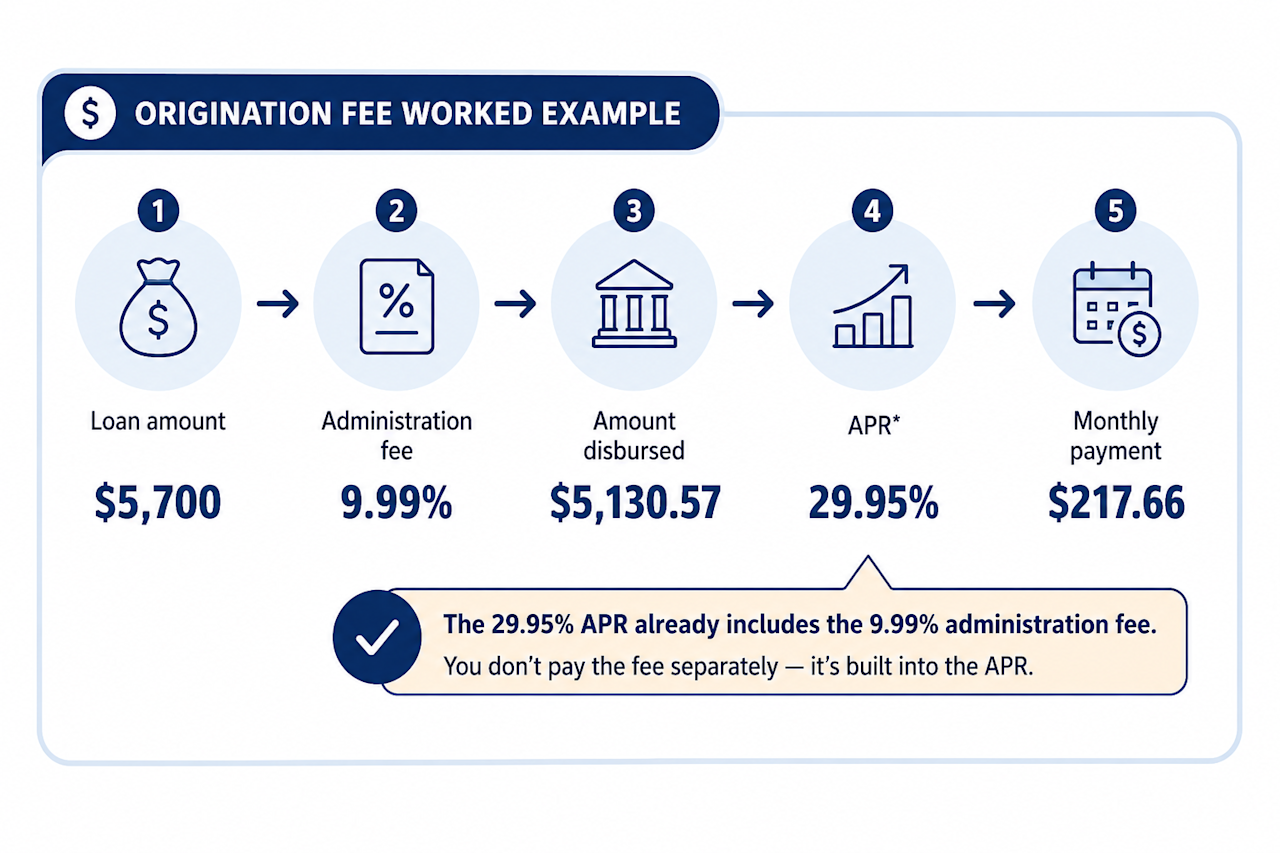
An origination fee is worth knowing because it reduces how much money lands in your account. If you need $5,700 in hand from a lender that charges an origination fee, you have to borrow more than $5,700.
Banks, credit unions, and online lenders compared
Online lenders, banks, and credit unions offer personal loans with different terms.
| Lender Type | Typical APR Ceiling | Speed | Access Requirement |
|---|---|---|---|
| Online lender | ~36% | Often faster | Broad |
| Bank | ~24% | Average to faster | Existing client often preferred |
| Federal credit union | 18% (legal cap) | Average to slower | Membership/Affiliation required |
| State-chartered credit union | Varies | Average to slower | Membership/Wait times required |
The Federal Credit Union Act limits federal credit unions to a 15% interest rate ceiling on loans. The National Credit Union Administration board can set a temporary higher rate for periods of up to 18 months, and in February 2026 it extended the 18% ceiling through September 10, 2027. If you’re approved for a personal loan through a federal credit union, your APR won’t exceed that threshold, which could keep interest from ballooning relative to what you get elsewhere.
Navy Federal is federally chartered, and its personal loan APRs top out at 18.00%. Most online lenders in this comparison reach 35.99%. On $15,000 over four years, that difference runs into thousands of dollars.
Alliant is state chartered, regulated by the Illinois Department of Financial and Professional Regulation, so the federal ceiling doesn't apply to it. State-chartered credit unions may still offer competitive rates. Alliant’s published rates top out around 12% for unsecured personal loans, which is low relative to what many lenders offer.
Membership rules limit who can reach these rates. Alliant asks you to be a member for 90 days before you can apply. Navy Federal requires a military connection. Plan around membership requirements if a credit union is on the menu.
Banks fall between the two on rate ceilings. U.S. Bank tops out at 24.99% and caps non-clients at $25,000 and 60 months.
How to compare personal loan offers
Prequalification, sometimes called prescreening, runs a soft credit inquiry. A soft inquiry doesn't affect your credit score. What comes back is an estimate that may differ from your final offer.
Confirm the check is soft before you start. Some lenders run a hard credit check and still call it prequalification. Whether a rate check is hard or soft depends on the lender, and you can contact the lender to ask.
Prequalify with several lenders. Then apply to one. Prequalify across all three categories: one credit union, one bank, one online lender for the widest range of options.
Comparing APRs
Compare APR, not the interest rate, because APR folds in most fees. Compare total interest paid rather than the monthly payment, since a longer term lowers the payment and raises what you pay overall. Check the term itself too. Personal loan terms typically run two to seven years, though some lenders offer shorter or longer.
Special loan options
Co-signer and joint-applicant rules vary by lender. Some lenders allow joint applications (LendingClub, Prosper, Achieve, OneMain—joint, not co-signer), others don't (Discover, Upstart, Avant, Wells Fargo, LendingPoint). Check the lender's eligibility page.
Most personal loans are unsecured, but secured options exist. A secured offer could lower your rate.
When not to take out a personal loan
A personal loan solves some problems and makes others worse.
The National Consumer Law Center (NCLC) recommends a 36% APR ceiling, including all fees, as the benchmark for affordable lending, the same cap that the Military Lending Act applies to active-duty servicemembers. Loans above 36% APR are widely considered predatory by consumer-protection groups. Predatory essentially means bad for the borrower.
Some lenders price far above 36%. NetCredit reaches 99.99% APR and Integra Credit reaches 399%.
Credit card consolidation is generally worth it only when the new APR beats what you pay now. Add up your current balances and their rates first. If the loan doesn't come in lower, you're paying for the convenience of one payment.
Applying for a personal loan could make future rates for upcoming loans worse, including big loans like mortgages. If your mortgage is coming up within a year, you might hold off on applying for a personal loan, which could trigger a hard credit inquiry that impacts your score for a year.
If you're already behind on payments, a new loan may not be the fix. Debt consolidation and credit counseling handle that situation differently.
How we chose these lenders
Six factors decide each lender's score: interest rates and fees (25%), customer experience (25%), accessibility (20%), loan flexibility (15%), time to funding (10%), and reputation and stability (5%). Each is scored 0 to 10, then weighted into a single score shown as one to five stars.
Prequalification scores zero unless it uses a soft credit check, because a hard check dressed up as a rate quote isn't risk-free. Above 36% APR the weighting shifts toward the rate itself, so a high APR can't hide behind a clean fee schedule.
Rates come from each lender's own disclosure pages and are date stamped. Anything older than 90 days gets re-verified. The full framework is in our personal loan lender review methodology.
Bills.com has business ties with some lenders. Those ties do not change scores. We set our rules the same way for every lender, no matter what business ties exist.
Bills Action Plan
- Work out the number you need to beat. Add up the balances you would consolidate and the rate on each one. Your blended rate is the benchmark, and any offer above it costs you money.
- Prequalify with three lenders in different categories. Pick one credit union, one bank, and one online lender. Ask each one whether its rate check uses a soft credit inquiry before you enter anything.
- Compare on APR and total interest, then apply once. Check the origination fee and whether it comes out of your proceeds. Submit one full application, to the best offer you have.
Key Terms
APR (annual percentage rate) The yearly cost of borrowing. It includes the interest rate plus most fees, which is what makes APR the right number for comparing loans.
Origination fee An upfront charge some lenders take for processing the loan, usually deducted from your proceeds. A 5% fee on a $10,000 loan means $9,500 reaches your account.
Soft-pull prequalification A rate check that uses a soft inquiry and doesn't affect your credit score. A few lenders run a hard check and still call it prequalification.
Hard inquiry The full credit check that happens when you formally apply. It can lower your score.
Unsecured loan A loan backed by nothing but your promise to repay. Most personal loans work this way. Secured loans put an asset, often a car, on the line instead.
Joint applicant vs co-signer A joint applicant shares the loan and can use the money. A co-signer promises to pay if you don't, but gets nothing. Lenders treat them differently, and many accept only one or neither.
This article is for general education. Rates, terms, and fees are subject to change and may vary by applicant. Bills.com ratings are independent and reflect our own evaluation methodology.
What credit score do you need for a personal loan?

Lenders set their own minimums, and many work with fair-credit borrowers in the 580 to 669 FICO range. Scores of 670 and higher open up more lenders and lower rates.
Does checking personal loan rates hurt your credit?
Prequalification runs a soft credit inquiry, so checking your rate doesn't affect your score. The hard inquiry comes later, when you submit a full application. A few lenders run a hard check and still call it prequalification, so it's worth asking which one you're getting.
Which online lender is easiest to be approved by?
Lenders weigh credit history, income, and existing debt differently, so the same application can draw different offers. No lender publishes its approval odds, and any site claiming to know them is guessing. The offers you get back are the only reliable answer.
What happens if you're denied a personal loan?
A lender that denies your application must tell you within 30 days, and the notice either gives the specific reasons or explains that you can request them. If you ask within 60 days, the creditor has 30 days to answer. "You didn't score high enough" isn't a permitted reason. You're entitled to something specific. If you’re denied credit, you’ll receive a letter that gives the reason and notifies you that you’re entitled to a free copy of the credit report that the decision was based on. Get that report to see what the lender saw.
How fast can you get the money?
Several lenders here fund same-day or next business day when you sign early enough on a business day. Funding times vary by lender, but it’s often within a week of approval. Each lender's own timing appears on its card.
Does applying to multiple personal loans count as one hard credit inquiry?
Multiple hard inquiries count as a single inquiry only for auto loans, mortgages, and student loans, and only when they fall within 14 to 45 days of each other. Personal loans are not included. Four personal loan applications means four hard inquiries on your report.