

How to File Chapter 7 Bankruptcy: 7 Steps (2026 Guide)




Table of Contents
Bills Bottom Line
Filing Chapter 7 bankruptcy typically takes 4–6 months from filing to discharge. The court filing fee is $338, plus two required courses (about $20–50 each). You'll gather documents, fill out forms, and file them with the court. Then, you'll attend a short trustee meeting and complete the second course. Most filers keep their everyday property through exemptions.
DISCLAIMER: This article provides general educational information about the Chapter 7 bankruptcy filing process under federal law. It is not legal advice. Bankruptcy rules and exemption laws vary by state, and court procedures can vary by district. If you’re unsure about eligibility, exemptions, or whether you risk losing property, talk with a qualified bankruptcy attorney.
You've made the decision. Chapter 7 bankruptcy feels like the right move.
But now you're looking at forms, deadlines, and court requirements—wondering where to start and what happens if you mess something up.
Good news: it's more straightforward than it looks. Seven steps, about 4–6 months, and a $338 filing fee. Here's the roadmap.
How much does it cost to file Chapter 7 bankruptcy?
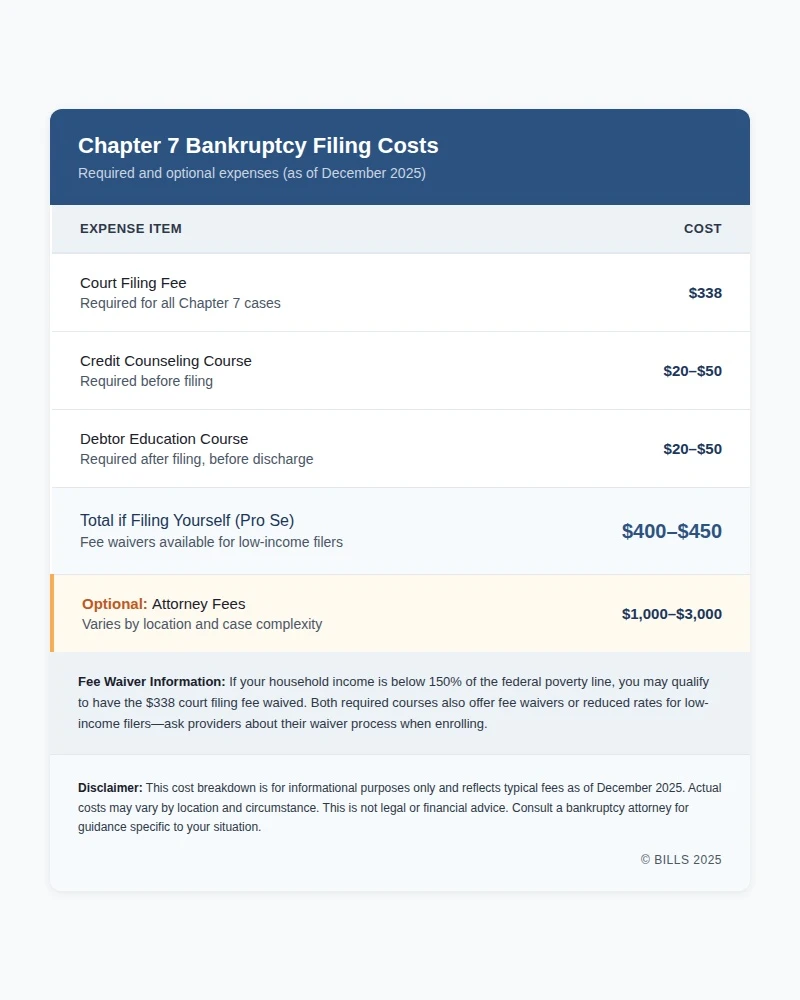
Not including attorney fees, the out-of-pocket costs fall into three buckets: the court filing fee, and the two required courses.
- Court filing fee: $338 (As of January 2026, the Chapter 7 court filing fee is $338)
- Credit counseling course (pre-filing): usually $20–$50
- Debtor education course (post-filing): usually $20–$50
- Total if you file yourself: commonly around $400–$450
If you hire an attorney, legal fees vary widely by location and complexity. Simple cases may be on the lower end; cases involving real estate equity, business issues, or non-exempt assets tend to cost more.
How to file for free (or close to it)
If you’re broke enough to be considering bankruptcy, it can be hard to come up with money for attorneys and filing fees. It’s possible to file bankruptcy with no money. If your income is low enough, you may be able to get the filing fee waived. You'll need to show you can't afford to pay—even in installments. If you don’t qualify for a waiver, you can usually ask to pay in installments (up to four payments, typically within 120 days). The required courses often offer fee waivers or reduced fees too—ask the provider before you enroll.
How long does Chapter 7 take?
Here’s the typical sequence for a straightforward case:
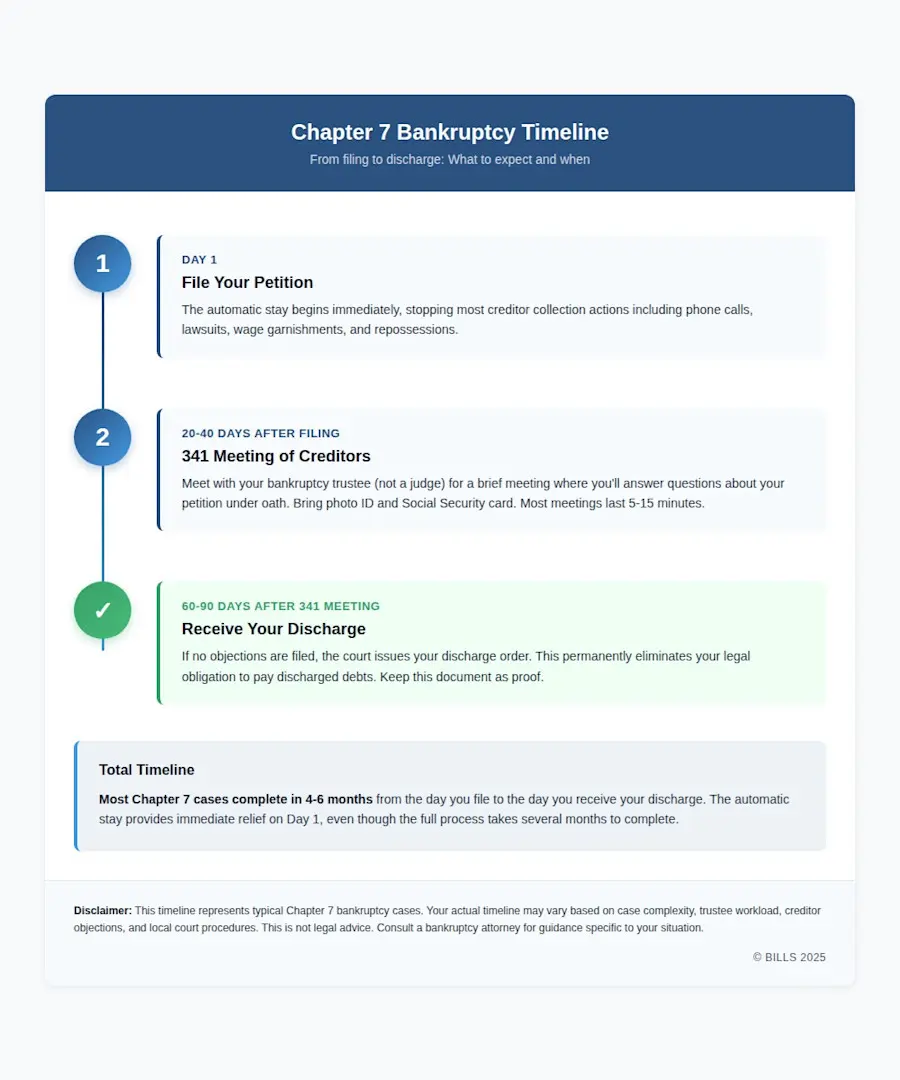
- Day you file: The automatic stay usually starts immediately, which stops most collection actions.
- About 20–40 days after filing: Your 341 meeting (meeting of creditors) is scheduled with the trustee.
- About 60–90 days after the 341 meeting: If there are no objections from creditors, the court issues your discharge.
Total timeline: Often 4–6 months from filing to discharge.
Documents to gather before you fill out your bankruptcy form
You could start the forms without everything, but most people move faster (and avoid mistakes) when their documents are ready. Think of this as building your “bankruptcy binder.”
Income & taxes
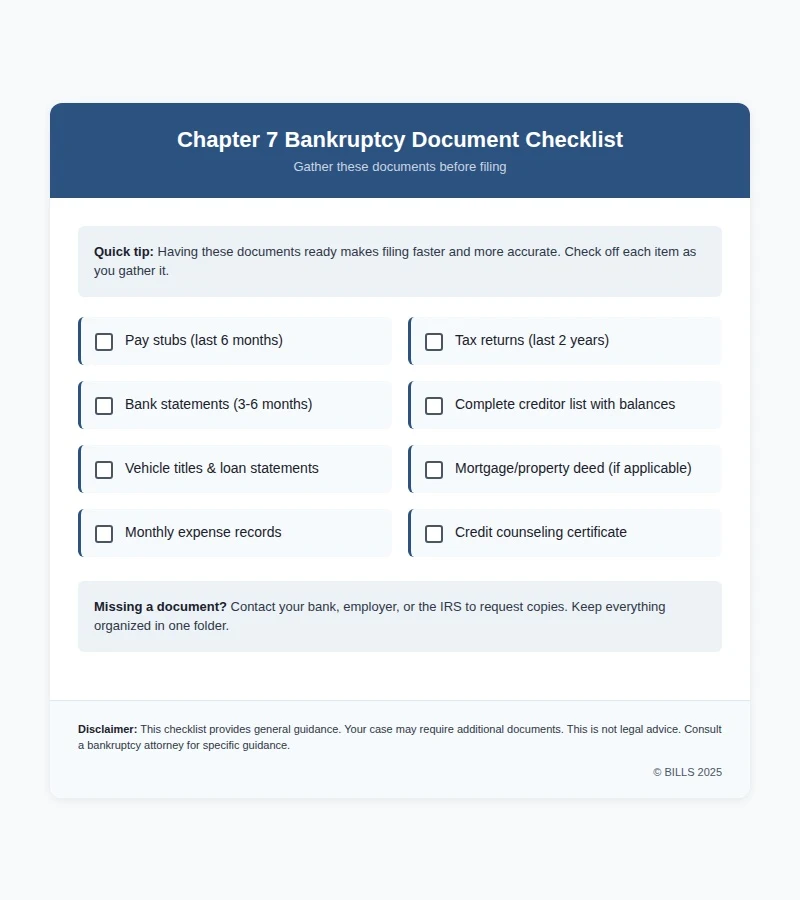
- Pay stubs or income proof for the last 6 months
- Tax returns for the last 2 years
Banking & bills
- Bank statements (typically 3–6 months, for all accounts)
- A full list of creditors (names, account numbers, balances)
Property & asset paperwork
- Vehicle titles/loan statements
- Mortgage statement and/or property deed (if you own real estate)
- Retirement accounts, brokerage statements, and any “valuable items” you’ll need to list
Your budget
- Monthly expenses (rent, utilities, insurance, groceries, childcare, etc.)
Course certificate
- Your credit counseling certificate (from Step 1)
The 7-step chapter 7 filing process
Here’s the complete 7-step roadmap from start to discharge.
Step 1: Complete credit counseling (before you file)
Federal law requires credit counseling before you file. It must be from an approved provider, and you have up to 180 days to complete it. No certificate, no case
The course usually takes 60–90 minutes and can be online, by phone, or in person. When you finish, you’ll get a certificate to file with your bankruptcy petition.
Step 2: Complete your bankruptcy forms
All official bankruptcy forms are free through the U.S. Courts website. You should not have to pay for the actual forms.
In plain terms, the forms do four big jobs:
- list what you own,
- list what you owe,
- show your income and expenses, and
- flag any recent financial events (like transfers, lawsuits, or big purchases).
Most individual filers will use Form 101 (Voluntary Petition). They also need a set of schedules. These include assets, debts, exemptions, income, and expenses. Plus, they must complete the Statement of Financial Affairs.
Step 3: Decide whether to request a fee waiver or installment plan
If you think you qualify for a fee waiver, you’ll file the waiver request with your petition. If you don’t qualify for a waiver (or you’re not sure), you can file an installment plan request so you can pay the filing fee over time. Not every court treats every situation the same way, so always check your local court’s instructions.
Step 4: File your petition with the right bankruptcy court
You generally file in the district where you’ve lived for most of the last 180 days.
Courts may allow:
- filing in person,
- filing by mail, and/or
- limited electronic filing options for individuals (depending on the district).
Once your petition is filed, the court assigns a case number and appoints a trustee.
Step 5: Attend the 341 meeting of creditors (often 20–40 days after filing)
This is a meeting with the trustee—not a courtroom hearing. Creditors are invited to attend but they usually don’t. This meeting is usually brief if your paperwork is complete. Most 341 meetings are held on Zoom.
Bring:
- Government-issued photo ID
- Social Security card (or an approved substitute, depending on local rules)
You’ll be placed under oath and asked basic questions to confirm your forms are accurate and complete.
Step 6: Complete the debtor education course (after filing, before discharge)
The second course is often called debtor education or financial management. It’s required to receive your discharge.
You can usually take it shortly after filing (many people do it after the 341 meeting). Once you complete it, a certificate must be filed with the court—sometimes the provider files it for you, sometimes you file it yourself.
Step 7: Receive your discharge (often 60–90 days after the 341 meeting)
If no one objects, the court issues a discharge order. That discharge generally wipes out your eligible unsecured debts (like credit cards and medical bills). Some debts commonly do not go away in Chapter 7 (for example, many student loans, child support, and certain tax debts).
Keep your discharge paperwork. It’s your proof that the listed debts were discharged.
Common Chapter 7 filing mistakes to avoid
A lot of bankruptcy trouble comes from normal decisions made at the worst possible time. Here are a few common pitfalls so you can sidestep them:
- Recent large purchases or cash advances: This can raise fraud concerns, especially if it looks like you ran up debt knowing you were about to file.
- Paying back family or friends right before filing: Trustees can sometimes “claw back” certain payments and transfers.
- Transferring property or selling it cheaply: Transfers close to filing can be challenged.
- Hiding assets or leaving things out: Bankruptcy requires complete disclosure. Omissions can delay your case or cause much bigger problems.
- Missing deadlines or failing to file course certificates: Deadlines matter, and missing them can lead to dismissal with no debt forgiveness.
If you’re worried any of these apply to you, it’s a good moment to get legal advice before you file.
Bills Action Plan
Step 1: Confirm you’re eligible for Chapter 7 (including whether the bankruptcy means test applies in your situation).
Step 2: Find an approved credit counseling provider and complete the course within 180 days before you file. Check the official U.S. Court website to find a list of approved courses.
Step 3: Gather your documents (income, taxes, bank statements, creditor list, and property paperwork) so your schedules are accurate.
Step 4: Download the official bankruptcy forms and complete them carefully—double-check names, balances, account numbers, and your exemption choices.
Step 5: If paying the $338 fee is a hardship, look into a fee waiver request or an installment plan request (and follow your local court’s instructions).
Step 6: File your case with the correct bankruptcy court and keep copies of everything you submit.
Step 7: Attend the 341 meeting and complete the debtor education course so your discharge isn’t delayed.
Free up cash each month with Freedom Debt Relief

Ozzy S., Freedom client
“Right away, I had more money each month because of program costs so much less than what I was paying on my minimums.”
Actual client of Freedom Debt Relief. Client’s endorsement is a paid testimonial. Individual results are not typical and will vary.
Can I file Chapter 7 bankruptcy without an attorney?

Yes—many people file pro se (without an attorney), especially when the case is simple (mostly unsecured debt, straightforward income, and limited assets). But some situations call for a lawyer: if you own a home with equity, have a business, expect creditor disputes, or aren't sure which exemptions apply.
What happens if I miss my 341 meeting?
The 341 meeting is required. Missing it can lead to dismissal of your case. That means your bankruptcy case is thrown out and you’re back where you started. If you have an emergency, contact the trustee’s office as soon as possible to ask about rescheduling.
How do I find my local bankruptcy court?
Start with the U.S. Courts court locator and then click through to your district’s bankruptcy court website for local instructions. Filing rules can vary by district, so always follow your local court’s process.