

Chapter 7 Bankruptcy: What It Is & How It Works




Chapter 7 is a way to eliminate most unsecured debts (credit cards, medical bills, personal loans) in 3-4 months. You must pass the means test (income below state median) or show low disposable income after expenses. Most people who qualify for Chapter 7 keep all their property thanks to exemptions that protect a home, a car, household goods, and retirement accounts. You typically cannot discharge child support, alimony, most tax debt, or student loans. Chapter 7 stays on your credit report for 10 years. Total cost: $338 court filing fee plus $1,000-$1,500 attorney fees (averages); filing fee waivers available for those under 150% poverty level.
Table of Contents
Sarah, 34, stares at her credit card statements scattered across her kitchen table. Medical bills from last year’s emergency surgery, $18,000. Three maxed-out credit cards, another $22,000. Her retail job barely covers rent and groceries, let alone the minimum payments that keep climbing with interest charges. The collection calls start before she’s even had her morning coffee.
She’s not lazy. She’s not irresponsible. She’s drowning—and Chapter 7 bankruptcy might be her way back to solid ground.
If you’re in a similar situation, you’re probably wondering what Chapter 7 actually does, whether you qualify, and what you stand to lose. Chapter 7 bankruptcy is a legal process that wipes out most unsecured debts in 3-4 months. Unlike other bankruptcy chapters that require years of repayment plans, Chapter 7 could put you on stronger financial footing relatively quickly. But it’s not automatic, and understanding how it works matters before you file.
This article is for general education. We can’t advise you on whether to file for bankruptcy protection. If you’re considering bankruptcy and want to learn more, talk to a bankruptcy attorney licensed to practice in your state.
What is Chapter 7 bankruptcy?
Chapter 7 bankruptcy erases most unsecured debts by liquidating any nonexempt assets you own. Here’s what that means in practice: a court-appointed trustee reviews your finances and sells property you own that you can’t protect with exemptions. The proceeds go to your creditors, and the court discharges (legally eliminates) your remaining eligible debts.
The good news? Most people keep everything they own because people who file Chapter 7 tend to have little to no nonexempt assets. Bankruptcy exemptions protect essential items like some home equity, one modest vehicle, household goods, and retirement accounts.
Also called “liquidation bankruptcy” or “straight bankruptcy,” Chapter 7 moves fast. You’ll typically get your discharge in 3-4 months—not the 3-5 years required by Chapter 13 repayment plans.
Chapter 7 operates under federal law (Title 11 of the U.S. Bankruptcy Code). It’s designed to give honest debtors a financial reset when they can’t reasonably repay what they owe.
How Chapter 7 differs from other bankruptcy types
You have three main bankruptcy options, and they serve different needs:
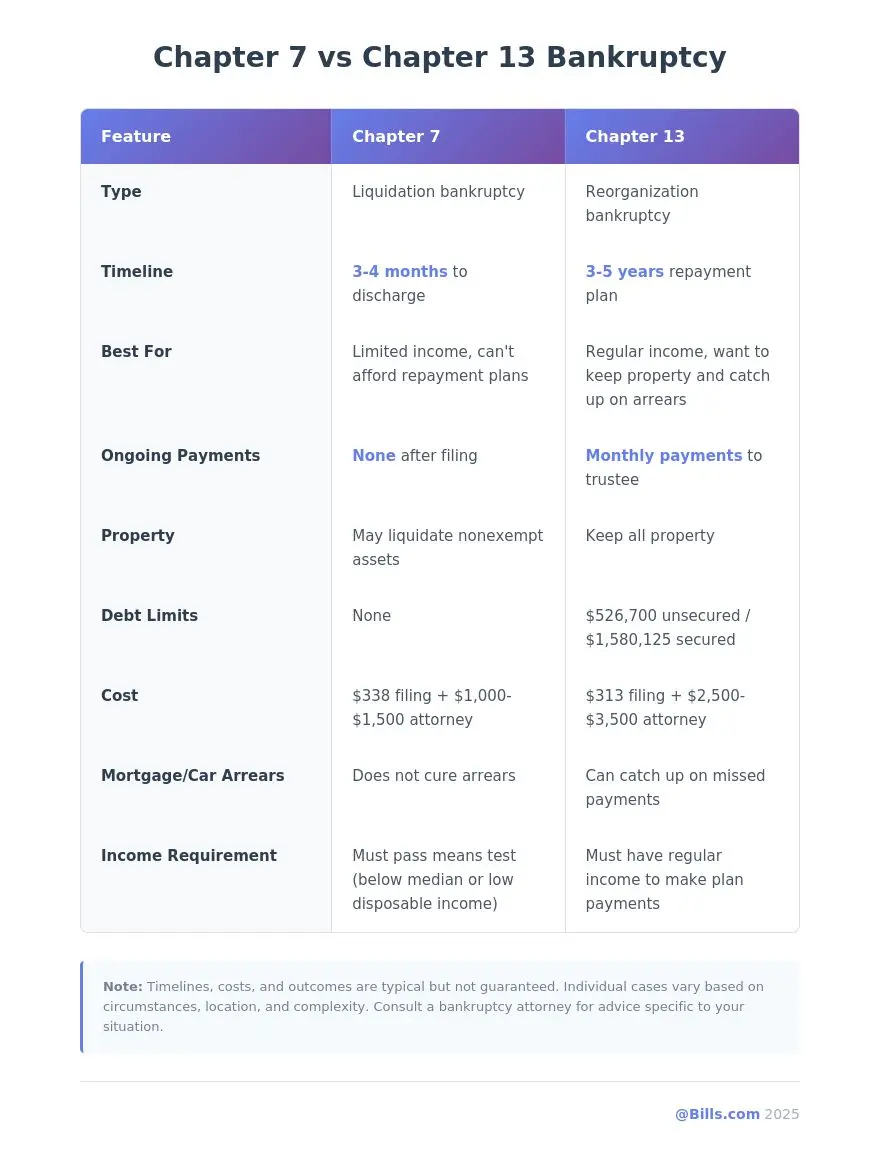
Chapter 7 liquidates assets to discharge debts in 3-4 months. Best if you have limited income and can’t afford repayment plans. No ongoing payments after filing.
Chapter 13 creates a 3-5 year repayment plan without liquidating assets. Better if you have regular income and want to catch up on mortgage or car payments while keeping property. You make monthly payments to the trustee.
Chapter 11 reorganizes business debts (or works for high-debt individuals who exceed Chapter 13 limits). Complex and expensive—typically used by corporations, partnerships, or individuals with debts exceeding $1.58 million secured or $526,700 unsecured.
Who qualifies for Chapter 7 bankruptcy?
Not everyone can file Chapter 7. The bankruptcy system uses a two-step process to determine whether you qualify: first comparing your income to your state’s median, then calculating disposable income if needed. You also need to meet timing requirements and complete credit counseling.
The Chapter 7 means test explained
The means test exists to prevent high-income filers from walking away from debts they could reasonably repay. Think of it as the court’s way of asking: “Do you need complete bankruptcy relief, or could you pay back at least some of what you owe?”
Step 1: Compare Your Income to State Median
Calculate your average monthly income over the six full months before filing. This includes wages, bonuses, rental income, and regular contributions from others—but excludes Social Security and victim compensation payments.
Compare this to your state’s median income for your household size. If you’re below the median, you automatically qualify. You’re done with the means test.
Step 2: Calculate Disposable Income (If Above Median)
If your income exceeds your state median, the court calculates your disposable income by subtracting allowed expenses:
- Housing and utilities (actual or IRS standard amounts)
- Transportation (actual or IRS standard amounts)
- Food, clothing, and personal care
- Healthcare expenses
- Secured debt payments (mortgage, car loan)
- Child support, alimony
The court then multiplies your remaining disposable income by 60 (representing a 5-year period). If that amount is over $17,150, you fail. Below that, it depends on whether you could repay at least 25% of your unsecured debt. If your total is very low, you pass the means test and can file Chapter 7.
Here’s what matters: failing the means test doesn’t mean you can’t file bankruptcy. It just means you’ll likely need to file Chapter 13 instead, where you make monthly payments over 3-5 years.
Income requirements and exceptions
Your “current monthly income” includes all money coming in from most sources during the six months before filing:
- Wages, salaries, tips, bonuses
- Self-employment income
- Rental income
- Unemployment benefits
- Pension and retirement withdrawals
- Alimony and child support you receive
- Regular contributions from family or friends
What doesn’t count: Social Security benefits, payments to crime victims, and certain payments made because of terrorism or war.
If you’re married, you include your spouse’s income even if you’re filing for bankruptcy alone—unless you’re legally separated or living apart.
Who cannot file Chapter 7
You’re ineligible to file Chapter 7 if:
- The court dismissed a previous bankruptcy within the past 180 days for willfully failing to appear in court or comply with orders
- You received a Chapter 7 discharge within the past 8 years
- You haven’t completed credit counseling from an approved agency within 180 days before filing
- The court finds your filing would abuse the bankruptcy system
What debts can Chapter 7 erase?
Chapter 7 eliminates most common unsecured debts but leaves certain obligations intact. Understanding what disappears and what remains helps you decide if Chapter 7 actually solves your problem.
Debts Chapter 7 discharges
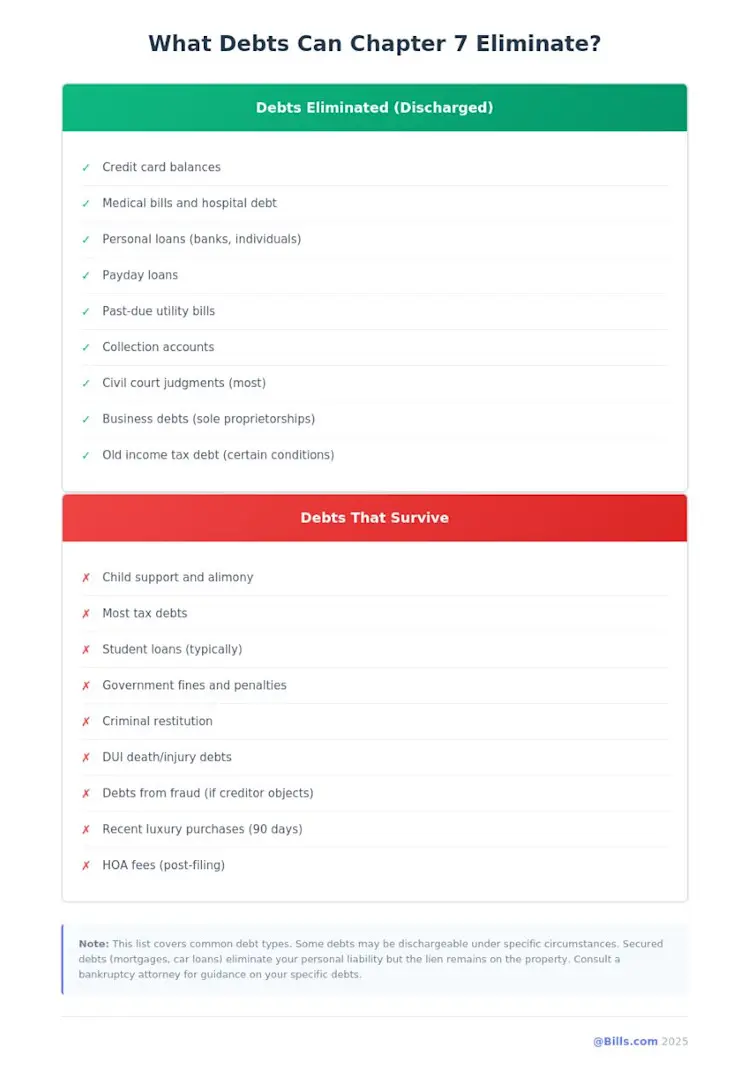
These unsecured debts typically disappear in Chapter 7:
- Credit card balances
- Medical bills and hospital debt
- Personal loans from banks or individuals
- Payday loans
- Past-due utility bills
- Collection accounts
- Civil court judgments (except those for fraud or willful injury)
- Business debts from sole proprietorships
Once discharged, creditors cannot call you, sue you, garnish your wages, or take any action to collect. The debt is legally gone.
Debts that survive Chapter 7
Federal law protects certain debts from discharge to prevent abuse and protect vulnerable parties:
Not dischargeable
- Child support and alimony
- Most tax debts (unless specific conditions are met)
- Student loans (unless you prove undue hardship in a separate lawsuit)
- Government fines and criminal restitution Debts for death or personal injury caused by drunk driving
- Debts you didn’t list in your bankruptcy paperwork (if the creditor didn’t get notice)
Dischargeable If Creditor Doesn’t Challenge
- Debts from fraud or false pretenses
- Debts from willful and malicious injury
- Debts from breach of fiduciary duty
Creditors must file a complaint within 60 days of your 341 meeting to challenge these debts. If they don’t challenge it, the debt gets discharged.
Secured debts: redeem, reaffirm, or surrender
Secured debts work differently. Your mortgage lender or auto finance company holds a lien on the collateral. Chapter 7 eliminates your personal liability, but the lien survives.
You have three options:
Redeem the property. Pay the current market value in a lump sum to keep the item free and clear. This rarely works unless you have cash available.
Reaffirm the debt. Sign a legal agreement to remain personally liable. Reaffirmation requires court approval. You must be current on payments and able to afford the debt going forward.
Surrender the property. Give back the house or car, and the creditor cannot pursue you for any remaining balance after they sell it.
Most people who are current on car payments and want to keep their vehicles reaffirm the loan. Those who are underwater on mortgages often surrender the property.
Will you lose your property?
Here’s the reality most people don’t know: the vast majority of Chapter 7 filers keep everything they own. Bankruptcy exemptions protect essential property, and unless you own luxury items or have substantial equity in assets beyond those exemptions, the trustee won’t take anything.
The fear of losing everything keeps many people from filing when bankruptcy would actually help. Let’s clear up the confusion.
How bankruptcy exemptions work
Exemptions are dollar limits you can claim to protect specific types of property. Federal law provides one set of exemptions. Each state has its own set. Some states let you choose between federal or state exemptions; others require you to use state exemptions only. No states allow you to mix and match federal and state exemptions.
When you file Chapter 7, you list all your property and claim exemptions. If the exemption covers the full value of an item, the trustee can’t take it.
Example: If you take your state’s exemptions, the vehicle exemption is $8,000, and you own a car worth $7,000, you won’t have to give up your car.
If property exceeds the exemption amount, you might be able to buy back the nonexempt portion, or the trustee might sell it and give you the exempt amount.
If your vehicle exemption is $8,000 and you own a car worth $20,000, you could give up the car and let the trustee sell it. If so, you’d receive $8,000 and your creditors would get the rest.
Federal bankruptcy exemptions (2025)
As of April 1, 2025, federal exemptions protect:
- Homestead: $31,575 of equity in your primary residence
- Motor vehicle: $5,025 of equity in one car
- Household goods: $16,850 total, with individual items limited to $800 each (furniture, appliances, clothes, books)
- Jewelry: $2,125
- Tools of trade: $3,175 in items you need for work
- Wildcard: $1,675 plus up to $15,800 of unused homestead exemption—can apply to any property
- Retirement accounts: Fully protected (401(k), IRA, pension plans)
State exemptions vary widely. Some states like Florida and Texas offer unlimited homestead protection if certain conditions are met. Others provide less generous exemptions but protect different types of property.
Keeping your home and car
Your Home
You can keep your house if:
- Your equity (home value minus mortgage balance) fits within the homestead exemption
- You’re current on mortgage payments
- You can afford to continue making payments
Here’s an example: Your home is worth $250,000 with a $230,000 mortgage. Your equity is $20,000. You opt for the federal exemptions, giving you a $31,575 federal homestead exemption. The trustee can’t touch your home.
If you’re behind on mortgage payments, Chapter 7 doesn’t help you catch up. The automatic stay temporarily stops foreclosure, but you’ll need to work out a payment plan with your lender or consider Chapter 13 to cure the arrears.
Your Car
You can keep your vehicle if:
- Your equity fits within the motor vehicle exemption
- You’re current on any car loan
- You reaffirm the debt (if financed) or the vehicle is owned outright
Example: Your car is worth $12,000 with an $8,000 loan balance. Your equity is $4,000—well within the $5,025 federal vehicle exemption. All good.
If the car is paid off and worth $18,000, your equity exceeds the exemption by $12,975. The trustee might sell the car, give you $5,025, and distribute the rest to creditors. Or you could pay the trustee $12,975 to keep the car.
Many people keep their homes and cars without issue.
What property trustees actually take
In practice, trustees focus on:
- Cash in bank accounts over the wildcard exemption
- Second homes or rental properties
- Valuable collections (coins, art, antiques)
- Expensive jewelry beyond the exemption
- Boats, RVs, motorcycles
- Stock portfolios and investment accounts (except retirement accounts)
- Tax refunds you’re owed for pre-filing tax years
Trustees don’t bother with used household goods, basic furniture, or normal personal items—these have minimal resale value and are likely fully exempt.
The Chapter 7 bankruptcy process
Filing Chapter 7 follows a structured timeline. Each step matters, and missing deadlines or requirements can delay your discharge or get your case dismissed.
Before you file
Complete Credit Counseling (Required)
Within 180 days before filing, you must complete an approved credit counseling course. These courses take 60-90 minutes, cost $10-$50, and are available online or by phone. The counseling agency provides a certificate you file with your bankruptcy petition.
The U.S. Trustee’s office maintains a list of approved agencies.
Gather Financial Documents
You’ll need:
- Six months of pay stubs
- Two years of tax returns
- Bank statements from all accounts
- List of all debts with creditor names, addresses, and amounts
- List of all property you own with values
- Records of any major financial transactions in the past two years (property transfers, large payments to creditors)
Consider Timing
Don’t file if:
- You made large credit card purchases or took cash advances in the past 90 days (creditors can challenge as fraud)
- You paid back loans to friends or family in the past year (trustee can recover as preferential transfers)
- You’re about to receive a lawsuit settlement or inheritance (becomes property of the bankruptcy estate)
- You recently transferred property to family members (can be reversed as fraudulent transfer)
Sometimes waiting 90 days or longer prevents complications. Talk to an attorney about your specific situation.
Filing your petition
You file your Chapter 7 petition with the bankruptcy court in the district where you’ve lived for most of the past 180 days. The petition includes:
- Voluntary Petition (Official Form 101)
- Schedules listing all assets, debts, income, and expenses
- Statement of Financial Affairs
- Means test calculation (Official Form 122A-1 and 122A-2)
- Credit counseling certificate
The forms can be complicated, and if you get them wrong, your case could be thrown out. This is a great example of why an experienced bankruptcy attorney could be a real benefit.
Filing Fees
The total court fee is $338:
- $245 filing fee
- $78 administrative fee
- $15 trustee fee
If your income is below 150% of the federal poverty level, you can apply for a fee waiver. Otherwise, the court may allow you to pay in up to four installments over 120 days.
Attorney fees average $1,000-$1,500 but vary by region and case complexity. Most bankruptcy attorneys require payment upfront since they can’t be paid from post-filing income.
The Automatic Stay Takes Effect
The moment you file, the automatic stay goes into effect. This is immediate protection that stops:
- Collection calls and letters
- Lawsuits
- Wage garnishments
- Bank account levies
- Foreclosure proceedings
- Vehicle repossession
- Utility disconnections
The stay gives you breathing room while your bankruptcy proceeds. Creditors who violate the stay face sanctions.
The stay doesn’t stop:
- Criminal proceedings
- Child support collection
- Tax audits
- Some eviction proceedings if the landlord already has a judgment
The 341 meeting of creditors
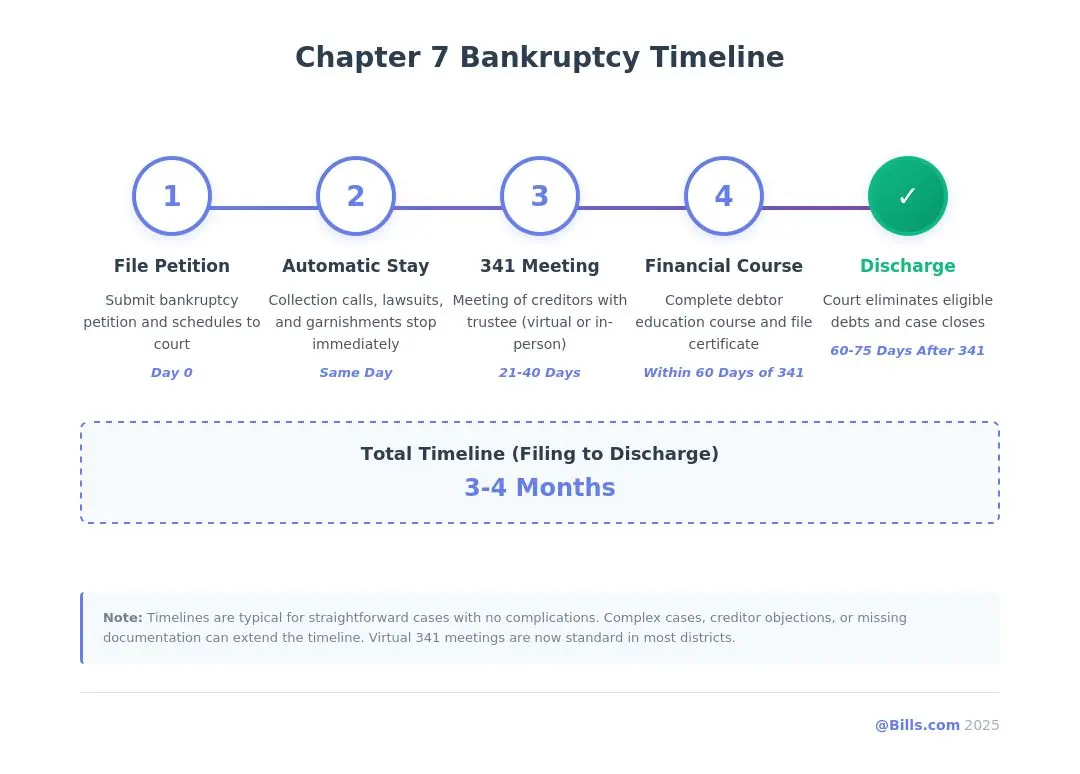
Twenty-one to 40 days after filing, you’ll attend the 341 meeting. Most districts now conduct these virtually via Zoom, though some still hold in-person meetings.
What Happens at the 341 Meeting
The trustee puts you under oath and asks questions about your finances:
- Did you review your petition and schedules? Are they accurate?
- What caused your financial problems?
- Do you own any real estate?
- Do you have any valuable property not listed?
- Did you transfer any property to anyone in the past two years?
- Did you pay back any loans to family or friends?
- Are you expecting any inheritances, lawsuit settlements, or tax refunds?
- Do you have any bank accounts not listed?
Answer honestly. The trustee reviews your bank statements, tax returns, and pay stubs beforehand and will catch inconsistencies.
Creditors can attend and ask questions, but they rarely do unless there’s a dispute about collateral or they suspect fraud.
The meeting typically lasts 10-15 minutes. Bring photo ID and proof of Social Security number.
After the 341 meeting
Complete Financial Management Course
Within 60 days of the 341 meeting, complete a debtor education course on financial management. Like prebankruptcy counseling, this costs $10-$50 and takes about two hours. File the completion certificate with the court.
Wait for Objections
Creditors have 60 days from the 341 meeting to object to your discharge or challenge specific debts. The U.S. Trustee has 10 days to report whether your case appears abusive under the means test.
Objections are uncommon in Chapter 7 cases. Most cases proceed without challenge.
Receive Your Discharge
If no objections are filed and you’ve completed the financial management course, the court issues your discharge order 60-75 days after the 341 meeting.
The discharge notice lists all debts included in your bankruptcy. Creditors cannot attempt to collect those debts from you ever again.
Total timeline: 3-4 months from filing to discharge in straightforward cases.
What the trustee does
Here’s what to expect from the Chapter 7 trustee—a private attorney appointed by the U.S. Trustee’s office. The trustee will:
- Review your bankruptcy documents for accuracy
- Conduct the 341 meeting
- Identify and liquidate nonexempt assets
- Distribute proceeds to creditors according to priority rules
- Investigate potential fraud or abuse
Most Chapter 7 cases are “no-asset” cases where the trustee determines you have no nonexempt property worth liquidating. They file a report stating the estate has been fully administered, and your case closes.
In asset cases, the trustee sells nonexempt property and pays creditors in this order:
1. Secured creditors (from proceeds of their collateral)
2. Priority unsecured debts (recent taxes, child support)
3. General unsecured creditors (credit cards, medical bills)
4. You receive any remaining funds
How much does Chapter 7 cost?
You’ll need to budget for both court fees and attorney fees when you declare bankruptcy. Some filers can reduce costs through fee waivers or pro se filing, but most people hire attorneys for the higher success rate.
Court filing fees
$338 total, broken down as:
- $245 case filing fee
- $78 administrative fee
- $15 trustee fee
Fee Waiver: If your household income is below 150% of the federal poverty guidelines, you can apply to waive all fees. File Official Form 103B with your petition.
Installment Payments: The court may allow up to four installment payments over 120 days. You must make the final payment before your case is closed.
Attorney fees
Attorney fees vary by location and complexity:
- Simple cases: $1,000-$1,500 (routine consumer bankruptcy, no complications)
- Complex cases: $1,500-$3,000+ (business debts, multiple properties, adversary proceedings)
Most bankruptcy attorneys require full payment before filing a Chapter 7 case because they can’t collect fees from you once bankruptcy protection is in place.
Many offer payment plans before filing. You make payments over several months, then the attorney files once paid in full.
Credit counseling and debtor education
- Pre-filing credit counseling: $10-$50
- Post-filing financial management course: $10-$50
Both courses are available online or by phone. Many providers offer fee waivers if you cannot afford the cost.
Filing without an attorney (Pro Se)
You can file Chapter 7 without an attorney. The court provides forms and basic instructions. However:
- Discharge rate with attorney: approximately 95%
- Discharge rate pro se: approximately 60%
Common pro se mistakes include:
- Incorrectly claiming exemptions (lose property you could have kept)
- Failing to list all assets and debts (case dismissed or denial of discharge)
- Missing deadlines (automatic dismissal)
- Incomplete or incorrect forms (case dismissed)
If your case is straightforward—simple consumer debts, limited assets, income below median—pro se filing might work. If you own real estate, have complex debt, or face creditor challenges, hiring an attorney could be worth the cost.
Chapter 7’s impact on your financial life
Chapter 7 provides immediate debt relief but creates long-term credit consequences. The bankruptcy stays on your credit report for 10 years, though its impact diminishes over time as you rebuild.
Credit score impact
How bankruptcy affects your credit depends on where you started:
If you had good credit before filing (score 680-750): Expect your score to drop 130-200 points initially. The impact is most severe because you’re showing financial distress inconsistent with your history.
If you had poor credit before filing (score 500-620): Expect a drop of 50-100 points. Your score was already damaged by missed payments, collections, and high utilization. Bankruptcy doesn’t hurt as much because those negative marks were already pulling you down.
The bankruptcy notation lasts 10 years, but:
- After 2 years, you can apply for an FHA mortgage
- After 3-4 years, you can apply for conventional mortgages (with good payment history post-bankruptcy)
- Immediately after your bankruptcy is complete, you can apply for secured credit cards and begin rebuilding
- Your score could gradually improve as the bankruptcy ages and you add positive payment history.
Rebuilding your credit after discharge
Start rebuilding immediately:
Get a secured credit card. Deposit $200-$500 to open the account. Use it for small purchases and pay the full balance each month. This establishes positive payment history.
Become an authorized user on a family member’s established account (if they have good payment history). Their positive history reports to your credit file.
Pay all bills on time—every time. Set up automatic payments for rent, utilities, insurance, and any bills you have post-bankruptcy. Payment history is 35% of your credit score.
Keep credit utilization low. If you get a credit card with a $300 limit, owe no more than $90 (30% utilization). Lower is better.
Don’t apply for credit accounts unless you really need to. Each application triggers a hard inquiry that could temporarily lower your score.
Most people who follow this approach see their credit score climb 100+ points within 18-24 months.
Employment and housing
Employment: Federal law prohibits government employers from discriminating against you for filing bankruptcy. Private employers cannot fire you solely for bankruptcy, but they can consider it in hiring decisions—particularly for positions involving financial responsibility.
Housing: Landlords often check credit and may hesitate to rent to recent bankruptcy filers. You could:
- Offer a larger security deposit (if allowed where you live)
- Get a co-signer
- Provide references from previous landlords
- Explain your situation and show proof of stable income post-bankruptcy
Future credit access
Auto loans: Available immediately after discharge from subprime lenders. Interest rates will be higher until you rebuild. After 12-18 months of on-time payments, you could apply to refinance to better rates.
Mortgages:
- FHA loans: 2 years after Chapter 7 discharge with good credit rebuilding
- Conventional loans: Typically 4 years, sometimes 2 years with extenuating circumstances
- VA loans: 2 years after discharge for veterans
Credit cards: Expect secured cards only for the first year. Get one and use it sparingly, paying the bill on time each month. Try not to carry a balance. After 18-24 months, you might qualify for unsecured cards with low limits.
Emotional and psychological effects
Filing bankruptcy often brings relief. Collection calls stop. The weight of overwhelming debt lifts. Many people describe sleeping better the night after filing than they have in years.
But bankruptcy also carries shame for some. You might feel like you failed, particularly if you believed in always paying debts. That feeling is normal—and misplaced. Bankruptcy exists because sometimes circumstances overwhelm even responsible people.
Alternatives to Chapter 7
Chapter 7 isn’t always the best solution. Consider these alternatives:
Chapter 13 bankruptcy
Better if you:
- Have regular income and can afford monthly payments
- Want to catch up on mortgage or car payments while keeping the property
- Earn too much to qualify for Chapter 7
- Own nonexempt property you want to keep
Chapter 13 creates a 3-5 year repayment plan. You make monthly payments to the trustee, who distributes funds to creditors. At the end, remaining eligible debt is discharged.
Advantages: Keep all property, cure mortgage arrears, possibly reduce car loan to vehicle value.
Disadvantages: Takes years to complete, requires steady income, monthly payments might take up a large percentage of your income.
Debt consolidation loans
Better if you:
- Have decent credit and can qualify for a consolidation loan
- Have manageable debt ($15,000-$30,000)
- Want to avoid bankruptcy on your credit report
You take out one loan to pay off multiple debts, leaving you with a single monthly payment.
Advantages: Simplifies payments, possibly lowers interest rate, less credit damage than bankruptcy.
Disadvantages: Requires good credit to qualify, doesn’t reduce principal owed, risk of re-accumulating debt.
Debt management plans
Better if you:
- Have steady income
- Owe primarily unsecured credit card debt
- Can afford to pay back all of what you owe over 3-5 years
Credit counseling agencies negotiate with creditors to reduce interest rates and create payment plans.
Advantages: No court involvement, less long-term credit damage than bankruptcy, creditors often agree to reduce interest and fees.
Disadvantages: Takes 3-5 years, requires monthly payments, doesn’t reduce principal, not all creditors participate.
Debt settlement
Better if you:
- Have lump sums available to offer creditors
- Are willing to let accounts go delinquent strategically
- Can handle aggressive collection during negotiations
Debt settlement means you negotiate with creditors to accept less than full balance.
Advantages: Could reduce total debt owed by 40-60%, sometimes faster than debt management plans.
Disadvantages: Severely damages credit, creditors may sue during the process, fees if you work with a debt settlement company, potential tax consequences on forgiven debt.
Bills Action Plan
If Chapter 7 might fit your situation, follow these steps:
Step 1: Assess Your Situation
Compare your income to your state’s median. List all debts by type (secured vs. unsecured). Calculate the equity in major assets (home, car).
Questions to answer:
- Is most of my debt unsecured?
- Can I afford a repayment plan, or do I need full discharge?
- Will I lose any property I want to keep?
- Do I have any non-dischargeable debts (student loans, child support, taxes)?
Step 2: Gather Financial Documents
Collect six months of pay stubs, two years of tax returns, bank statements, debt statements, and asset valuations. Having everything organized before consulting an attorney saves time and money.
Step 3: Complete Pre-Filing Credit Counseling
Find an approved agency on the U.S. Trustee’s website. Complete the course and save your certificate. This is mandatory before filing.
Step 4: Consult a Bankruptcy Attorney
Most bankruptcy attorneys offer free initial consultations. Bring your documents. Ask:
- Do I qualify for Chapter 7?
- Will I lose any property?
- Are there timing issues I should address before filing?
- What are your fees and payment options?
- What are my state’s specific exemptions—are they more generous than federal limits?
Get recommendations from friends, check state bar associations, or search for attorneys on nacba.org (National Association of Consumer Bankruptcy Attorneys).
Step 5: File and Prepare for Your 341 Meeting
If you decide to proceed, your or your attorney will file your petition and mark your calendar for the 341 meeting. Review your petition and schedules beforehand so you can answer the trustee’s questions accurately.
Bring photo ID and Social Security card to the meeting. Be honest in your answers.
Free up cash each month with Freedom Debt Relief

Ozzy S., Freedom client
“Right away, I had more money each month because of program costs so much less than what I was paying on my minimums.”
Actual client of Freedom Debt Relief. Client’s endorsement is a paid testimonial. Individual results are not typical and will vary.
Can I file Chapter 7 if I’m employed?

Yes. employment doesn’t disqualify you. Many Chapter 7 filers work full-time but earn too little to pay back their debts after covering basic living expenses. The means test looks at your income relative to expenses and state median, not whether you have a job.
What happens to joint accounts and co-signers?
Chapter 7 only protects you—not co-signers. If your parent co-signed your credit card or your spouse co-borrowed a personal loan, they remain fully liable for the debt. Creditors will pursue them for the full balance. That’s why many married couples file jointly to protect both spouses.
Can creditors contact me after I file?
No. The automatic stay prohibits all collection activity once you file. Creditors cannot call, text, email, sue, garnish wages, or contact you in any way. If they do, they violate federal law and face sanctions. Report violations to your attorney immediately.
Will my spouse’s credit be affected?
Not if you file alone and the debts are solely in your name. Joint debts appear on both credit reports—your spouse remains liable for those even if you receive a discharge. If most debts are joint, consider filing together. If debts are mostly separate, one spouse can file while the other maintains clean credit.
In community property states, bankruptcy for one spouse but not the other involves some complexities that you should discuss with an attorney.
Can I keep my tax refund?
It depends on timing. Tax refunds for tax years ending before you filed are property of the bankruptcy estate. The trustee can take refunds you’re owed for those years. Refunds for tax years after filing are yours to keep. If you file in March 2025, any refund for 2024 taxes goes to the trustee. Your 2025 refund (filed in 2026) is yours. If you file for bankruptcy later in the year, you might have to surrender your upcoming refund.
What if I forgot to list a debt?
If the creditor received notice of your bankruptcy (which happens if they’re on your mailing list), the debt is discharged even if you didn’t specifically list it. If the creditor never received notice because you didn’t include them, the debt survives. You can usually amend your schedules to add forgotten debts before your case closes.
Can I file Chapter 7 more than once?
Yes, but you must wait 8 years from the date you filed your previous Chapter 7 case to receive another Chapter 7 discharge. You can file sooner than 8 years, but you won’t receive a discharge—useful only if you need the automatic stay’s protection temporarily.
Do I need a lawyer to file Chapter 7?
No, but it’s strongly recommended. According to U.S. Bankruptcy Court data, Chapter 7 cases filed with attorney representation result in discharge approximately 95% of the time, compared to approximately 60% for pro se (self-represented) filers. Bankruptcy is technical, and mistakes cost you—either through losing property you could have kept, having your case dismissed, or being denied discharge. If your situation is straightforward (simple consumer debts, no property complications, income well below median), pro se filing might work. For most people, the attorney fee is worth the peace of mind and higher success rate.
6 Comments
Again, bankruptcy questions are fact-dependent, and what I wrote here should not be considered legal advice.
I do know that a reputable debt settlement program would require you to make a certain number of payments on large purchases, before trying to settle the debt.