

10 Tips to Negotiate Your Debt




Bills Bottom Line
Debt negotiation works better when you prepare before you call, keep your story short, know your limits, and get everything in writing. You don't need to be aggressive or clever—you need to be organized and patient.
Table of Contents
- Before you negotiate: quick prep that makes or breaks the call
- Tip 1: Keep your hardship story short and honest
- Tip 2: Know your “I can't go above this” number
- Tip 3: Use a simple script to start the call
- Tip 4: Ask the right questions
- Tip 5: If you're dealing with a collector, slow everything down
- Tip 6: Timing matters more than people think
- Tip 7: Take notes like a pro
- Tip 8: If you're discussing settlement, know realistic ranges
- Tip 9: Always ask for everything in writing
- Tip 10: If the offer is bad, call back later or escalate
- When negotiation isn't enough
- Bills Action Plan
Calling a creditor to negotiate debt feels harder when you don't know what to expect. The person on the other end sounds prepared. You're figuring it out as you go.
But most debt negotiation mistakes aren't inevitable—they happen when people go in without a plan. Here's how to prepare so you're both on equal footing.
Before you negotiate: quick prep that makes or breaks the call
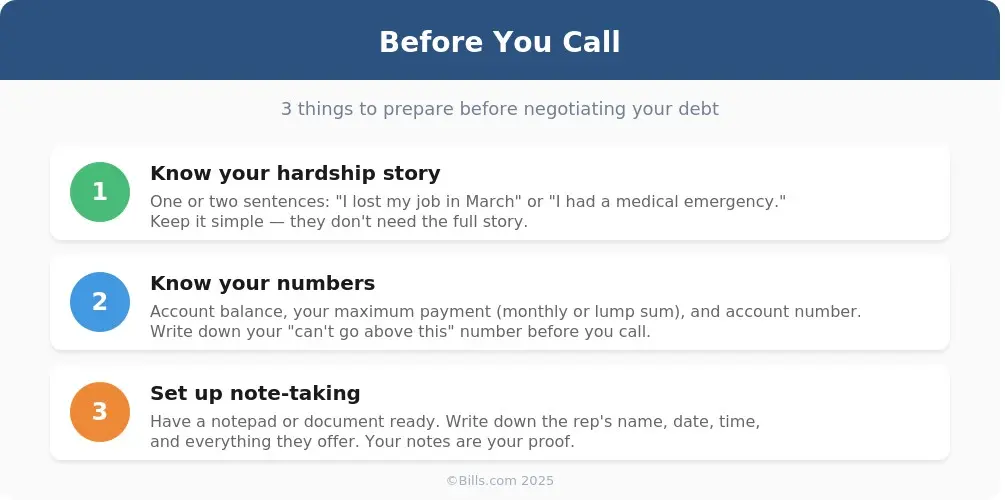
The difference between a productive call and a frustrating one often comes down to five minutes of prep work. Before you pick up the phone:
- Know your hardship. Can you explain in two sentences why you're struggling? Job loss, medical bills, divorce—keep it simple.
- Know your numbers. What's the balance? What can you realistically afford—monthly or as a lump sum?
- Have account details ready. Account number, last payment date, current balance.
- Set up a way to take notes. A notepad, a Google Doc, whatever works. You'll want to write down names, dates, and anything they offer.
Preparation makes a real difference when you want to negotiate debt. Someone who calls without knowing their balance, can't remember their last payment, and hasn't thought about what they can afford will spend half the call digging through emails while the rep waits. By the end, they're flustered and often agree to a payment they can't actually make. The same person, calling back a week later with notes in front of them, can often get a better deal in half the time.
Tip 1: Keep your hardship story short and honest
Creditors and collectors hear sob stories all day. They're not heartless, but they're also not therapists. A five-minute explanation of everything that went wrong in your life doesn't help your case—it just slows down the call.
What works: one or two sentences:
"I lost my job in March and I'm behind on everything."
"I had a medical emergency and I'm trying to get back on track."
That's enough. They don't need the full story.
People who've been through this often say the same thing: when they stopped over-explaining and just said "I had a financial setback and I'm trying to work something out," they got to the actual options faster.
Tip 2: Know your “I can't go above this” number
Before you call to negotiate with your creditors, decide on your maximum—whether that's a monthly payment or a lump-sum settlement. Write it down. This is your ceiling, and you shouldn't go above it no matter how much pressure you feel.
Why? Because in the moment, it's easy to agree to something that sounds doable but isn't. A $400/month payment sounds manageable until you realize your rent is due the same week.
Sticking to your number works. If the billing department pushes for more and you hold firm, there's often a pause—and then they accept what you can actually afford. If you agree to more than you can pay, you'll likely miss payments within a couple months anyway.
Tip 3: Use a simple script to start the call
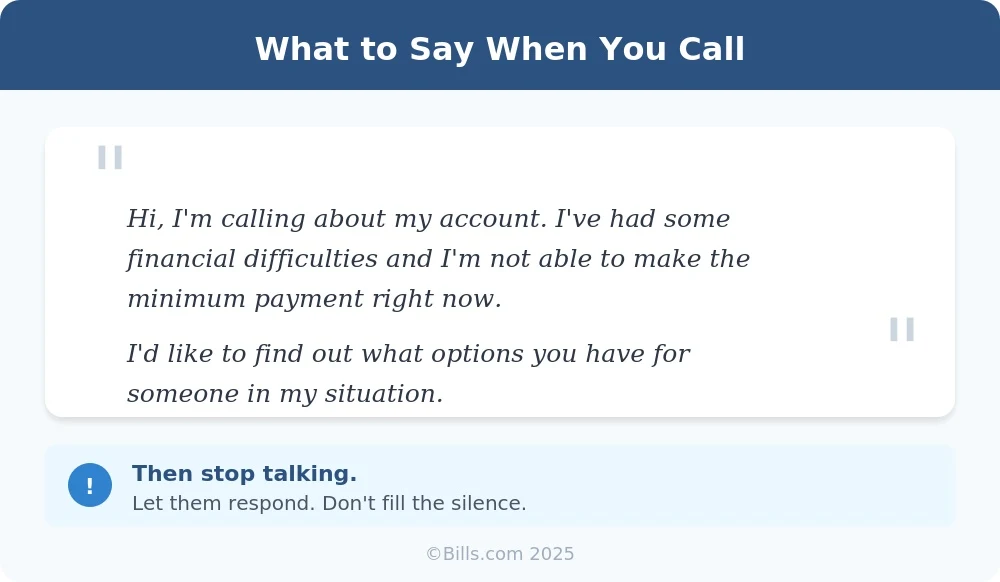
You don't need to wing it. Having a few sentences ready helps you sound calm and keeps the conversation on track. Something like:
"Hi, I'm calling about my account. I've had some financial difficulties and I'm not able to make the minimum payment right now. I'd like to find out what options you have for someone in my situation."
Then stop talking. Let them respond. This approach is polite, direct, and puts the ball in their court. You're not begging, you're not demanding—you're asking what's available.
Tip 4: Ask the right questions
Don't just accept the first thing they offer. Ask questions to understand what's actually on the table:
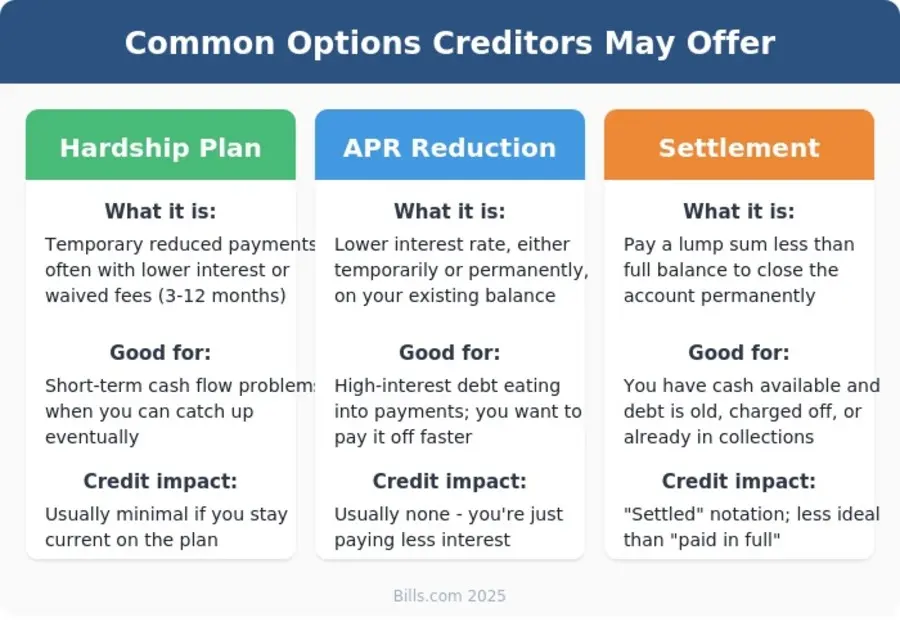
- "Do you have any hardship programs?"
- "Is there a way to lower my interest rate temporarily?"
- "Would you accept a lump-sum settlement for less than the balance?"
- "What happens if I can't make this payment?"
- "Can I speak with a supervisor or someone in your hardship department?"
The person who answers the phone may not have authority to offer much. Asking for a supervisor or hardship specialist sometimes opens up better options.
Tip 5: If you're dealing with a collector, slow everything down
Collection calls can feel urgent and high-pressure. That's intentional. Collectors are trained to create a sense of urgency because people make faster (and often worse) decisions under stress.
Your job is to slow things down. You're allowed to say:
- "I need to verify this debt before I discuss payment. Please send me written validation."
- "I'm not making any decisions today. I'll call you back after I've reviewed my options."
- "I need that offer in writing before I agree to anything."
You don't have to resolve anything on the first call. Taking time to think is not rude—it's smart. And those "today only" deadlines? They're often not real. The same offer is usually available if you call back tomorrow.
Tip 6: Timing matters more than people think
When you call can affect what you're offered. A few patterns people have noticed:
- End of the month: Some reps and collectors have quotas. They may be more flexible if they're trying to close deals.
- Earlier in the day: Reps are often fresher and less burned out. You might get a more patient conversation.
- After the account has aged: Older debts—especially ones that have been sold to collectors—often settle for less because the creditor has already written them off.
None of this is guaranteed, but it's worth keeping in mind.
Tip 7: Take notes like a pro
Every time you talk to a creditor or collector, write down:
- Date and time of the call
- Name of the person you spoke with (ask if they don't give it)
- What they offered or said
- Any reference or confirmation numbers
This protects you. If someone promises you something and it doesn't happen, your notes are evidence. If you call back and get a different answer, you can say, "On October 3rd, I spoke with Sarah, and she told me X." That level of detail changes the conversation.
Tip 8: If you're discussing settlement, know realistic ranges
Settlement means paying a lump sum that's less than the full balance to resolve the debt. Not every creditor will agree to this, but it's worth asking—especially if the debt is old or already in collections.
There's no official data on settlement percentages—just anecdotal reports from people who've been through it. Based on what people share in forums and with financial counselors, many unsecured debts settle somewhere between 30% and 60% of the balance. But outcomes vary widely depending on the creditor, how old the debt is, and your specific situation.
Start lower than your max. If you can afford $2,000, offer $1,500. They'll probably counter, and you'll have room to move up.

Tip 9: Always ask for everything in writing
This is the most important tip on the list. If someone offers you a payment plan, a settlement, a rate reduction, or anything else, do not pay until you have it in writing.
Verbal agreements mean nothing if the person you talked to quits, the account gets transferred, or someone just makes a mistake. Written confirmation is your proof.
Say: "Before I make any payment, I need this agreement sent to me in writing by email or mail. Once I receive and review it, I'll send payment."
It's not uncommon for a collector to agree to a settlement, promise to send written confirmation, and then nothing arrives. If you'd paid without documentation, you'd have no proof the account was supposed to be closed. Always wait for the paper trail.
Tip 10: If the offer is bad, call back later or escalate
Not every call will be productive. Sometimes you get a rep who's having a bad day, doesn't have authority to help, or just won't budge. That doesn't mean you're out of options.
- Call back another day. You might get someone different with more flexibility.
- Ask for a supervisor. Higher-level staff often have authority to approve things the first rep can't.
- Send a letter. Sometimes putting your offer in writing gets a different response than a phone call.
- Wait. If a debt ages, the creditor's calculus changes. What they won't accept today, they might accept in three months.
Persistence matters. Just because the first answer was no doesn't mean every answer will be.
When negotiation isn't enough
Sometimes, even with all the right preparation and tactics, you can't get to a payment or settlement you can afford. That's not a failure—it's information. It means you might need more structured help.
- A nonprofit credit counselor can help you evaluate whether a debt management plan (DMP) makes sense—if you can afford a fixed monthly payment.
- A debt settlement company may be able to negotiate on your behalf if you're behind on unsecured debts and can't manage the minimums.
- A bankruptcy attorney may give you a free consultation to see if Chapter 7 or Chapter 13 is appropriate for your situation.
There's no shame in needing professional help. These situations are complicated, and sometimes the math just doesn't work without outside intervention.
Quick comparison: Common options creditors may offer
Bills Action Plan
- Before you call, write down your hardship in one or two sentences, your account details, and your maximum payment.
- Call and use a simple opening: explain your situation briefly and ask what options are available.
- Ask about hardship programs, rate reductions, or settlement—and ask for a supervisor if the first rep can't help.
- Take notes on everything: date, time, name, what was offered.
- Get any agreement in writing before you pay. No documentation = no payment.
- If the first call doesn't work, try again later or escalate. Persistence pays.
- If you can't reach an affordable agreement, consider talking to a credit counselor, debt settlement company, or bankruptcy attorney.
Disclaimer: This article is for informational purposes only and is not legal or financial advice. Results vary based on individual circumstances, creditor policies, and other factors. Consider consulting with a licensed professional for advice specific to your situation.
Free up cash each month with Freedom Debt Relief

Ozzy S., Freedom client
“Right away, I had more money each month because of program costs so much less than what I was paying on my minimums.”
Actual client of Freedom Debt Relief. Client’s endorsement is a paid testimonial. Individual results are not typical and will vary.