

HELOC Rates Explained: How They Work and What Affects Yours




Bills Bottom Line
Published HELOC rates often reflect idealized borrower profiles—getting direct quotes from multiple lenders gives you a far more accurate picture of what’s available to you. Most HELOC rates are variable, calculated by adding a lender’s margin to the prime rate. Your credit score, equity, and other factors influence your quotes.
Table of Contents
If you’ve seen a HELOC rate and wondered if it’s the best you can do, you might be right. Lenders set their own terms, and the rate on one lender’s website isn’t the rate across the board.
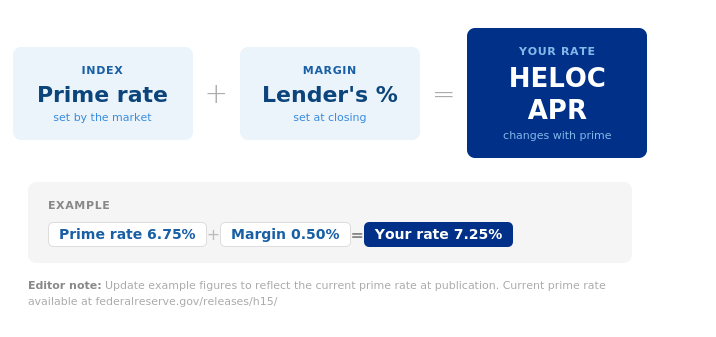
Every HELOC rate is built from two pieces. The first is the prime rate, a benchmark set by the market. A benchmark is a standard that others are compared to. The second piece is the lender’s margin, a percentage added on top of the benchmark. Two lenders working from the same prime rate can quote you very different numbers. Their margins differ, and your credit profile affects the margin you’re offered.
Understanding how that number is built, and what moves it, puts you in a better position to evaluate any offer you receive.
Current HELOC rates and how to read what you’re being offered
HELOC rates are tied to the prime rate, and most are variable. That means that as the prime rate changes, so does your HELOC rate. Lenders add their own margin on top of the prime rate. Because margins vary by lender and borrower profile, there’s no single published figure that reliably reflects what you’ll be offered. Your credit score, equity level, property type, and the size of the line all affect the number.
Current Prime Rate
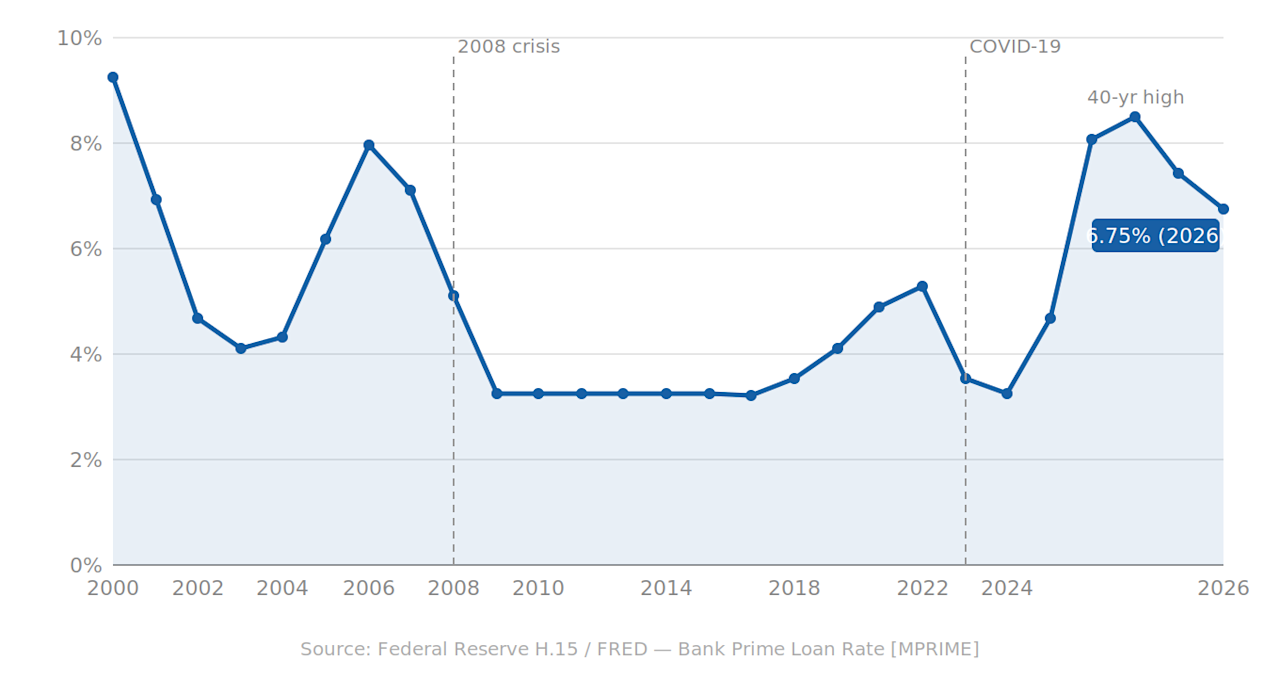
Rates range from under 6% for introductory offers to 12% or higher for borrowers with thinner credit profiles. The spread is wide enough that shopping around matters—a lot. All rates are subject to credit approval and change frequently. Contact lenders directly for current quotes.
What affects your HELOC rate
Some of what determines your rate is in your hands. Some isn’t. Knowing the difference helps you figure out where to focus.
What you control
Credit score. Minimum standards vary by lender, and the 680 range isn't an uncommon floor. The rate you’re offered for any given score also varies, which is why direct quotes beat published rate tables. Those tables often reflect idealized profiles that don’t match your situation.
Combined loan-to-value ratio (CLTV). To determine how much you can borrow, add your current mortgage balance to the HELOC amount you want, then divide by your home’s estimated value. For instance, if your home is worth $200k, you owe $100k and want to borrow $25k, you’ll divide $125k by $200k to get 62.5, or 62.5%. Many lenders prefer a CLTV of 80% or below; others are comfortable going higher for well-qualified borrowers. Higher CLTV often means a higher rate, however.
Debt-to-income ratio (DTI). To find your DTI, add up all of your minimum monthly debt payments along with your mortgage payment (including taxes, insurance, and HOA dues) and divide it by your gross (before tax) monthly income. Lenders commonly look for a DTI of no more than 43% to 50%. Credit unions often accept higher ratios than traditional banks. The government doesn’t set a maximum DTI for HELOCs; it’s lender-determined.
Property type and use. A primary residence generally gets a better rate than a second home or investment property, and single-family homes may get better offers than manufactured homes or condos. Larger credit lines can also carry higher rates, so it’s worth asking when you structure the request.
What you don’t control
The prime rate. It’s set by the market, based on the economy and moves with Federal Reserve decisions. You and your lender don’t set it.
Rate cap. Lenders are required to disclose the maximum rate your HELOC can reach. It’s in your loan agreement before you sign. That ceiling varies by lender and may also be subject to your state’s usury limits. No federal maximum exists. Some loan agreements also include a rate floor, the lowest your rate can go regardless of how far the prime rate falls. Check for both before signing.
How HELOC rates are calculated
Every lender in a rate comparison table starts from the same prime rate. The difference between offers is the margin.
Index rate plus lender margin equals your HELOC rate. The index is almost always the prime rate. The margin is set at closing and doesn’t change for the life of the loan. The prime rate does—and that’s what makes most HELOCs variable.
As an example: if the prime rate is 6.75% and a lender’s margin is 0.50%, your rate is 7.25%. The same lender offering a 1.25% margin to a borrower with a thinner credit profile would price that loan at 8.00%. Same prime rate, different margin.
Fixed-rate HELOCs do exist. Some lenders offer them from the start. Others let you lock individual draws at a fixed rate during the draw period. If rate predictability matters to you, ask specifically about fixed-rate options when you shop.
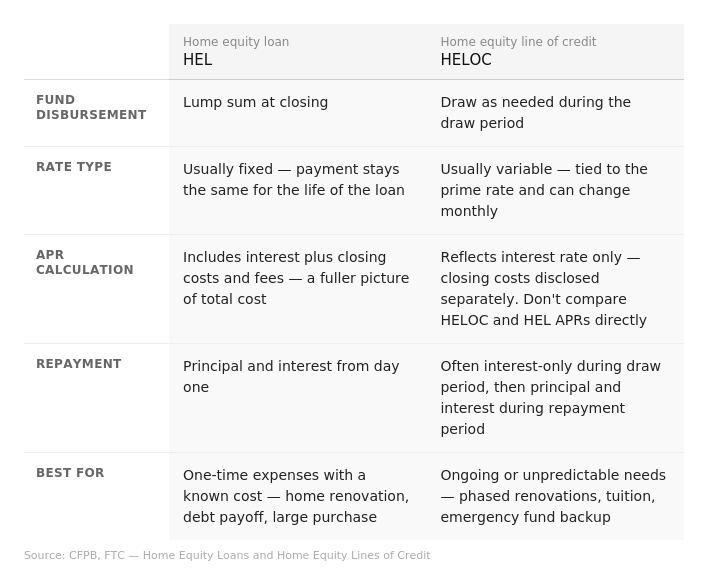
Worth knowing: a HELOC’s APR reflects only the interest rate. Closing costs are disclosed separately, unlike a home equity loan or mortgage. So comparing APRs across HELOCs is fair; comparing a HELOC APR to a home equity loan APR isn’t.
How your rate changes over time
The rate you start with isn’t the only thing that affects your payment. A HELOC moves through two distinct phases, and that shift can change your payment even when the rate stays the same.
During the draw period, commonly around 10 years, you borrow as needed. Most lenders allow interest-only payments during this phase. If your rate is variable, it moves with the prime rate when the Fed adjusts rates, which is how the loan was designed. Lenders aren’t required to send advance notice when the prime rate shifts.
When the draw period ends, you enter the repayment period, often 10 to 20 years. You can no longer draw funds, and payments now cover both principal and interest. Even if your rate stays flat, your HELOC payment tends to increase when the draw ends because you’re paying down the balance.
Here’s what that looks like: a $50,000 balance at 7.25% during the draw period costs about $302 a month in interest-only payments. The same balance at the same rate on a 20-year repayment schedule runs about $395 a month—roughly 30% more, with no rate change at all.
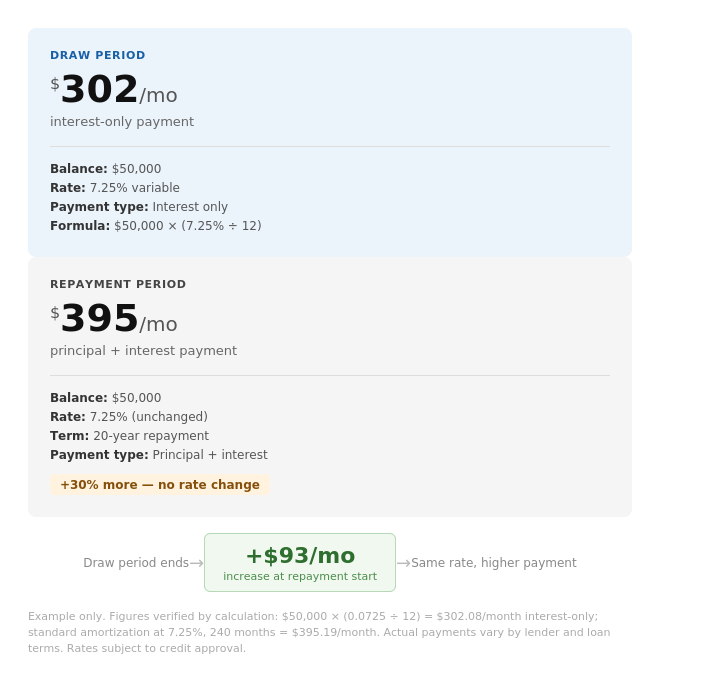
For rate shopping, that gap matters. A lower rate has more impact during repayment than during the draw. If you’re planning to carry a significant balance into the repayment period, weigh the rate heavily when you compare offers.
One more thing: your home is the collateral securing the line. If you fall behind or can’t repay, you could lose it. That’s worth keeping in mind before drawing against your equity.
How to get a lower HELOC rate
The rate you’re quoted first isn’t the only option. Here’s where the leverage is.
Shop more than one lender. Your current mortgage servicer isn’t automatically the most competitive. Get quotes from at least three lenders. The differences can be significant.
Check your credit before you apply. Errors can drag down your score and push your margin higher. Dispute anything that looks off, and give yourself time to see changes before submitting applications.
Know your CLTV before you shop. If you’re just above the 80% threshold, a smaller credit line request might move you into better pricing.
Ask about relationship pricing. Many lenders reduce the margin for existing checking account holders or borrowers who set up autopay.
Think about timing. HELOC rates follow the prime rate, which follows Fed decisions. If a rate cut looks likely soon, waiting could lower your starting point, but don’t hold out indefinitely for a cut that may not arrive on schedule.
Negotiate. Take the best competing quote to your preferred lender and ask them to match it. Lenders have flexibility, especially for strong borrowers.
Get everything in writing. HELOCs aren’t covered by the Loan Estimate requirement, so lenders aren’t required to use that form. Ask each lender for a written breakdown of rate, margin, fees, and caps before you commit.
If you plan to use the funds for home improvements, interest may be tax deductible. Interest on a HELOC used for other purposes generally isn’t deductible for tax years after 2017. Consult a tax advisor.
Bills Action Plan
- Pull your credit report and check your score. If there’s room to improve it, take time before applying. Even a modest gain could move you to a better margin tier.
- Calculate your CLTV: add your current mortgage balance to the amount you want to borrow, then divide by your home’s estimated value. A result at or below 80% may open up more competitive pricing at a wider range of lenders.
- Get written rate quotes from at least three lenders, including at least one that isn’t your current mortgage servicer. Compare the margin directly, not just the headline rate, and ask what the rate becomes after any introductory period ends.
Key Terms
Prime rate: The benchmark interest rate set by major U.S. banks in response to Federal Reserve decisions. Most HELOC rates are calculated as prime plus a lender’s margin.
Margin: The fixed percentage a lender adds to the prime rate to set your HELOC rate. Set at closing and doesn’t change. Varies by lender and borrower profile.
Index rate: The benchmark rate used to calculate your HELOC rate. For most HELOCs, the index is the prime rate.
CLTV (combined loan-to-value): All debt secured by your home divided by its estimated value. Lenders use CLTV, not just LTV, when evaluating a HELOC.
Draw period: The phase, commonly around 10 years, when you can borrow from your HELOC. Payments during this phase are often interest-only, though not always, and the rate is usually variable.
Repayment period: The phase, often 10 to 20 years, when you repay principal and interest. Some lenders allow you to lock a fixed rate during this phase.
Rate cap: The highest rate your HELOC can reach over its life. Set by the lender and disclosed in your loan agreement. No federal maximum exists.
Rate floor: The lowest rate your HELOC can reach, regardless of how far the prime rate falls.
This article is for general education. HELOC terms, rates, and eligibility vary by lender and borrower profile. Rates are subject to credit approval. Consult a financial advisor.
What is the average HELOC rate right now?

HELOC rates equal the prime rate plus a lender’s margin. Both vary too much for any survey figure to be reliable. You can check the current prime rate on the Federal Reserve H.15 release (federalreserve.gov/releases/h15/). Direct quotes from multiple lenders are the most accurate gauge of what’s available to you. All rates are subject to credit approval.
Are HELOC rates fixed or variable?
Most HELOCs carry a variable rate tied to the prime rate, so your rate rises or falls with it. Fixed-rate HELOCs do exist: some lenders offer them from the start, and others let you lock individual draws. If payment predictability matters, ask about fixed-rate options when you shop. Terms vary by lender.
What credit score do I need for the best HELOC rate?
Minimum credit standards vary by lender, and scores in the 680 range aren’t an uncommon floor. Rates vary by lender at every score tier, which is why direct quotes are more reliable than published tables. Lenders weigh CLTV and DTI too, not just your score.
Can I negotiate my HELOC rate?
The prime rate can’t be negotiated. But the margin, fees, and loan structure are worth comparing. With competing quotes in hand, asking your preferred lender to match the best margin is a reasonable move. A strong profile or existing relationship may also help.