

How long does it take to get a HELOC?




Bills Bottom Line
A HELOC typically takes two to six weeks from application to funding, with an industry average of about 39 days. After closing, federal law requires a three-business-day waiting period before your lender can release funds, no exceptions for primary residences.
Table of Contents
A HELOC isn't instant. There's a process that involves an appraisal, underwriting, and closing, and then a mandatory waiting period before you can touch the money. The good news: once you know what drives the clock, you can plan around it.
Most HELOCs take two to six weeks, but where you land in that range depends mostly on two things: how your lender assesses your home's value and how fast you get them what they need.
Here's what the timeline actually looks like and what you can do to move it faster.
Most HELOCs take 2-6 weeks
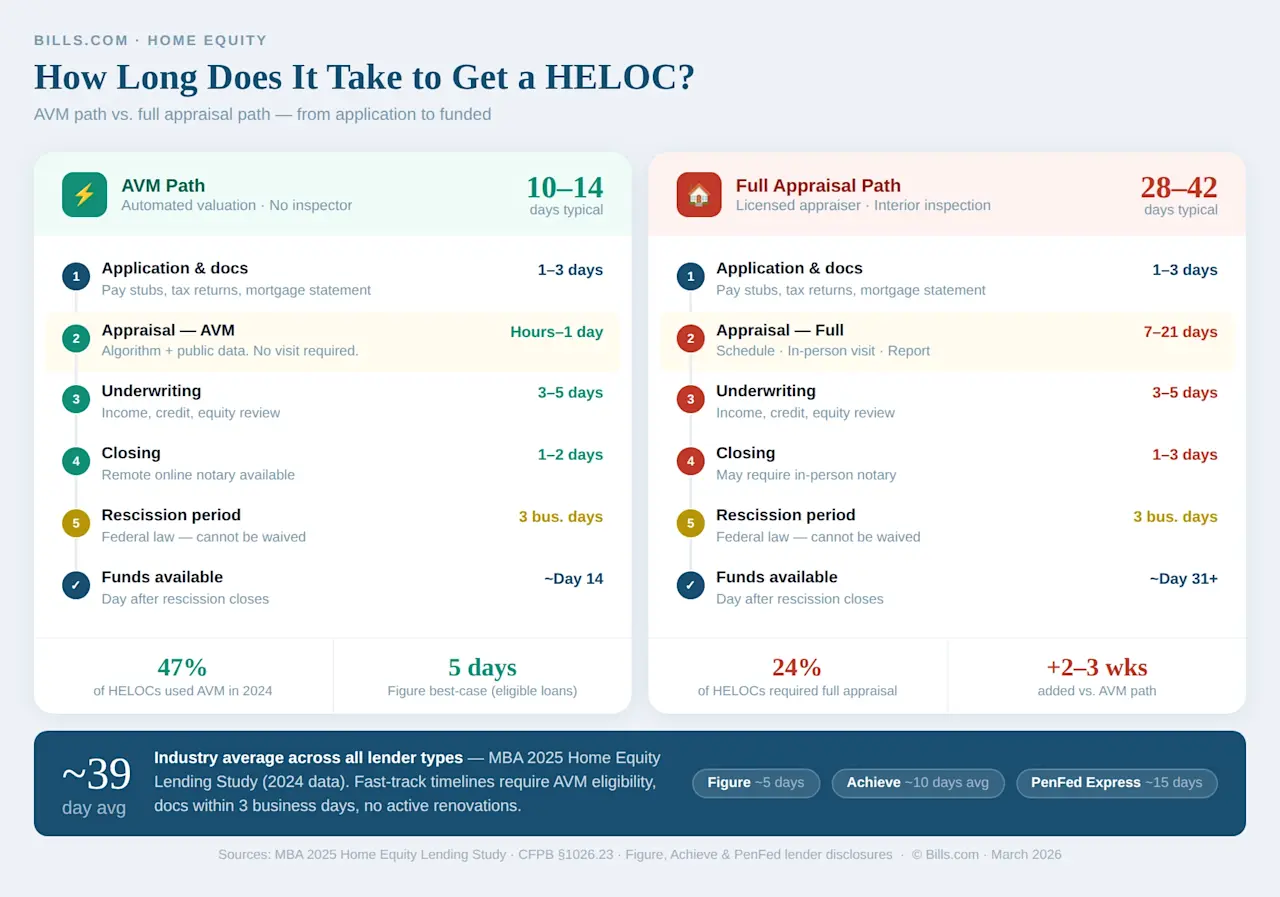
Most HELOCs take two to six weeks from application to funding, with an industry average of about 39 days. The biggest factor is your appraisal type: automated valuations take minutes, while a full in-person appraisal could add a few weeks. After closing, there's a mandatory three-business-day waiting period before funds are released.
Two variables are mostly in your hands: the documents you provide and how fast you respond to lender requests. Two others aren't: your lender's current workload and whether your county allows electronic signatures at closing.
If you haven't started yet, see how to get a HELOC for the full step-by-step process.
HELOC timeline by stage
From the day you submit your application, here's what the clock looks like.
| Stage | Typical Duration | Key Variable | What You Control |
|---|---|---|---|
| Application & document review | 2-5 business days | How fast you submit docs | High—have docs ready in advance |
| Appraisal | Minutes (AVM) to weeks (full appraisal) | Appraisal type—lender decides | Low—but ask about AVM eligibility upfront |
| Underwriting | 1-2 weeks | Lender workload, credit complexity | Medium—respond to requests fast |
| Closing | 1–3 days to schedule | Notary availability, county rules | Medium—ask about remote online notary |
| Rescission period | 3 business days (mandatory) | Federal law—cannot be waived except in emergencies | None |
| Funds available | Day after rescission ends | No variable—clock is fixed once rescission starts | None |
To see what that spread looks like in practice, three lenders publish specific timeline disclosures:
- Figure advertises funding in as few as five business days for qualifying borrowers—those with an AVM-eligible property, a loan under $400,000, all documents submitted within three business days, no active renovations, and a county that permits e-signatures at closing.
- Achieve reported a 2025 average of 10 business days from application to funding, including the rescission period.
- PenFed's HELOC Express program advertises closing in as little as 15 days—with the same conditions: AVM appraisal, eligible income type, docs within three business days, no active renovations.
Industry-wide, the MBA puts the typical turn time at about 39 days. The spread reflects how much lender type, appraisal path, and document speed vary in practice.
The rescission period: why your funds aren't available right after closing
You've signed everything. The closing is done. And yet your lender still can't give you the money.
Federal law gives you the right to cancel a HELOC on your primary residence within three business days of closing, no questions asked. Until that window closes, your lender is legally prohibited from releasing funds.
The day count matters. Saturdays count as business days for rescission purposes. Sundays and federal holidays do not.
If you close on a Friday, your rescission clock starts Saturday. With no federal holidays in the window, Monday is day two and Tuesday is day three—meaning your lender can release funds on Wednesday.
The rescission period can be waived, but only in a documented, bona fide personal financial emergency, and the waiver must be in writing before closing. It's a narrow exception, not a routine option. The right of rescission applies only to primary residences. If the HELOC is on an investment property or second home, there's no waiting period.
What slows a HELOC down—and what doesn't
Some delays are yours to prevent. Others aren't.
In your control:
- Missing or incomplete documents like pay stubs, tax returns, mortgage statements, or homeowners insurance declarations page. Get these together before you apply, not after.
- Slow responses to underwriter requests. When a lender asks a follow-up question, the clock stops until you answer.
- Not asking about the closing type. If you wait until after approval to learn your county requires in-person notarization, you've added days you didn't need to add.
Not in your control:
- Lender workload. Some lenders are running at capacity; others aren't.
- Whether your county permits e-signatures at closing. County-level restrictions on electronic notarization vary and can force an in-person appointment.
- Full appraisal requirement. The lender decides whether to use an automated valuation or require an in-person inspection, not you. But you can ask upfront.
One nuance worth knowing: automated valuations rely on public records. If you've made significant interior improvements—a renovated kitchen, a finished basement—the AVM may not capture them. In that case, a full appraisal could result in a higher home value and a larger credit line. It's worth asking your lender about before assuming faster is always better.
Three questions to ask your lender before you apply
Most people wait until they're deep in the process to ask these questions. Asking them before you submit a single document could save you weeks.
- "Will you use an AVM or do you require a full appraisal?" This is the single biggest swing in your timeline.. If a full appraisal is required, ask how quickly they can schedule it and whether you can help accelerate the process.
- "Is a remote online notary available in my county?" County-level e-signature restrictions can force an in-person closing and add scheduling time you hadn't budgeted. If your county doesn't permit it, adjust your timeline now rather than after approval.
- "What's your current average time from application to closing?" A lender quoting a 39-day average is telling you something different from one advertising “as fast as five days.” Both can be true for different borrowers, different properties, or different conditions. Know which category you're likely in before you pick a lender.
For a full walkthrough of what to expect at each step, see how to get a HELOC.
Bills Action Plan
- Call or chat with your lender today and ask whether your property is AVM-eligible. This single question could tell you whether you're looking at a longer or shorter timeline before you've filled out a single form.
- Gather your documents now: last two pay stubs, last two years of tax returns, recent mortgage statement, homeowners insurance declarations page. Document delays are the most common cause of HELOC slowdowns, and the most avoidable.
- Ask about closing options before you apply. If a remote online notary is available in your county, you could close from home. If it isn't, factor the scheduling time into your timeline now.
Key Terms
| Term | Definition |
|---|---|
| AVM (Automated Valuation Model) | A digital property valuation using public data and algorithms—no inspector, no visit. Takes minutes. Used for 47% of HELOCs in 2024. |
| Desktop Valuation (DV) | A hybrid appraisal using data plus an exterior or drive-by inspection. Faster than a full appraisal, but not instant. |
| Full Appraisal | A licensed appraiser visits the property, inspects interior and exterior, and produces a formal value report. Can take several weeks. |
| Underwriting | The lender's review of your income, credit, equity, and debt to decide whether to approve your HELOC and for how much. |
| Right of Rescission | A federal right under CFPB §1026.23 that gives you three business days after closing to cancel. Your lender cannot release funds during this window. |
| CLTV (Combined Loan-to-Value) | Your total mortgage debt divided by your home's value. Most lenders cap HELOC borrowing at 80–85% CLTV. |
| Draw Period | The phase—typically five to 10 years—when you can borrow from your HELOC. Begins after the rescission window closes. |
Can you get a HELOC in less than 2 weeks?

Yes—under specific conditions. Figure advertises funding in as few as five business days but requires AVM eligibility, no active renovations, and all documents within three business days. Achieve reported a 2025 average of 10 business days including rescission. Industry-wide, the MBA puts the average at about 39 days, so fast-track timelines represent best-case scenarios, not typical ones. Ask your lender what their current average is before planning around their fastest number.
How long does HELOC underwriting take?
Underwriting typically takes one to two weeks once your lender has a complete file—meaning all documents received and appraisal completed. Delays happen when information is missing or when the underwriter has follow-up questions, called conditions. Responding to any conditions within 24 hours is the most effective way to keep underwriting on track. Many slowdowns at this stage are borrower-side, not lender-side.
Can I use my HELOC funds right after closing?
No. Federal law (CFPB §1026.23) gives you a three-business-day right of rescission after closing on a HELOC secured by your primary residence. Your lender cannot release funds until that window closes. Saturdays count as business days, but Sundays and federal holidays do not. If you close on a Friday with no holidays, the earliest your funds are available is Wednesday.
Does a HELOC require an appraisal?
Usually, but typically not a full one. In 2024, only 24% of HELOCs required a full in-person appraisal,while 47% used an automated valuation model (AVM), which takes minutes and requires no inspector visit. Whether your property qualifies for an AVM is the lender's call, but you can ask. If you've made significant interior improvements, a full appraisal could produce a higher value and a larger credit line.