

Personal Loan Companies: Types, How They Work, and How to Choose One




Bills Bottom Line
Personal loan companies aren't all the same. Banks, credit unions, online lenders, and marketplaces each work differently, with their own rates, fees, and requirements. Most check your credit and income before approving you, and rates vary by lender. Comparing a few before you apply could help you find better terms.
Table of Contents
You searched "personal loan companies," and every result looks the same. A bank pitching its own personal loans. Or a "best of" list with five near-identical logos. Or a marketplace asking for your information before it tells you anything useful.
Here's what none of those sites mention: "personal loan company" isn't one thing. Banks, credit unions, online lenders, and marketplaces lend money the same basic way, but their processes vary.
Comparing lenders is easier once you know how they work. Let's start there.
What is a personal loan company?
A personal loan company lends you a lump sum of money that you repay in fixed installments over a set term. You might use it for a big purchase, an unexpected expense, or to roll several debts into one with better terms.
Not every company works the same way. Four types show up most often:
- 🏦 Banks. Typically offer in-person service, and approval can be faster if you're already a customer.
- 🤝 Credit unions. These member-owned lenders require you to join before you can borrow.
- 💻 Online lenders. Fully digital, they’re often the fastest to fund.
- 🌐 Marketplaces. You submit one application and multiple lenders compete for your business.
| Type | Funding speed | Membership needed | Rate note | Best for |
|---|---|---|---|---|
| 🏦 Bank | A few days to a week | No, but current customers may get a discount | Rates vary; an existing relationship can help | In-person service from a bank you already use |
| 🤝 Credit union | A few days | Yes | Rates vary; often competitive for members | Borrowers eligible to join who want member pricing |
| 💻 Online lender | Same day to a few days | No | Rates vary widely by credit profile | Speed and a fully digital process |
| 🌐 Marketplace | A few days | No | Rates vary; several lenders bid on your loan | Comparing multiple offers at once |
Personal loans are sometimes called signature loans because the lender takes your signature as a promise to repay. Most personal loans don’t require collateral. Adding collateral—for example, borrowing against your savings—may get you better terms or more flexible underwriting.
See our full breakdown of types of personal loans and signature loans if you want more detail on either. Once you've sorted companies by type, you can see ranked picks of the best personal loan companies within whichever type fits you.
How personal loan companies decide whether to approve you
Personal loan companies look at the same handful of factors before they approve you:
- Credit score
- Credit history
- Income
- Employment
- Debt-to-income ratio (DTI)
DTI is all your monthly debt payments (including your rent or mortgage) divided by your gross monthly income. Some online lenders also weigh education and employment history, especially if your credit file is thin.
A soft inquiry doesn't affect your credit score. A hard inquiry, made when you formally apply for credit, can lower your score by a few points for a while.
Prequalifying with a lender generates a soft inquiry, so it's a low-risk way to see what terms you might get. Not every lender's prequalification works this way, though. Confirm it's a soft check before you submit anything.
Your credit score sorts you into a tier:
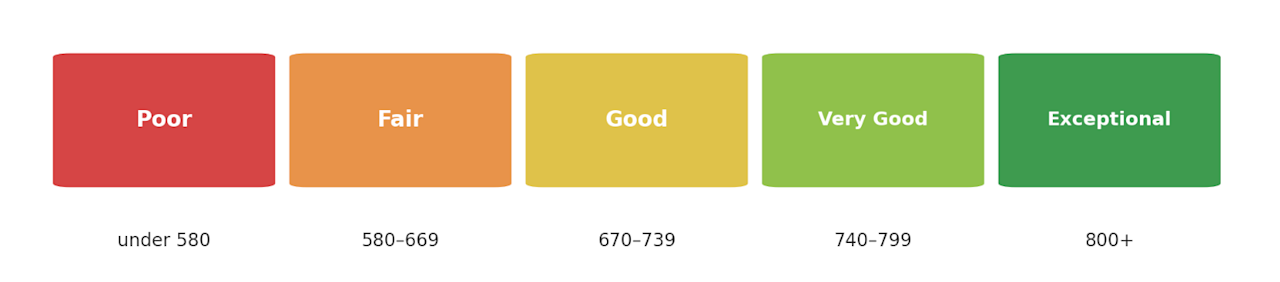
These are general guidelines. Lenders create their own tiers that roughly match these, but each sets its own standards for what credit score you need for a personal loan and how to get approved.
Many lenders also ask to see recent bank statements, or ask you to link an account, to confirm the income you reported.
What personal loan companies charge
An interest rate is what you pay to borrow money, and it's the number used to calculate your monthly payment. APR is different: it's a calculation based on your interest rate and includes most loan fees. You use APR to compare loans with different rates and costs. The loan with the lower APR is cheaper over its lifetime.
Origination fees vary by lender. Some charge none; others charge up to roughly 12% of the loan amount, deducted from what you receive.
Most personal loans carry a fixed rate, though some lenders offer variable-rate options. Rates vary widely by lender, your credit, and your term. This figure changes often, so don’t rely on advertised numbers. Check current personal loan rates for an up-to-date picture.
The National Consumer Law Center sets a 36% APR cap as its benchmark for affordable lending.The Military Lending Act applies that same cap to active-duty servicemembers. Loans above 36% APR are widely considered predatory by consumer-protection groups.
How to compare personal loan companies before you apply
Before you apply anywhere, prequalify with two or three companies. Then compare the interest rate, fees, and total repayment cost side by side. Before you sign anything, check the fine print on prepayment penalties and late fees.
Personal loan companies vs. other ways to borrow
A personal loan isn't your only path. Here's how a few alternatives stack up.
Home equity loan or HELOC
Your home secures the debt, so default risks foreclosure. An unsecured personal loan carries no such risk. A personal loan can be funded within days; a home equity loan or HELOC commonly takes two to six weeks.

Personal loan rates aren't always higher than home equity rates. Don't assume one beats the other without checking current numbers for a valid home equity loan vs. personal loan comparison.
Family or private loans
These can carry any terms the two of you agree to, for better or worse. Put the agreement in writing.
Debt management plan
A debt management plan (DMP) consolidation isn’t a loan. A DMP is a full repayment plan under the guidance of a professional credit counselor. You shut down your cards, and the creditors usually agree to lower your interest rates. It’s a route worth a look if juggling several debts is the real problem.
Bills Action Plan
1. Match your lender type. Want speed and don't need a branch? Look at online lenders. Want in-person support and possibly better terms? Check credit unions you're eligible to join.
2. Prequalify first. Get soft-check offers from two or three companies. Confirm each one uses a soft pull before you submit anything.
3. Compare before you sign. Line up the interest rate, fees, and total repayment cost side by side.
Run your numbers through a personal loan calculator before you commit.
Key Terms
Personal loan: A lump sum you borrow from a company and pay back in fixed monthly amounts over a set period.
Signature loan: Another name for an unsecured personal loan. Your signature is your promise to repay, not collateral.
Origination fee: A fee some lenders take out of your loan before you get the money. Not every lender charges one.
Debt-to-income ratio (DTI): All your monthly debt payments added up, divided by your gross monthly income. Lenders use it to gauge how much more you can handle.
Soft inquiry / hard inquiry: Prequalifying generates a soft inquiry, which doesn't affect your credit score. Formally applying generates a hard inquiry, which can lower your score a few points for a while.
This is general information. It isn't personal financial or legal advice. Your situation may call for guidance from a licensed financial advisor or attorney.
What credit score do I need for a personal loan company to approve me?

There's no single number every company uses. Many work with fair credit, in the 580 to 669 range, though your rate and terms improve the higher you go. Some online lenders also weigh education and employment history, not just your score.
Can I get a personal loan with no credit history?
It's harder, but not impossible. You may be able to add a co-signer or co-borrower to improve your chances. Some online lenders look at factors beyond your credit file, like employment or education. Expect a smaller loan amount or a higher rate until you build a track record.
Is prequalifying with a few companies bad for my credit?
No, as long as the lender's prequalification generates a soft inquiry instead of a hard one. That's standard practice at most companies. A soft inquiry doesn't affect your score. Only a formal application, which triggers a hard inquiry, can cause a small, temporary dip.
What happens if a personal loan company denies my application?
You can ask why. Lenders generally have to tell you the main reasons. From there, you can address the issue, apply with a different type of company, or ask about a secured option instead.