

He's Current on His Cards. He's Thinking About Stopping


Bills Bottom Line
Staying current on minimum payments is not the same as paying down debt. On maxed cards with high interest rates, most of what you pay each month goes to interest. Balances barely move, and credit scores stay stubbornly low even without a single missed payment, simply because utilization stays high. Debt settlement works differently. You stop making payments, save toward a negotiated lump sum, and hope creditors accept less than the full balance — but the credit damage starts before any deal is reached. A consolidation loan offers a single structured payment, but it requires qualifying, and a fair credit score puts that approval in doubt. Neither path is clean. That’s what makes this decision hard.
Marcus paid the April minimums on a Tuesday morning, same as every month. He opened the app, entered the amounts across Chase, Capital One, Citi, and Discover — $710 total — and closed it before the balances finished loading. He’d learned to do it that way.
He and Dana had a shared calendar. He had a car fund. He paid bills the day they arrived. The credit card balances were the one thing in his life he hadn’t been able to organize his way out of.
When the April statements came, he let them sit in his inbox for two days before opening them.
| Creditor | Balance |
|---|---|
| Chase Sapphire | $9,200 |
| Capital One | $7,800 |
| Citi Double Cash | $6,900 |
| Discover | $4,500 |
| Total | $28,400 |
| Monthly minimums | $710 |
He’d been making these payments for eighteen months. He ran the numbers the way he always did, carefully. At this pace, he’d still owe approximately $26,000 in three years.
Marcus ran the numbers
At $710/month in minimums, he’d still owe approximately $26,000 in three years.
Something shifted when he saw it written out like that. Not panic exactly. More like something he’d been holding carefully for a long time finally put itself down.
He started reading after Dana went to sleep. Debt settlement, debt management plans, consolidation loans. He read slowly, going back to sections he didn’t understand, following links until the browser tabs multiplied. A calendar notification appeared at one point. Dana had added dentist, Thursday 10am. He closed it and kept reading.
The part that stopped him was the settlement requirement: creditors don’t negotiate when they think you can pay. For most programs, the process only starts once payments stop, which means the credit damage starts before any offer is made, before any deal is reached, before there’s any guarantee a creditor will settle at all.
He thought about the balance transfer he’d done six months ago. $6,000 moved to a 0% card to get ahead of things. The card was maxed now, groceries, a car repair, the slow accumulation of a month where more went out than came in. He’d done the responsible thing and watched it make the situation worse.
The balance transfer looked attractive at the time
He did a balance transfer and it only made things worse'
Settlement looked like this: stop paying, absorb the calls and the credit damage, save money toward offers, keep at it for wait three to four years. Fees up to 25% of enrolled debt. No guarantee the creditors on the other end would agree to anything. His score, already at 661, would keep falling.
The consolidation loan was the cleaner option on paper, one payment to one lender at a lower rate. But his credit score was already down from 718 eighteen months ago, and at 661 the approval wasn’t certain. If he applied and got declined, he’d have used an inquiry and solved nothing. And the rates for someone at his score likely ran 15 to 22% APR, meaning the monthly payment relief might be smaller than it looked.
He could protect his credit score. Or he could stop digging. He couldn’t see a way to do both.
Both paths required the same thing, he realized. Whichever path he chose, he’d have to sit down with Dana and show her the full number. Not the situation — the number. $28,400. The spreadsheet, the monthly payments going nowhere, the three-year projection. He hadn’t done that yet.
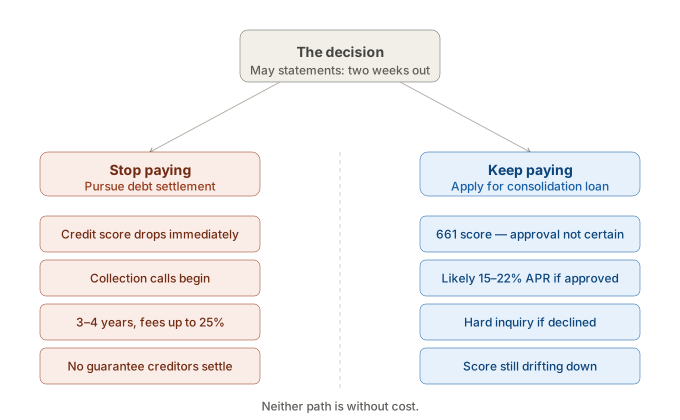
The May statements were two weeks out. On his laptop, two tabs sat open: the debt settlement intake form on one side, the consolidation loan eligibility checker on the other. Neither was filled in. In the other room, Dana was watching something — he could hear the low sound of it through the wall.
The cursor blinked on the first field of the settlement form. On the other tab, a prompt asked for his credit score.
Bills Bottom Line
Marcus’s situation puts a spotlight on something that’s easy to miss when you’re making every payment on time.
Being current doesn’t mean making progress. Minimum payments on maxed cards are mostly covering interest. Without reducing the principal or the utilization rate, balances stay high and credit scores can stay lowkeep drifting down, even with a perfect payment history.
Stopping payments is a deliberate strategic choice, not a failure. Most settlement programs require demonstrating genuine financial hardship. Stopping payments is generally a prerequisite before creditors will consider negotiating, which starts the clock on credit damage and collection activity before any settlement offer is made or accepted.
A consolidation loan requires qualifying. A 661 credit score sits in the “fair” range. Some lenders approve it, others don’t, and the rates for scores in that range may be high enough to limit the financial benefit. An application that’s declined solves nothing and uses a hard inquiry.
Other options exist between these two paths. Debt management plans and creditor hardship programs offer structured relief without requiring missed payments, worth understanding before committing to settlement or a consolidation loan.
Real Talk Disclaimer
The rates, terms, and financial details in this story are illustrative examples. Actual rates and qualification requirements vary by lender, market conditions, and individual circumstances.
Key terms
Minimum payment — The smallest amount a lender requires each month. On maxed credit cards, most of this covers interest, not principal. Balances barely move even when payments are made consistently.
Debt settlement — Negotiating with creditors to pay less than the full amount owed. Requires clear financial hardship. Results vary — some creditors settle, others pursue collections or legal action.
Debt consolidation loan — A new loan used to pay off multiple debts, ideally at a lower interest rate, resulting in one monthly payment. Approval depends on credit score and income. Not guaranteed.
Credit utilization — The percentage of available credit currently in use. High utilization — even with on-time payments — signals financial stress to lenders and can pull down a credit score.